Design an end-to-end learning model for self-driving, where a single neural network (or a tightly coupled stack) maps raw sensor inputs directly to driving actions (steering, acceleration, braking), as pursued by Tesla’s FSD v12+, Wayve’s LINGO, and research systems like UniAD and VAD. Unlike the traditional modular pipeline of separate perception, prediction, planning, and control modules, an end-to-end model learns the full policy from data and can in principle optimize the driving objective globally.
The catch is that this policy is a black box. It is hard to interpret, hard to verify for safety, hungry for data and compute, and it only ever sees the long tail of rare driving situations a handful of times.
How would you design this model? Cover the candidate architecture approaches (pure end-to-end policy network vs loosely coupled perception-prediction-planning with learned interfaces vs hybrid with a differentiable cost head), the training data and objective (imitation learning vs reinforcement learning vs inverse RL), how you handle the long tail of rare safety-critical events when learning from data, and how you verify and debug a black-box policy before deployment.

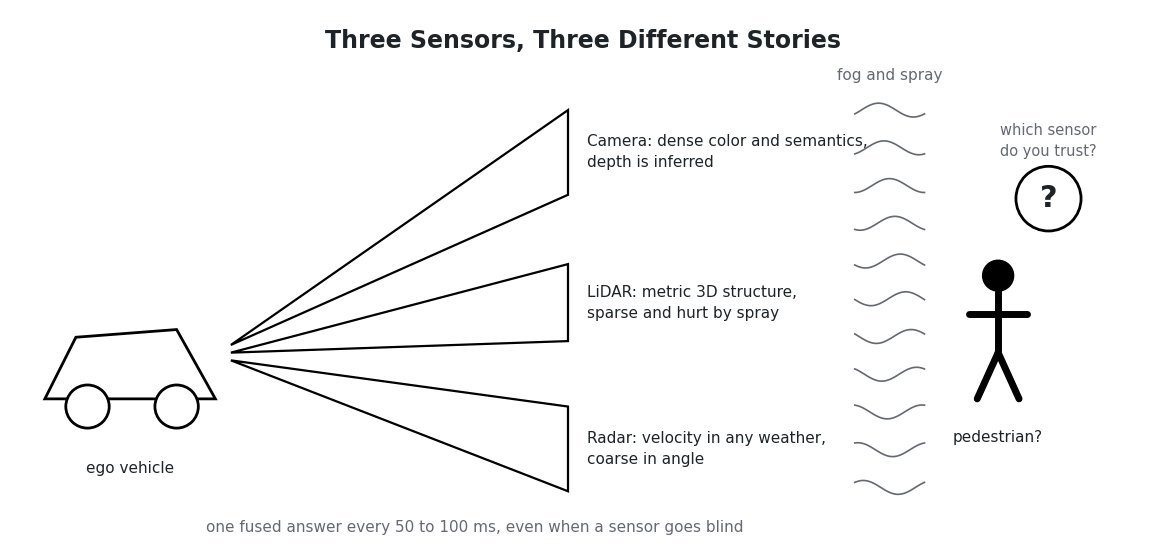
The Problem: one learned function must turn photons into pedal and steering commands, and the events that decide whether it is safe appear once every hundred thousand miles.
Answer
I would build a query-based end-to-end network with a differentiable cost head, not a raw pixels-to-pedal regressor. Multi-camera features are lifted into a BEV representation, a set of scene queries carries agents, map, and occupancy, and an ego query cross-attends to those queries to produce a short-horizon trajectory that a learned cost head scores together with a few hand-authored terms. Everything is trained jointly with one driving loss, so gradients still reach the encoder, but every intermediate is supervised and therefore inspectable. The two pivotal decisions are to keep auxiliary supervision on the intermediate queries (this is what buys sample efficiency and debuggability without cutting the gradient path) and to keep hard safety constraints outside the learned cost, in an independent rule-based guardian that the network cannot argue with.
(1) Pure End-to-End Policy: one network maps sensor history directly to control, trained by behavior cloning on fleet data with no intermediate supervision.
(2) Loosely Coupled Modules with Learned Interfaces: perception → prediction → planning stays as stages, but the interfaces are differentiable query tokens rather than hand-defined object lists, as in UniAD and VAD.
(3) Hybrid with a Differentiable Cost Head: the network emits a learned cost over candidate ego trajectories, combined with explicit collision, comfort, and rule terms, and an optimizer or sampler picks the executed trajectory.
(4) Chosen Combination: approach 2 for the representation plus approach 3 for the output, imitation pretraining followed by closed-loop fine-tuning in simulation.

Figure 1: The chosen architecture. One driving loss backpropagates all the way to the encoder, while auxiliary heads keep the intermediate scene representation readable and the cost head keeps the final decision expressible in physical terms.
Clarify Before Designing:
(1) Sensor Suite And Output Interface: camera-only or camera plus lidar and radar, and does the model emit a 3 second trajectory for a downstream controller or raw actuator commands?
(2) Compute And Latency Budget: how many TOPS on-vehicle and what reaction budget, since that caps token count, temporal context, and model size?
(3) Data Access: fleet miles per day, whether human control signals are time-aligned with sensors, and whether a closed-loop simulator with reactive agents exists.
(4) Operational Design Domain: highway lane keeping, dense urban, or both, and in which geographies and weather, because the ODD size sets the length of the tail.
(5) Safety Architecture: is an independent rule-based guardian or a safety driver allowed downstream, or must the network’s output be the last word before the actuators?


 at roughly 30 hashes per second, and video frame descriptors sampled at 2 to 4 fps after letterbox and border normalization.
 ; adjacent winning chunks are stitched into segments with a minimum matched duration.