
How would you detect data drift in a deployed machine learning model?
Answer
You monitor in layers, because no single statistic sees everything. Layer one watches the inputs: per-feature distribution statistics (PSI, KS distance) of live traffic against the training baseline. Layer two watches the outputs: the prediction distribution and confidence profile, which catch label shift and model-side anomalies. Layer three estimates or measures performance: delayed ground truth when it arrives, and label-free estimators like NannyML’s CBPE in the gap. Each layer has thresholds with alerting, and alerts route to a decision: investigate the pipeline, retrain, or roll back. The whole pattern is standardized in AWS SageMaker Model Monitor: a baseline job computes statistics and constraints from training data, scheduled jobs compare live captures, and violations fire CloudWatch alarms.
(1) Baseline vs Window: freeze reference statistics from the training distribution, then compute drift metrics over sliding or scheduled production windows; the metric is a distance between two empirical distributions, not a model property.
(2) What Each Layer Sees: input stats see covariate shift, output stats see label shift and confidence collapse, and only ground truth (or calibrated estimation) sees concept drift; NannyML’s CBPE handles covariate shift but explicitly not concept drift.
(3) Production Pattern (AWS): Model Monitor’s built-in container (Deequ on Spark) emits statistics.json and constraints.json from a baseline, then scheduled monitoring jobs check distribution distance (linf_simple / two-sample KS via linf_robust, LInfinity or ChiSquared for categoricals) and write violation reports that drive alarms. AWS has announced that Model Monitor closes to new customers on 30 July 2026, with existing customers unaffected, but this baseline/constraints/violations design remains the reference pattern.
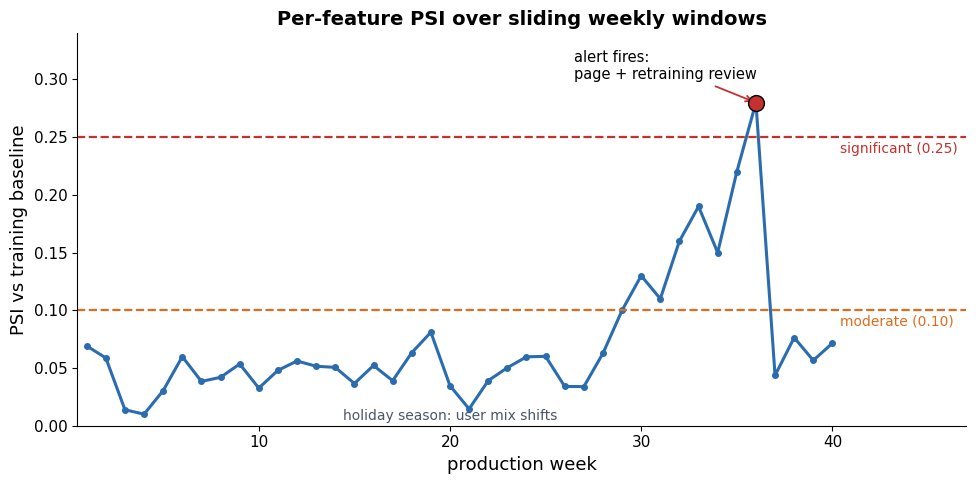
Figure 1: A drift monitor in action: per-window PSI against the training baseline crosses the moderate band (0.1) and then the significant band (0.25), which is where alerting and retraining triggers fire.
Design details separate a working monitor from alert fatigue. Thresholds must account for sample size (small windows inflate every distance metric), per-feature tests need multiplicity control or aggregation, and the window length trades detection latency against statistical power. When labels are delayed, record them when they land and backfill realized metrics so you can audit how well the label-free estimators tracked reality. Finally, every alert needs a playbook: distinguish a broken upstream pipeline (schema violations, sudden null spikes) from genuine distribution drift, because the fix for the former is a data engineer, not a retraining job.

Figure 2: The layered monitoring stack: input-distribution checks, output/confidence checks, and delayed-label evaluation feed one decision layer that separates pipeline breakage from genuine drift and triggers the right response.
Mathematical Formulation:


Where:
 and are the fractions of the current (actual) and reference (expected) samples in bin ; rules of thumb: PSI above 0.1 indicates moderate drift, above 0.25 significant drift.
- are the empirical CDFs of the baseline and current window; is their maximum vertical gap (the statistic behind SageMaker’s linf distance checks).
- Both are computed per feature per window and compared against thresholds tuned for window size and alert budget.
 and
and  are the fractions of the current (actual) and reference (expected) samples in bin
  ; rules of thumb: PSI above 0.1 indicates moderate drift, above 0.25 significant drift.
 are the empirical CDFs of the baseline and current window;
  is their maximum vertical gap (the statistic behind SageMaker’s linf distance checks).
| Layer | Signal | Catches | Blind To |
|---|---|---|---|
| Input Stats | PSI / KS per feature vs baseline | Covariate shift, schema breakage | Concept drift |
| Output Stats | Prediction mix, confidence histogram | Label shift, confidence collapse | Silent concept drift |
| Estimated Performance | CBPE from calibrated probabilities | Accuracy loss under covariate shift | Concept drift (by assumption) |
| Delayed Ground Truth | Realized metrics when labels land | Everything, eventually | Nothing, but late |


 collects all parameters at step
  ,
,  is the learning rate, and
  is the per-step decay rate.
 is the minibatch loss; the
  factor is the multiplicative shrink applied every step.
 is the L2 coefficient that makes the two formulations equivalent for SGD, exposing the coupling: change the learning rate and the effective regularization changes too (this equivalence fails for adaptive optimizers, hence AdamW).


![r_{i,m} = -\left[\frac{\partial\, \ell(y_i, F(x_i))}{\partial\, F(x_i)}\right]_{F = F_{m-1}}](https://s0.wp.com/latex.php?latex=r_%7Bi%2Cm%7D+%3D+-%5Cleft%5B%5Cfrac%7B%5Cpartial%5C%2C+%5Cell%28y_i%2C+F%28x_i%29%29%7D%7B%5Cpartial%5C%2C+F%28x_i%29%7D%5Cright%5D_%7BF+%3D+F_%7Bm-1%7D%7D&bg=ffffff&fg=000&s=3&c=20201002)
 is the ensemble after stage
  ,
,  the tree added at that stage, and
  the learning rate (shrinkage, typically 0.01-0.1).
 is the pseudo-residual for example
  : the negative gradient of the loss
  with respect to the current prediction, i.e. the direction that most reduces the loss.
 , the ordinary residual; other losses (logistic, absolute) change what the trees are fit to.


 is the set of masked positions,
  the hidden token, and
  the visible context (masked language modeling).
 are embeddings of two augmented views of the same input,
  covers all candidate views,
  is a similarity such as cosine, and
  is a temperature (contrastive InfoNCE).


![\mathcal{L}_{unsup} = \frac{1}{M}\sum_{j=1}^{M} \mathbf{1}\left[\max_c p_j(c) > \tau\right]\, \ell(f(x_j), \hat{y}_j)](https://s0.wp.com/latex.php?latex=%5Cmathcal%7BL%7D_%7Bunsup%7D+%3D+%5Cfrac%7B1%7D%7BM%7D%5Csum_%7Bj%3D1%7D%5E%7BM%7D+%5Cmathbf%7B1%7D%5Cleft%5B%5Cmax_c+p_j%28c%29+%3E+%5Ctau%5Cright%5D%5C%2C+%5Cell%28f%28x_j%29%2C+%5Chat%7By%7D_j%29&bg=ffffff&fg=000&s=3&c=20201002)
 is the ordinary supervised loss over the
  labeled examples, and
  counts the unlabeled examples,
  is an unlabeled input, and
  is the current model.
 is the predicted probability of class
  ,
,  is its argmax pseudo-label, and
  (Gaussian, calibrated per point) with low-dimensional affinities
  (Student-t) via KL divergence; the heavy t-tails let dissimilar points sit far apart without penalty, solving the crowding problem.


 is the probability that
  is set so the perplexity matches the chosen value, and the conditionals are symmetrized into
  with a Student-t kernel (1 degree of freedom), whose heavy tails prevent crowding.
 is the KL divergence between the two affinity matrices, minimized by gradient descent directly on the map coordinates.

 to fit in the number of trials and struggles in high-dimensional or heavily categorical spaces.
 and uncertainty
  from a handful of noisy trials, and it is cheap to query, unlike the real objective.
![\mathrm{EI}(x) = \mathbb{E}\big[\max(f(x) - f^{*}, 0)\big]](https://s0.wp.com/latex.php?latex=%5Cmathrm%7BEI%7D%28x%29+%3D+%5Cmathbb%7BE%7D%5Cbig%5B%5Cmax%28f%28x%29+-+f%5E%7B%2A%7D%2C+0%29%5Cbig%5D&bg=ffffff&fg=000&s=3&c=20201002)

 is the expensive black-box objective (for example validation accuracy) and
  the best value observed so far.
 grows both with predicted quality
  is the next configuration to evaluate; the acquisition maximization is cheap because it queries only the surrogate.
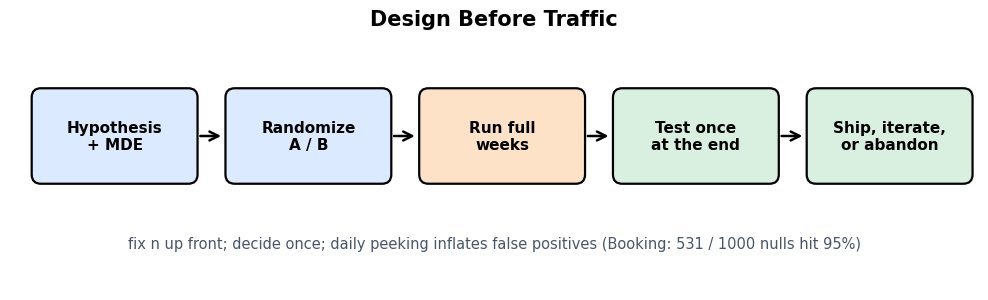


 is the required sample size per arm;
  is the MDE;
  is the per-user metric variance.
 and
and  are normal quantiles for the significance level and power (1.96 and 0.84 at the usual settings).
 is the baseline rate for a binary metric such as conversion, whose variance is set by
  .
.


 is the forest’s averaged prediction over
  trees, each with individual variance
  is the pairwise correlation between trees: this is what bagging and random feature subsets try to shrink.
 the second term vanishes but the
  floor remains: correlation, not tree count, is the limiting factor.
 in K-means, combine visual tools (the elbow method), quantitative metrics (the silhouette score), and statistical methods (the gap statistic), balancing model fit against generalization without overfitting. Domain knowledge and interpretability should have the final word.


 is cluster
  its centroid; WCSS is the total within-cluster squared distance that the elbow method plots against
  is point
  its mean distance to the nearest other cluster.
![s(i) \in [-1, 1]](https://s0.wp.com/latex.php?latex=s%28i%29+%5Cin+%5B-1%2C+1%5D&bg=ffffff&fg=000&s=2&c=20201002) : near 1 means well clustered, near 0 means on a boundary, negative means likely misassigned; average it over all points for each
: near 1 means well clustered, near 0 means on a boundary, negative means likely misassigned; average it over all points for each