
How do you detect and handle duplicates in a dataset, from exact matching to NVIDIA NeMo Curator’s GPU-accelerated fuzzy deduplication?
Answer
Duplicate detection has two levels: exact duplicates (identical rows or records) and near-duplicates (small edits, reformatting, or paraphrases). Exact duplicates are found by hashing: compute a hash (MD5, SHA) of each row or document, group by hash, and flag collisions in O(n) time. Near-duplicates are harder and require similarity-based methods: MinHash converts each document into a set of shingles and estimates the Jaccard similarity via shared min-hash signatures, then Locality-Sensitive Hashing (LSH) buckets signatures so that similar documents collide in the same bucket, reducing the O(n^2) all-pairs comparison to near-linear. NVIDIA NeMo Curator provides GPU-accelerated fuzzy deduplication using MinHash and LSH, and the research framework SEDD pushes this further by replacing data shuffling with streaming, reaching 158x over CPU-based SlimPajama tooling and 7.8x over NeMo Curator while deduplicating 1.2 trillion tokens in 3 hours on a 32-GPU cluster. LSHBloom replaced the expensive LSH index with Bloom filters, achieving 12x speedup and 18x less disk space at the same deduplication quality.
(1) Exact Duplicates: hash each row or document, group by hash, flag collisions; O(n) time, zero false positives; handles identical rows, copy-paste records, and repeated data entries.
(2) Near-Duplicates (MinHash + LSH): shingle each document, compute MinHash signatures (k random permutations), bucket via LSH so similar documents collide, then verify candidate pairs by exact Jaccard similarity; reduces O(n^2) all-pairs to near-linear.
(3) Production Scale: NVIDIA NeMo Curator supplies the GPU MinHash LSH baseline, and SEDD deduplicates 1.2 trillion tokens in 3 hours on a 32-GPU cluster (158x over CPU tooling, 7.8x over NeMo Curator) while keeping Jaccard similarity above 0.95; LSHBloom replaces the LSH index with Bloom filters for 12x speedup and 18x less disk space at internet scale.

Figure 1: The two-tier deduplication pipeline: exact duplicates are found by hashing and grouping (O(n), zero false positives), while near-duplicates use shingling, MinHash signatures, and LSH bucketing to reduce the O(n^2) all-pairs comparison to near-linear.
Duplicates matter because they inflate evaluation metrics and bias the model. If the same example appears in both training and test sets, the model memorizes it during training and gets it right at test time, producing an accuracy estimate that will not hold on truly unseen data. Even within the training set alone, duplicates cause the model to over-weight those examples, effectively up-sampling them. The handling strategy depends on the duplicate type: exact duplicates within one split should be removed; cross-split duplicates (train-test contamination) require deduplication before the split; near-duplicates in LLM training corpora are removed at scale to prevent memorization and recitation, which is why NVIDIA NeMo Curator and HuggingFace’s datasets deduplication tools exist. For structured tabular data, pandas’ drop_duplicates() handles exact duplicates, and fuzzy matching libraries (recordlinkage, dedupe) handle near-duplicates via string similarity. For text corpora at scale, MinHash LSH is the standard, and GPU acceleration made it practical for trillion-token pretraining datasets.
Mathematical Formulation:

![P[\min(\pi(A)) = \min(\pi(B))] = J(A, B)](https://s0.wp.com/latex.php?latex=P%5B%5Cmin%28%5Cpi%28A%29%29+%3D+%5Cmin%28%5Cpi%28B%29%29%5D+%3D+J%28A%2C+B%29&bg=ffffff&fg=000&s=3&c=20201002)

Where:
 is the Jaccard similarity between two sets and (e.g., the shingle sets of two documents); near-duplicates have Jaccard similarity above a threshold (typically 0.8-0.9).
- is a random permutation of the universe; the MinHash property states that the probability of two sets sharing the same minimum hash value equals their Jaccard similarity, so averaging over permutations gives an unbiased estimate.
- is the MinHash signature of document : a vector of minimum hash values. LSH buckets signatures so that similar signatures (and thus similar documents) collide with high probability, reducing candidate pairs from O(n^2) to near-linear.
 is the Jaccard similarity between two sets
  and
and  (e.g., the shingle sets of two documents); near-duplicates have Jaccard similarity above a threshold (typically 0.8-0.9).
 is a random permutation of the universe; the MinHash property states that the probability of two sets sharing the same minimum hash value equals their Jaccard similarity, so averaging over
  permutations gives an unbiased estimate.
 is the MinHash signature of document
  : a vector of
 | Method | Duplicate Type | Complexity | Scale |
|---|---|---|---|
| Hashing (exact) | Exact duplicates | O(n) | Any (pandas drop_duplicates) |
| MinHash + LSH | Near-duplicates (text) | O(nk) + candidate verification | Millions of documents |
| GPU MinHash LSH (NeMo Curator, SEDD) | Near-duplicates (GPU) | GPU-parallelized MinHash LSH | 1.2T tokens in 3 hours (32 GPUs, SEDD) |
| LSHBloom | Near-duplicates (Bloom) | O(nk), 12x faster than LSH | Internet-scale (billions of docs) |

 of observed (noisy) labels and true labels using the cross-validated probability matrix, then identifying the most likely mislabeled examples via pruning, counting, and ranking. This requires no hyperparameters and works with any classifier. For correction, the simplest approach is to remove or relabel the flagged examples if you have access to a human annotator. If human annotation is expensive, weak supervision lets you define labeling functions as natural-language prompts to foundation models, and the label model combines their outputs by learning each function’s accuracy and correlations. For training-time correction, noise-aware methods like CANOLA replace hard labels with soft labels (class probability distributions) that are refined iteratively, avoiding the hard commitment of relabeling while reducing the impact of noise. A 2026 paper on spectral signatures showed that the tail index of eigenvalue distributions at network bottleneck layers predicts test accuracy under label noise with R-squared of 0.984, providing a diagnostic that identifies 9% noise in CIFAR-10N with 3% error.
![\hat{P}(\tilde{y}=i,\, y^*=j) = \frac{1}{n}\sum_{k=1}^{n} \mathbb{1}[\tilde{y}_k = i] \cdot \mathbb{1}[\hat{p}_j(x_k) \geq t_j]](https://s0.wp.com/latex.php?latex=%5Chat%7BP%7D%28%5Ctilde%7By%7D%3Di%2C%5C%2C+y%5E%2A%3Dj%29+%3D+%5Cfrac%7B1%7D%7Bn%7D%5Csum_%7Bk%3D1%7D%5E%7Bn%7D+%5Cmathbb%7B1%7D%5B%5Ctilde%7By%7D_k+%3D+i%5D+%5Ccdot+%5Cmathbb%7B1%7D%5B%5Chat%7Bp%7D_j%28x_k%29+%5Cgeq+t_j%5D&bg=ffffff&fg=000&s=3&c=20201002)

 is the estimated joint distribution of the noisy label
  and the true label
  ;
;  is the cross-validated predicted probability of class
  for example
  is the average per-class confidence threshold (the average self-confidence for class
  but
but  are flagged as likely mislabeled.
 is the Confident Learning estimate of the true label: the argmax of the cross-validated probabilities, used for relabeling or soft-label assignment in noise-aware training.


![s(x, n) = 2^{-\mathbb{E}[h(x)]\,/\,c(n)}](https://s0.wp.com/latex.php?latex=s%28x%2C+n%29+%3D+2%5E%7B-%5Cmathbb%7BE%7D%5Bh%28x%29%5D%5C%2C%2F%5C%2Cc%28n%29%7D&bg=ffffff&fg=000&s=3&c=20201002)
 is the z-score of point
  ;
;  and
and  are the mean and standard deviation of the feature. The z-score method is not robust because outliers inflate
  and
and  are the 25th and 75th percentiles; the IQR rule is robust because percentiles are unaffected by extreme values. A related robust rule used in production: flag values outside median plus or minus 5 times the robust standard deviation (RSTD).
 is the Isolation Forest anomaly score.
 ![\mathbb{E}[h(x)]](https://s0.wp.com/latex.php?latex=%5Cmathbb%7BE%7D%5Bh%28x%29%5D&bg=ffffff&fg=000&s=2&c=20201002) is the average path length needed to isolate
is the average path length needed to isolate  is the expected path length for
  points, so outliers isolate in fewer splits, which drives the exponent up and pushes
  toward 1, while normal points sit near 0.5 or below.


 is the mutual information between the test labels and the training features; leakage means this is positive, i.e., the training features contain information about the test labels that should not be there.
 is the model trained on the training set; the goal is that
  and nothing from the test set, including test-set statistics used in preprocessing.
 itself contains a feature derived from
  (or
(or  ), so the model learns
  from
from  via a shortcut. Temporal leakage is the case where a feature
  is computed from data observed at some later time
  , which is unavailable when the prediction must actually be made.
 into the sum
  , which is easier to differentiate, numerically stable, and decomposes additively over data points for stochastic gradient descent.
 and log-likelihood
  both peak at
  , the sample proportion of heads.
 of heads. The likelihood of observing this data is
  , and the log-likelihood is
  . Taking the derivative and setting it to zero gives
  , which solves to
  . This is the sample proportion, and it is the MLE because the likelihood is maximized there. The same principle scales to neural networks: the cross-entropy loss
  is the negative average log-likelihood, and gradient descent on this loss is MLE for the network’s parameters. A 2024 arXiv paper established finite-sample guarantees for MLE in logistic regression, showing the sample complexity depends on both dimension and signal strength, with distinct regimes at different signal-to-noise ratios.


 is the parameter value that maximizes the likelihood;
  is the probability of observation
  is the log-likelihood, which converts the product into a sum for tractability; maximizing
  is equivalent to maximizing the likelihood because log is monotonically increasing.
 , and setting
  gives
gives  , the sample proportion. For classification:
  , and minimizing
  is the cross-entropy loss.
 . In the M-step, the parameters are updated: the mean is the responsibility-weighted average, the covariance is the responsibility-weighted scatter, and the mixing weight is the average responsibility. Each iteration is guaranteed never to decrease the log-likelihood, but it converges only to a local optimum, so multiple random restarts are standard. The key trade-off versus k-means is cost: k-means is O(nKd) per iteration with a simple distance computation, while GMM is O(nKd^2) per iteration because of the multivariate Gaussian PDF with full covariance, plus the matrix inversion in the PDF. Flash-GMM (2026) addressed this by eliminating the full responsibility matrix from GPU memory, reducing memory from O(nK) to O(KD) and enabling 100x larger datasets on a single GPU.


 is the mixing weight of cluster
  is its mean, and
  is its covariance matrix.
 is the responsibility of cluster
  : the posterior probability that point
  is the average responsibility. k-means is the limit when all
  and
and  , collapsing responsibilities to 0 or 1.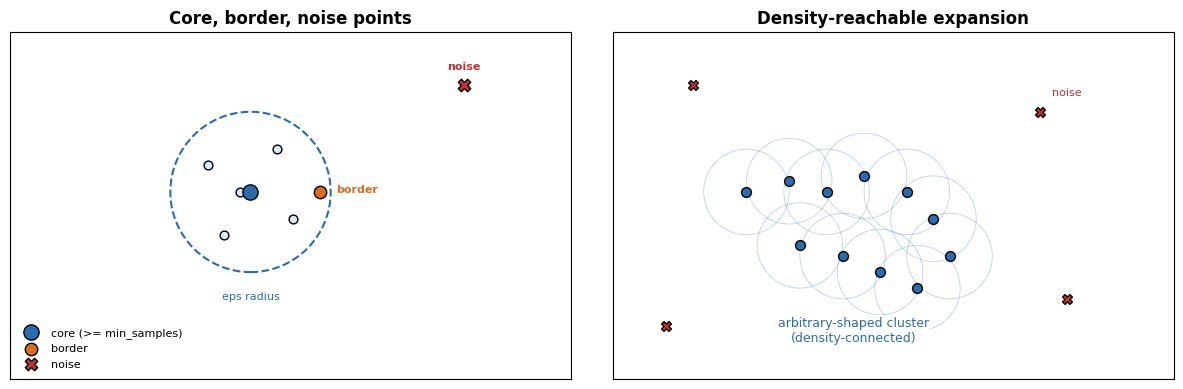


 is the eps-neighborhood of point
  in dataset
  , and
, and  is typically Euclidean distance.
 is the maximal set of points density-reachable from a core point via a chain of overlapping core neighborhoods; this transitive closure is what lets DBSCAN trace arbitrary shapes.
 and
and  per class per feature, then uses the Gaussian PDF in the likelihood product; O(nd) training, O(d) prediction, but assumes normality.
 ; the R naivebayes package and MATLAB’s ClassificationNaiveBayes both support it, and a 2025 paper used optimized robust KDE with Welsch M-estimation to handle outliers in Bayesian classification.


 .
. is the number of training points in class
  is the bandwidth,
  is the kernel function (typically Gaussian), and
  are the training values of the feature in class
  with Laplace smoothing, reducing the continuous feature to a categorical one.

![\alpha_t(j) = \left[\sum_{i=1}^{N} \alpha_{t-1}(i)\, a_{ij}\right] b_j(o_t)](https://s0.wp.com/latex.php?latex=%5Calpha_t%28j%29+%3D+%5Cleft%5B%5Csum_%7Bi%3D1%7D%5E%7BN%7D+%5Calpha_%7Bt-1%7D%28i%29%5C%2C+a_%7Bij%7D%5Cright%5D+b_j%28o_t%29&bg=ffffff&fg=000&s=3&c=20201002)
![\delta_t(j) = \max_{i} \big[\delta_{t-1}(i)\, a_{ij}\big]\, b_j(o_t)](https://s0.wp.com/latex.php?latex=%5Cdelta_t%28j%29+%3D+%5Cmax_%7Bi%7D+%5Cbig%5B%5Cdelta_%7Bt-1%7D%28i%29%5C%2C+a_%7Bij%7D%5Cbig%5D%5C%2C+b_j%28o_t%29&bg=ffffff&fg=000&s=3&c=20201002)

 is the forward variable: the joint probability of emitting
  and landing in state
  ; the evaluation problem sums
  over all final states.
 is the Viterbi variable: the highest probability of any single path ending in state
  record the argmax to reconstruct the best path.
 is the posterior state occupancy, formed from the forward variable and the backward variable
  , the probability of emitting the remaining observations
  given state
  is the transition probability from state
  the emission probability of
  in state
  using
using  and the pairwise posterior
  .
.
![w_i^{(m+1)} = \frac{w_i^{(m)} \exp\!\big(\alpha_m\, \mathbb{1}[y_i \neq h_m(x_i)]\big)}{Z_m}](https://s0.wp.com/latex.php?latex=w_i%5E%7B%28m%2B1%29%7D+%3D+%5Cfrac%7Bw_i%5E%7B%28m%29%7D+%5Cexp%5C%21%5Cbig%28%5Calpha_m%5C%2C+%5Cmathbb%7B1%7D%5By_i+%5Cneq+h_m%28x_i%29%5D%5Cbig%29%7D%7BZ_m%7D&bg=ffffff&fg=000&s=3&c=20201002)

![r_{i,m} = -\left[\frac{\partial\, \ell(y_i, F)}{\partial\, F}\right]_{F = F_{m-1}}](https://s0.wp.com/latex.php?latex=r_%7Bi%2Cm%7D+%3D+-%5Cleft%5B%5Cfrac%7B%5Cpartial%5C%2C+%5Cell%28y_i%2C+F%29%7D%7B%5Cpartial%5C%2C+F%7D%5Cright%5D_%7BF+%3D+F_%7Bm-1%7D%7D&bg=ffffff&fg=000&s=3&c=20201002)
 is the AdaBoost weight of example
  ,
,  is the stage weight (half the log-odds of being correct), and
  normalizes the weights so they sum to 1.
 is the gradient boosting ensemble after stage
  is the tree fit to the pseudo-residuals, and
  is the learning rate (shrinkage).
 is the pseudo-residual: the negative gradient of the chosen loss
  ; for logistic loss it is
  .
.