
Design a deep learning system for last-mile delivery route optimization that predicts travel times, sequences stops, and adapts to real-time traffic and demand. A delivery company such as UPS, FedEx, or Amazon Logistics must route thousands of drivers daily through dense urban and suburban areas, each driver visiting 50-150 stops.
The system must predict travel times between stops accounting for traffic, time of day, weather, and road type; sequence stops to minimize total time while respecting time windows and vehicle capacity; and re-optimize on the fly when a driver falls behind, a new stop is added, or traffic conditions change. The routing problem is NP-hard at scale, so the system must balance solution quality against compute time, and it must learn from historical route data to improve future predictions.
How would you design this system? Cover the travel-time prediction model, the route sequencing optimization algorithm (classical VRP solvers vs learned heuristics vs neural combinatorial optimization), the real-time re-optimization strategy, how you incorporate historical route data to improve predictions, and how you evaluate route quality against ground-truth completion times.

The Problem: one van, 150 stops, hard time windows, and edge costs that change hour by hour. The number of possible orderings is astronomical, so the system has to guess travel times well and then search the orderings cheaply enough to finish before the shift starts.
Answer
The design deliberately splits learning from search. A learned travel-time model turns the road network plus time, weather, and live speed feeds into a time-dependent, distributional cost matrix, and a classical metaheuristic VRP solver (guided local search or hybrid genetic search) sequences the stops against that matrix under time-window and capacity constraints. Deep learning is where it earns its keep, in prediction and in learning driver behavior, not in replacing a solver that must guarantee feasibility. The two pivotal decisions are to predict quantiles rather than mean travel times, so tight windows can be buffered by risk rather than by luck, and to regularize the sequence toward historically executed driver routes, because the Amazon Last Mile Routing Research Challenge showed that cost-optimal sequences are routinely overridden by drivers who know where parking, gates, and one-way alleys actually are. Real-time adaptation is a rolling-horizon re-solve with a frozen prefix, so the plan stays stable in front of the driver while the tail is repaired inside a two-second budget.
(1) Learned ETA, Classical Search: a road-graph neural network predicts edge travel times; a metaheuristic solver does the combinatorial work with hard feasibility guarantees.
(2) Distributional Time-Dependent Costs: per-edge p50 and p90 travel times bucketed by departure hour, so rush-hour edges and risky windows are priced correctly.
(3) Separate Service-Time Model: parking, walking, gates, and elevators are modeled per stop type independently of driving time, because they dominate dense urban routes.
(4) Driver-Preference Regularization: a zone-sequence model learned from executed routes constrains or penalizes orderings drivers reliably reject.
(5) Hierarchical Decomposition: sequence delivery zones first, then stops inside each zone, keeping every solver subproblem in the tens of nodes rather than 150.
(6) Frozen-Prefix Re-optimization: the next few stops are committed; only the tail is re-sequenced by warm-started large neighborhood search under a latency cap.
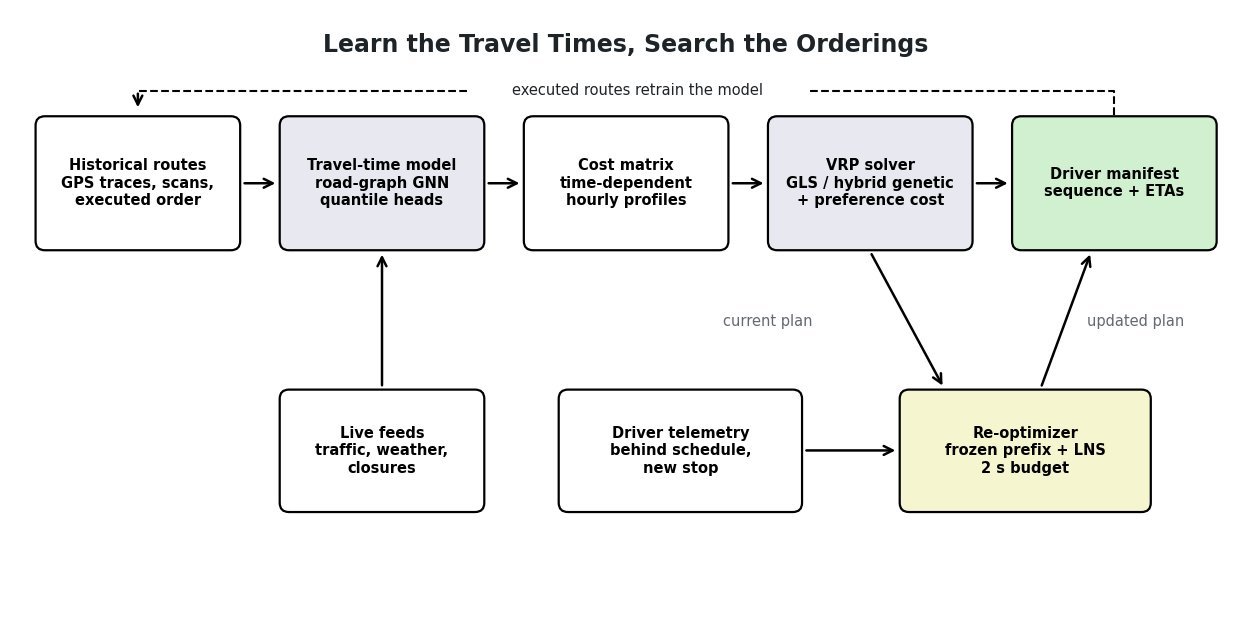
Figure 1: Overnight the pipeline runs left to right; during the shift the re-optimizer repairs the tail of an existing plan, and executed routes flow back as training data.
Clarify Before Designing:
(1) Scale And Geometry: how many drivers per station per day, how many stops per route, and is the mix dense urban (walking dominated) or suburban (driving dominated)?
(2) Cost Asymmetry: what does a missed delivery window cost relative to an hour of driver overtime or an extra van dispatched?
(3) Planning Cadence: is there an overnight batch window with frozen packages, or does volume keep arriving after dispatch?
(4) Driver Autonomy: must drivers follow the sequence, or may they override, and do we have GPS traces to measure how often they do?
(5) Label Availability: do we get per-stop arrival and departure timestamps and package scans, or only route start and end times?
(6) Compute And Connectivity: what solver budget exists per route overnight, what re-optimization latency is acceptable, and can the driver app fall back offline?
Leave a Reply