
Design a deep reinforcement learning system for warehouse robot path planning. An e-commerce fulfillment center (Amazon Robotics, Ocado) operates hundreds of mobile robots that navigate warehouse aisles to retrieve pods, transport goods to packing stations, and return to storage locations. Each robot must plan a collision-free path to its goal while avoiding static obstacles (shelves, pillars), dynamic obstacles (other robots, humans), and deadlocks where two robots block each other in a narrow aisle. The warehouse is a structured but dynamic grid: shelf layouts change as inventory moves, traffic density varies by time of day and order volume, and a single blocked aisle can cascade into gridlock across the entire floor. A deep RL system can learn coordinated path planning policies that outperform classical A* or Dijkstra-based planners in dense, multi-agent settings, but it must be trained safely (without crashing real robots), generalize to warehouse layouts it has never seen, and handle the non-stationarity of a live fulfillment center.
How would you design this system? Cover the RL formulation (state, action, reward design for goal-reaching vs collision-avoidance vs throughput), the candidate RL architectures (centralized training with decentralized execution vs multi-agent PPO vs graph neural network-based coordination), how you train safely in simulation and transfer to real warehouses (sim-to-real), how you handle non-stationary traffic and layout changes, and how you evaluate path quality and warehouse throughput against classical planners.

The Problem: hundreds of robots share narrow aisles, the shelf map changes with inventory, and one pair of robots blocking each other can stall the whole floor. Design the planner that keeps every robot moving toward its goal without a single collision.
Answer
The design is a hybrid planner: a classical shortest-path heuristic handles the global map, a learned per-robot policy handles the local, multi-agent decision of which move to take right now, and a hard safety shield sits between the policy and the motors. The policy is trained with centralized training, decentralized execution (multi-agent PPO with one shared actor and a team-level critic) inside a randomized simulator that never touches a real robot. The three pivotal decisions are to give the policy a precomputed path heuristic as an input channel so RL never has to rediscover the floor plan, to make every learned action pass a reservation-table and deadlock check before actuation, and to roll out through shadow mode and zone canaries where the classical planner keeps executing until the learned policy has earned trust.
(1) Hybrid Formulation: RL owns the local decision (one of five moves given a 9×9 egocentric window and neighbors’ intended next cells), while a per-map shortest-path distance field enters as an observation channel; layout changes become a heuristic recompute, not a retrain.
(2) CTDE With MAPPO: one shared actor runs on every robot, and a centralized critic sees the whole fleet during training only; shared weights make the robot count a runtime parameter rather than an architecture choice.
(3) Reward Shaping: potential-based progress on shortest-path distance, collision and idle penalties, and a team throughput bonus; the mix is tuned in simulation against measured throughput, never hand-tweaked on the live floor.
(4) Safety Shield: every proposed action is checked against a reservation table and a wait-for-graph deadlock detector; the policy proposes, the shield disposes, so collision-free is a property of the shield, not a hope about the network.
(5) Randomized Simulation and Staged Rollout: procedurally generated layouts, replayed order streams, and injected comms delay train a policy that generalizes; shadow mode, a single-zone canary, and rollback gates carry it to the floor.
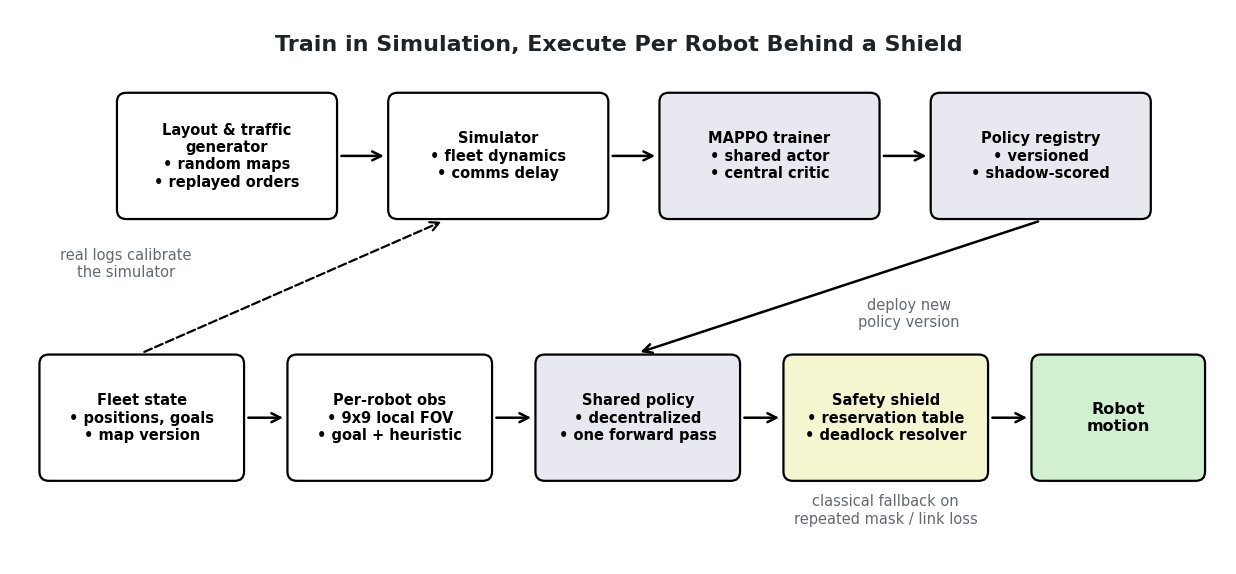
Figure 1: Train in simulation, execute per robot behind a shield: the learned policy only ever proposes a move, and real fleet logs flow back to keep the simulator honest.
Clarify Before Designing:
(1) Fleet and Floor: how many robots on how many square meters, and is the floor a fixed grid (Ocado-style hive) or free aisles with pods (Kiva-style pods)?
(2) Control Topology: does a central fleet server talk to every robot at a fixed tick, or must each robot decide on-board with lossy wireless; this decides whether decentralized execution is a choice or a necessity.
(3) Humans on the Floor: is the space caged robot-only, or mixed with pickers (as with Amazon’s Proteus); mixed traffic changes the safety envelope and the observation design.
(4) Layout Churn: how often does the map version change (daily inventory moves vs quarterly re-slotting), and is a new map available before robots see it?
(5) Latency Budget: what is the decision tick (100 ms is typical), and how much of it can planning consume after sensing and communication?
(6) Baseline and Success: what does the current planner achieve in trips per hour and stalls per thousand trips, and is task assignment (which robot takes which order) in scope or fixed upstream?
Leave a Reply