
Design a demand forecasting system for a large retail company like Costco, Walmart, or Target. The system should predict future product demand across stores and time to support inventory planning, replenishment, and promotions.
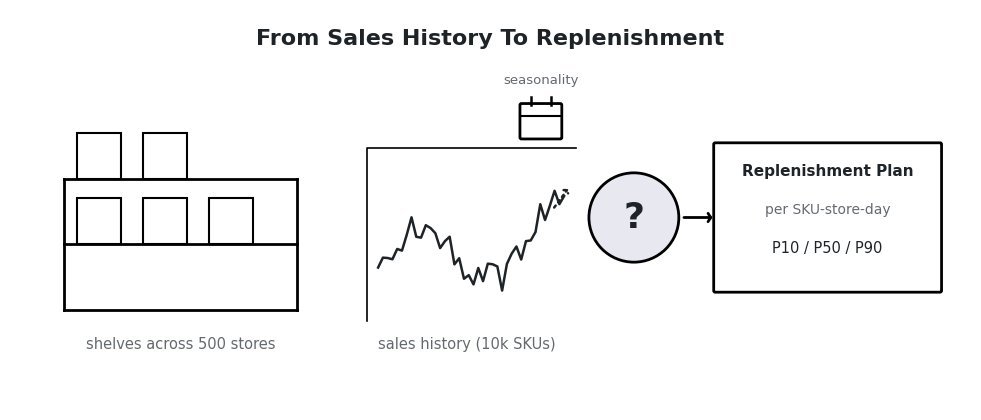
The Problem: thousands of SKUs across hundreds of stores. Predict each one’s future demand well enough to keep shelves full and waste low, then feed those numbers to replenishment and pricing.
Answer
The demand forecasting system ingests diverse data (sales, inventory, weather, promotions) and predicts product demand with ML models spanning time series, tree-based, and deep learning methods. It features a scalable layered architecture (data pipelines, real-time processing, integration for inventory management) and drives decisions with probabilistic forecasts, reducing stockouts, optimizing supply chains, and improving accuracy through iterative model training.
(1) Problem Definition & Metrics: Fix granularity (SKU-store-day), horizon (2-week operational, 3-month tactical), and objective (minimize out-of-stocks and waste); measure with WMAPE and forecast bias.
(2) Data Strategy: A unified feature store over internal signals (sales, hierarchy, pricing, promos, inventory, clicks) and external ones (calendar, weather, events, competitor, macro).
(3) Layered Architecture: Ingestion → processing & feature store → modeling layer → serving APIs → monitoring & feedback.
(4) Hierarchical Ensemble Modeling: Interpretable base (Prophet/ETS) at aggregate level, global LightGBM/XGBoost as the granular workhorse, TFT/DeepAR for high-volatility items, reconciled top-down and bottom-up.
(5) Probabilistic Forecasts: Output quantile forecasts (P10, P50, P90) so logistics can set safety stock from uncertainty, not a single number.

Figure 1: The five-layer system: ingestion and the feature store feed a model repository; forecasts are served through APIs to replenishment and pricing, while monitoring closes the loop back into retraining.
Clarify Before Designing:
(1) Scale: how many SKUs, stores, and series (SKU × store) must be forecast?
(2) Granularity & Horizon: store-day or region-week? 2-week replenishment or 3-month tactical planning?
(3) Decision Consumers: automated replenishment, or human planners reviewing suggestions?
(4) Data Reality: is a promotions calendar available in advance? New product launch cadence (cold-start rate)?
(5) Cost Asymmetry: the cost of a stockout (lost sale, empty shelf) versus overstock (waste, markdowns)?
Leave a Reply