
What are the challenges of using Reinforcement Learning in a production recommendation system, such as the YouTube home feed or Spotify’s carousels?
Answer
The hard part is almost never the learning algorithm. A production recommender is an off-policy problem with a combinatorial action space, a corrupted reward signal, and a closed feedback loop, and each of those violates an assumption that textbook RL takes for granted. You cannot explore freely on paying users, so the only training data is what yesterday’s serving policy logged, which makes importance weighting and its variance the central engineering problem rather than a footnote. The action is not one item but a slate of K items drawn from a catalogue of order  , so enumerating a Q value per action is impossible and the policy must be factorized or decomposed. Finally, the reward you actually want, long-term satisfaction, arrives days after the action, and is confounded by position bias, seasonality, and the recommendations themselves.
(1) Off-Policy By Construction: training data comes from a logging policy  , not from the policy you are optimizing, so every gradient needs an importance correction whose variance grows with the mismatch.
(2) Combinatorial Slate Actions: a page of  items from
  candidates gives
  actions, forcing decompositions such as top-K correction or SlateQ‘s per-item value factorization.
(3) Reward Specification And Delay: clicks are immediate and gameable, retention is the real objective and is observed days later, so credit assignment spans sessions rather than steps.
(4) Feedback Loops And Non-Stationarity: the deployed policy shapes tomorrow’s training distribution, so a small early bias compounds instead of averaging out, and the catalogue and user base drift underneath the model.
(5) Offline Evaluation Is Unreliable: off-policy estimators are high variance on large action spaces, so offline value gains routinely fail to reproduce in an A/B test.
(6) Infrastructure Cost: you must log propensities at serving time, keep the randomization budget small, and still return a ranked page inside a tens-of-milliseconds latency budget.

Figure 1: The loop is the problem. Supervised ranking treats the log as a fixed dataset, but here the policy under training generates its own future training distribution, so bias compounds across deployments and the reward attached to each logged action is both delayed and confounded by presentation.
The standard production recipe, popularized by YouTube’s top-K REINFORCE recommender, is to keep policy-gradient learning but reweight each logged trajectory by the ratio between the new policy and the logging policy. Two corrections then appear. The first is weight clipping, which caps the influence of any single log line and trades unbounded variance for a controlled downward bias. The second is the top-K correction factor, which accounts for the fact that the system shows slots rather than sampling one item, and which flattens the gradient on items the policy already places with near certainty. Both are variance-control devices, and understanding why they are needed is the difference between a candidate who has read the paper and one who has shipped the system.
Mathematical Formulation:
![J(\theta) = \mathbb{E}_{\tau \sim \pi_{\theta}}\left[\sum_{t=0}^{T} \gamma^{t} r_{t}\right]](https://s0.wp.com/latex.php?latex=J%28%5Ctheta%29+%3D+%5Cmathbb%7BE%7D_%7B%5Ctau+%5Csim+%5Cpi_%7B%5Ctheta%7D%7D%5Cleft%5B%5Csum_%7Bt%3D0%7D%5E%7BT%7D+%5Cgamma%5E%7Bt%7D+r_%7Bt%7D%5Cright%5D&bg=ffffff&fg=000&s=3&c=20201002)


Where:
 is the expected discounted return of the target policy over a user trajectory , with discount and per-step reward .
- is the user state (interaction history and context), the item actually shown and logged, and the return following that action.
- is the target policy and the logging (behavior) policy; is their ratio, and it is undefined wherever .
- is the clipping threshold; is the truncated weight, which is biased but bounded.
- is the top-K correction for showing slots instead of one; it tends to for rare items and to as approaches .
- is the effective sample size over logged records, and it is the number that decides whether a 10M-row log is really 10M rows.
 is the expected discounted return of the target policy over a user trajectory
  , with discount
 ![\gamma \in (0,1]](https://s0.wp.com/latex.php?latex=%5Cgamma+%5Cin+%280%2C1%5D&bg=ffffff&fg=000&s=2&c=20201002) and per-step reward
and per-step reward  .
. is the user state (interaction history and context),
  the item actually shown and logged, and
  the return following that action.
 is the target policy and
  is their ratio, and it is undefined wherever
  .
. is the clipping threshold;
  is the truncated weight, which is biased but bounded.
 is the top-K correction for showing
  as
as  approaches
  .
. is the effective sample size over
  logged records, and it is the number that decides whether a 10M-row log is really 10M rows.
Figure 2: Why off-policy learning is a variance problem before it is an optimization problem. As the target policy drifts from the logging policy, the effective sample size of the log collapses exponentially, so a huge log can carry the statistical weight of a small one. Clipping restores usable sample size at the price of a systematic downward bias on exactly the actions the new policy likes most.
This is also why the choice between supervised ranking, a contextual bandit, and full sequential RL is a real design decision rather than a question of ambition. A bandit captures most of the exploration benefit with a single-step correction and no long-horizon credit assignment, and it is what Spotify’s explainable-recommendation work uses for carousel and explanation selection. Full RL earns its cost only when an action genuinely changes the future state, for example when promoting a new creator today changes what the user is willing to watch next month.
| Property | Supervised ranker | Contextual bandit | Full sequential RL |
|---|---|---|---|
| Objective | Predict the immediate label, click or watch probability | Maximize immediate reward under uncertainty | Maximize discounted return across future sessions |
| Data required | Logged impressions and labels only | Logged action plus its propensity | Full trajectories with propensities and delayed rewards |
| Correction needed | None in principle, though position bias still needs debiasing | Single-step IPS or doubly robust | Per-step IPS, clipping, top-K factor, bootstrapped value targets |
| Exploration cost | None, and therefore no counterfactual coverage | Small randomized slot, epsilon-greedy or Thompson sampling | Randomization plus pessimism penalties for out-of-support actions |
| Dominant failure | Myopic optimization that rewards clickbait | No credit for downstream session value | Variance explosion offline and feedback-loop drift online |


 are the parameters after the
  -th update,
  the step size, and
  the arriving example; the pure online case uses each
  exactly once.
 is the batch actually used at step
  and a buffer sample
  , with replay ratio
  typically in the 0.05 to 0.20 range.
 is the loss on the incoming chunk and
  a stability penalty anchored at the previous checkpoint
  , with
  trading plasticity for retention.
 is the diagonal Fisher information for parameter
  under the old task, so weights the old task depended on move less; setting
  reduces the penalty to plain L2-to-previous.
 is accuracy on task
  measured after training through task
  , with
  is average accuracy over everything seen and
  the forgetting on task
 . A KAN swaps those two roles. Every edge carries its own learnable univariate function
  , implemented as a B-spline of grid size
  and order
  in parameters at the same layer shape, roughly an order of magnitude in wall-clock training time because per-edge splines do not collapse into one dense GEMM, and a new hyperparameter (the spline grid) that must cover the actual range of the activations.
 is a learned combination of
  basis functions added to a scaled SiLU, so a KAN is not activation-free; the fixed nonlinearity survives as a residual path that keeps gradients alive outside the grid.
 layer holds 4,160 parameters as an MLP and about 32,768 spline coefficients as a KAN with
  .
. ,
,  , or
, or  .
.


 is the input vector and
  the
the  , obtained by summation only in a KAN.
 and
and  and
and  are the inner and outer univariate functions of the Kolmogorov-Arnold representation, with
  the input dimension;
  to unit
  are B-spline basis functions with local support over the knot grid,
  their learned coefficients, and
  the scales of the SiLU residual and the spline branch.
 is depth,
  the parameter count, so the KAN pays the extra factor
  is test error against parameter count
  rate is the cubic-spline approximation rate and holds only when the target is smooth and effectively low-dimensional.
 and is simultaneously driven by a nonlinearity
  that also appears in the denominator of the effective time constant, so each neuron can behave like a fast detector on one input and a slow integrator on another. The trained parameters
  are static after training; what is “liquid” is the input-dependent time constant and synaptic drive, which makes the system a family of dynamics selected on the fly rather than one fixed linear-time-invariant filter. Because the state is a function of physical time, the elapsed interval
  is an explicit argument to a numeric solver, which is what lets LNNs consume irregularly sampled sensor streams without imputation. Against this, a gated RNN applies the same learned transition once per token at an implicit constant stride, and a Transformer has no recurrent state at all: it mixes tokens by attention over the whole prefix, paying
  prefill and carrying a linearly growing KV cache.
 varies per neuron per step, giving input-dependent timescales from one fixed parameter set.
 for
for  , so the dynamics cannot blow up the way an unconstrained neural ODE can.
 and sets the effective time constant, and the solver spans whatever


 is the continuous-time neuron state and
  the sensory input at that instant.
 the supremum of
  that bounds the fastest achievable dynamics.
 depends on step index
  applied identically at every step and no
 denominator: a strong input collapses
  , so one neuron spans a wide band of timescales. Right, the same input pulse through a fixed leaky integrator and an LTC cell with identical
 ![x(t) = \sigma(-f\,t) \odot g + [1 - \sigma(-f\,t)] \odot h](https://s0.wp.com/latex.php?latex=x%28t%29+%3D+%5Csigma%28-f%5C%2Ct%29+%5Codot+g+%2B+%5B1+-+%5Csigma%28-f%5C%2Ct%29%5D+%5Codot+h&bg=ffffff&fg=000&s=3&c=20201002)


 are separate learned heads of
  and
and  acts as a time-dependent gate that interpolates between two candidate states as elapsed time grows, which is the closed-form stand-in for exponential relaxation. Note that
  has no term in
  and no cache: an LNN controller at
  can run indefinitely in constant memory, while the Transformer term grows with every token retained.


 is a pixel coordinate and
  the predicted scene point for that pixel, expressed in the reference camera’s frame.
 is the pinhole projection,
  the pose of camera
  indexes valid pixels, and
  is the ground-truth pointmap from a simulator, LiDAR, or a reconstruction pipeline.
 is the mean point norm used for scale normalization, so
  on
on  is scale-invariant; dropping the division makes the loss metric and requires metric labels.
 is the reprojection error against a matched pixel
  in the other view, and it is valid only where the scene is static between the two frames.
 is a differentiable renderer (splatting or volume rendering) over a lifted representation
  .
. is the original appearance objective (diffusion denoising or masked prediction) and
  weight the geometric terms.
 , so a 32-view window is roughly 1,000x a single view. This is why practical models alternate frame-local and global attention and slide a bounded view window.
 . This is attractive because the gradient annihilates the intractable normalizing constant: if
  then
then  with no
  anywhere, so an unnormalized energy model becomes trainable. Direct score matching still needs the intractable
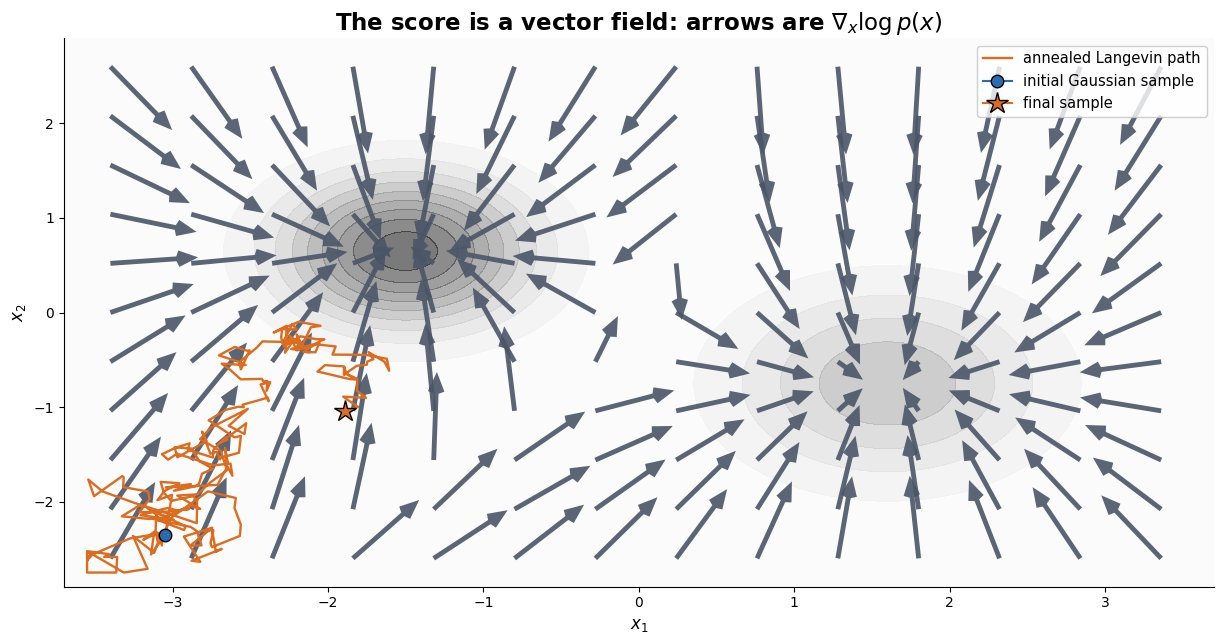
  , and the fix is denoising score matching: perturb the data with a known Gaussian kernel, and the score of the perturbed conditional is available in closed form, which reduces the loss to predicting the noise that was added. Because a single small noise level leaves the score undefined off the data manifold and unreliable in low-density regions, the model is trained over a continuum of noise levels, which turns into the forward SDE of Song et al. and makes sampling the simulation of a reverse-time SDE or its deterministic probability-flow ODE. The punchline is that DDPM’s noise-prediction network is the same object in different clothing:
  , so the discrete-time denoising story and the continuous-time score story are two parameterizations of one model.
 removes the partition function, so the network output is an unconstrained vector field of the same shape as the data.
 has the same minimizer as matching the true marginal score, and that target is just the scaled added noise.
 , and the loss weighting
  .
.
 , never evaluating the density itself.


![\mathcal{L}(\theta) = \mathbb{E}\left[ \lambda_t \left\| s_\theta(x_t,t) + \frac{\epsilon}{\sigma_t} \right\|^2 \right]](https://s0.wp.com/latex.php?latex=%5Cmathcal%7BL%7D%28%5Ctheta%29+%3D+%5Cmathbb%7BE%7D%5Cleft%5B+%5Clambda_t+%5Cleft%5C%7C+s_%5Ctheta%28x_t%2Ct%29+%2B+%5Cfrac%7B%5Cepsilon%7D%7B%5Csigma_t%7D+%5Cright%5C%7C%5E2+%5Cright%5D&bg=ffffff&fg=000&s=3&c=20201002)

![dx = \left[ f - g^2 s_\theta \right] dt + g\,d\bar{w}](https://s0.wp.com/latex.php?latex=dx+%3D+%5Cleft%5B+f+-+g%5E2+s_%5Ctheta+%5Cright%5D+dt+%2B+g%5C%2Cd%5Cbar%7Bw%7D&bg=ffffff&fg=000&s=3&c=20201002)
![dx = \left[ f - \tfrac{1}{2} g^2 s_\theta \right] dt](https://s0.wp.com/latex.php?latex=dx+%3D+%5Cleft%5B+f+-+%5Ctfrac%7B1%7D%7B2%7D+g%5E2+s_%5Ctheta+%5Cright%5D+dt&bg=ffffff&fg=000&s=3&c=20201002)

 is the network output, a vector with the same shape as
  .
. is a clean data point,
  its noisy version, and
  the Gaussian draw.
 and
and  define the noise schedule; variance-preserving keeps
  , variance-exploding fixes
  and grows
 ![t \in [0,T]](https://s0.wp.com/latex.php?latex=t+%5Cin+%5B0%2CT%5D&bg=ffffff&fg=000&s=2&c=20201002) indexes the noise level, with
indexes the noise level, with  essentially pure Gaussian noise;
  turns the objective into the plain noise-prediction MSE.
 is the drift and
  the diffusion coefficient of the forward SDE;
  is a Wiener process and
  its reverse-time counterpart, so the second SDE is integrated from
  down to
  .
. ; required initial condition for sampling:
  for the VE case.
 the score carries no usable signal away from the data, while at
  the smoothed field points inward from everywhere and bridges the two modes.
 steps, then learns the reverse process that removes a little noise at a time. The forward chain has no parameters and admits a closed form, so training reduces to a plain regression: sample a clean image
  , build the noisy state
  is Gaussian, any timestep can be sampled directly without simulating the chain, making each training step
  in
in  , which links diffusion to Langevin dynamics and to probability-flow ODE samplers such as DDIM.


![\mathcal{L}_{\text{simple}} = \mathbb{E}_{t, x_0, \epsilon} [ \| \epsilon - \epsilon_\theta(x_t, t) \|^2 ]](https://s0.wp.com/latex.php?latex=%5Cmathcal%7BL%7D_%7B%5Ctext%7Bsimple%7D%7D+%3D+%5Cmathbb%7BE%7D_%7Bt%2C+x_0%2C+%5Cepsilon%7D+%5B+%5C%7C+%5Cepsilon+-+%5Cepsilon_%5Ctheta%28x_t%2C+t%29+%5C%7C%5E2+%5D&bg=ffffff&fg=000&s=3&c=20201002)

 approximately standard Gaussian.
 is the injected noise and
  is sampled uniformly during training, and
  is the noise schedule, typically small and increasing, and
  is the cumulative signal factor giving signal-to-noise ratio
  .
. is the implied score function, the quantity an SDE or probability-flow ODE sampler integrates.
 , which is only valid if the schedule drives
  to (near) zero.
 (typically
  ) to a sample in data space, and the discriminator
  outputs the probability that its input came from the real dataset rather than from
  , and substituting it turns the generator’s objective into the Jensen-Shannon divergence between the data distribution and the model distribution, uniquely minimized when
  . The practical payoff is that
  ; the discriminator ascends it and the generator descends it, so no explicit reconstruction or likelihood term is ever written down.
 encodes
  , which is exactly the information the generator needs about where it is over- or under-producing mass.
 is defined only through the pushforward of
  by
by  term has almost no gradient while the generator is bad, so implementations maximize
  instead.
 and controls the balance with regularization instead. The three interventions that matter most in practice are spectral normalization or an R1 gradient penalty to keep the discriminator smooth, two-timescale learning rates so the discriminator can stay slightly ahead, and an exponential moving average of the generator weights for evaluation. The classic failure modes are mode collapse, where
![V(D,G) = \mathbb{E}_{x \sim p_{data}}[\log D(x)]](https://s0.wp.com/latex.php?latex=V%28D%2CG%29+%3D+%5Cmathbb%7BE%7D_%7Bx+%5Csim+p_%7Bdata%7D%7D%5B%5Clog+D%28x%29%5D&bg=ffffff&fg=000&s=3&c=20201002)
![\quad + \mathbb{E}_{z \sim p_z}[\log (1 - D(G(z)))]](https://s0.wp.com/latex.php?latex=%5Cquad+%2B+%5Cmathbb%7BE%7D_%7Bz+%5Csim+p_z%7D%5B%5Clog+%281+-+D%28G%28z%29%29%29%5D&bg=ffffff&fg=000&s=3&c=20201002)


![\mathcal{L}_G = -\mathbb{E}_{z \sim p_z}[\log D(G(z))]](https://s0.wp.com/latex.php?latex=%5Cmathcal%7BL%7D_G+%3D+-%5Cmathbb%7BE%7D_%7Bz+%5Csim+p_z%7D%5B%5Clog+D%28G%28z%29%29%5D&bg=ffffff&fg=000&s=3&c=20201002)
 is a real sample and
  is a generated sample and
  is the estimated probability of being real.
 is the resulting generator criterion;
  is the Jensen-Shannon divergence, so
  with equality only at
  is the non-saturating generator loss actually used in code; it shares the same fixed point as the minimax form but has large gradient when
  is near 0, which is the required starting condition of training.
 and minimizes reconstruction error alone, so nothing constrains where codes land: the latent space is an arbitrary point cloud with holes, and decoding a random vector usually produces garbage. A VAE instead makes the encoder output the parameters of a distribution
  , samples
  from it, and optimizes the evidence lower bound (ELBO), which adds a KL term pulling every posterior toward a fixed prior
  . That single extra term is what turns an encoder-decoder pair into a generator: after training you can draw
  and decode it, because the aggregate posterior now covers the prior. The sampling step is made differentiable by the reparameterization trick,
  with
with  , then decode) yields plausible data, and interpolation between two codes stays on the data manifold.
 , so a VAE gives a comparable density estimate, whereas an autoencoder’s reconstruction error has no probabilistic meaning.
 and ignore the latent entirely, a failure called posterior collapse that shows up as a KL term decaying to near zero while reconstruction stalls. Standard mitigations are KL annealing (ramp the weight from 0 to 1 over the first epochs) and free bits (do not penalize a dimension until its per-dimension KL exceeds a floor of roughly 0.05 to 0.5 nats). The second is the choice of likelihood: a diagonal Gaussian decoder is equivalent to an MSE reconstruction loss, which averages over plausible outputs and is the direct cause of the blurry samples VAEs are known for; discretized logistic or categorical likelihoods sharpen results noticeably. Modern image systems exploit this honestly, using a KL-regularized autoencoder as the perceptual compressor and putting the generative burden on a diffusion model in that latent space, as in Stable Diffusion.

![\mathcal{L}_{rec} = \mathbb{E}_{q_\phi(z|x)}[\log p_\theta(x|z)]](https://s0.wp.com/latex.php?latex=%5Cmathcal%7BL%7D_%7Brec%7D+%3D+%5Cmathbb%7BE%7D_%7Bq_%5Cphi%28z%7Cx%29%7D%5B%5Clog+p_%5Ctheta%28x%7Cz%29%5D&bg=ffffff&fg=000&s=3&c=20201002)


 is the ELBO, a lower bound on the marginal log-likelihood
  , so maximizing the bound both fits the data and sharpens the approximate posterior.
 the latent code, with
  in the usual bottleneck setting.
 is the encoder (recognition model) with parameters
  is the decoder (likelihood) with parameters
  indexes latent dimensions in the closed-form KL, where
  and
and  are the encoder outputs for example
  is elementwise multiplication and
  and
and  recovers the exact ELBO,
  gives the beta-VAE disentanglement regime, and
  degenerates to a plain autoencoder. Networks are typically initialized so
  , which starts training near the prior.
 to a code
  , and a decoder maps that code back to
  , with the reconstruction error as the only supervision. Because the target is the input itself, training needs no labels, which is why autoencoders are the canonical self-supervised compression model. The bottleneck is what makes the code useful: the network cannot pass everything through, so it must keep the structure that is shared across typical inputs and drop the rest. With linear encoder and decoder and squared loss, the optimum spans exactly the same subspace as the top
  principal components; nonlinear layers buy a curved manifold instead of a flat one. The practical uses split into three families depending on which part of the trained model you keep: the error (anomaly detection), the code (compression, retrieval, visualization, latent space for a diffusion model), or the decoder (denoising, inpainting, generation once the latent is regularized).
 (or cross-entropy for binary pixels), and the capacity constraint, not the loss, is what forces a compressed representation.
 penalty, input corruption, or a Jacobian penalty.
 and flag
  , with
  image to
  , a 48x reduction in elements, which is what makes high-resolution sampling affordable.
 bottleneck is a 24.5x squeeze, and nothing but the reconstruction error supervises what the code contains.


 the reconstruction of the input
  is the encoder and
  the decoder, with trainable parameters
  is the anomaly score, and a sample is flagged when
  is a corrupted copy of
  .
.