
Without activation functions, how does the model capacity of a 2-layer neural network compare to a 20-layer network?
Answer
Without activation functions, a neural network, regardless of depth, collapses to a single affine transformation (strictly linear if biases are omitted), so the 2-layer and 20-layer networks have the same representational capacity provided no hidden layer is narrower than  : both can only express affine mappings. Extra depth adds parameters but zero expressiveness: the collapsed map has at most
  effective degrees of freedom, and its rank is capped by the narrowest layer (the bottleneck) and by the input/output dimensions, never raised by depth or by parameter count. Depth alone provides no additional power to capture non-linear relationships; it changes only the optimization dynamics and implicit bias, never the representable function class.
(1) Layers Collapse: A composition of linear maps is itself linear: stacking 20 of them adds nothing a single layer cannot express.
(2) Only Bottlenecks Limit Capacity: Only a bottleneck layer (narrower than both input and output) lowers the achievable rank; otherwise a wide 2-layer and a wide 20-layer network express exactly the same affine family. Extra parameters from width or depth are redundant knobs, not more capacity.
(3) Neither Fits Non-Linear Data: Both are restricted to affine functions of the input (a hyperplane decision boundary for classification), so without non-linearities the extra depth buys no expressiveness for its compute.
Mathematical Formulation:


Where:
 is the effective weight matrix, the product of all layers’ matrices, itself just one matrix; the effective bias.
- and are the network’s input and output dimensions, while and are the input and output widths of layer ; the per-layer parameter count is weights plus biases.
- : even with every hidden layer arbitrarily wide, the rank is still capped at , and any hidden bottleneck only lowers it further, the only sense in which architecture limits capacity here.
 is the effective weight matrix, the product of all layers’ matrices, itself just one matrix;
  the effective bias.
 and
and  are the network’s input and output dimensions, while
  and
and  are the input and output widths of layer
  ; the per-layer parameter count is weights plus biases.
 : even with every hidden layer arbitrarily wide, the rank is still capped at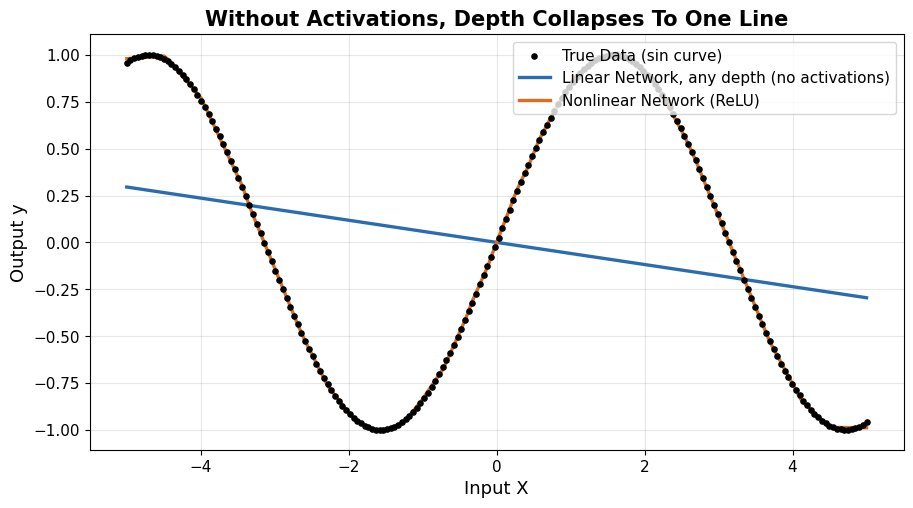
Figure 1: The collapse in practice: on sine-wave data, a network without activations (blue) fits nothing but a straight line regardless of depth, while the same architecture with ReLU activations (orange) tracks the true curve (black dots) almost perfectly.
Leave a Reply