
What actually causes attention collapse in ultra-deep Transformers with 100+ layers, uniform attention scores or rank degeneration, and how do register tokens, coupled attention, and SkipNet-style gated skipping address it?
Answer
Both phenomena are real, but they are not the same object and only one of them is the root cause. Rank degeneration is a property of the token matrix: after enough layers every row of  converges to the same vector, so the representation is effectively rank-1 and no head can distinguish positions any more. Uniform attention scores are one route to that state but not a requirement, because every softmax attention map is row-stochastic, and a product of row-stochastic matrices contracts any mean-zero component of the token set by the second-largest eigenvalue at each step, even when each individual map looks sharp and interpretable. Dong et al. proved the sharper version of this: pure self-attention without residual connections or MLPs loses rank doubly exponentially in depth, so the residual stream, the FFN nonlinearity, and the normalization placement are the load-bearing defenses that let 100-layer stacks exist at all. A third, opposite pathology is attention entropy collapse, where rows become nearly one-hot as the spectral norm of the query-key map grows; that destroys training stability rather than smoothing representations, and it is the failure that spectral reparameterization targets. Register tokens, cross-layer attention coupling, and gated layer skipping each attack a different factor of the product that drives the representation toward rank-1.
(1) Two Different Objects: entropy of the attention rows measures how a layer mixes, while the rank of measures what survives after mixing. A model can have healthy per-layer entropy and still be rank-collapsed at layer 90.
(2) Doubly Exponential Rank Loss: for attention-only stacks the distance to rank-1 obeys a cubic recursion, so it is numerically zero within a handful of layers, not after 100.
(3) Non-Uniform Attention Still Collapses: because  , the all-ones vector is always a fixed point, and repeated application contracts everything else toward the Perron eigenvector.
(4) The Opposite Failure Mode: entropy collapse to near one-hot rows correlates with exploding query-key spectral norm and produces loss spikes;  Reparam bounds it by spectral-normalizing the logit map with a learned scalar.
(5) Register Tokens: a handful of learnable non-content tokens (typically 4 to 16) give softmax a place to dump probability mass, so content rows are not forced to spread uniformly and the emergent high-norm artifact tokens disappear.
(6) Coupled Attention: adding the previous layer’s raw logits to the current layer’s logits means the effective attention is no longer a fresh independent stochastic matrix per layer, which preserves diversity and gives gradients a direct path across depth.
(7) Gated Skipping: a SkipNet-style gate that drops a block reduces the effective mixing depth below the nominal  , shortening the product of contraction factors and cutting sequential latency at the same time.
The reason a 100-layer Transformer is not already dead is that a residual block computes  rather than
  . In path-decomposition terms, the identity path carries the full-rank input straight through, and only paths that traverse many attention modules are strongly contracted. The FFN nonlinearity adds a second defense by increasing the Lipschitz constant of the layer map away from a pure average, which is why the empirical decay of the distance to rank-1 in a working model looks geometric with a factor close to 1 instead of doubly exponential. The remaining problem at extreme depth is that these defenses only slow the contraction: with a per-layer factor of 0.95, a 120-layer stack still retains only about 0.2% of the initial token spread, which shows up as flat similarity matrices, near-duplicate hidden states in the last third of the network, and layers whose removal barely changes the loss.

Figure 1: The two collapse modes are measured on different axes. Left: rank degeneration is catastrophic for attention-only stacks, already below  by layer 5, and merely slow once residuals and FFNs are present. Right: entropy can fail in either direction, drifting up toward the uniform limit
  (over-smoothing) or down toward zero (entropy collapse and loss spikes), and a healthy deep model must stay in the band between them.
Mathematical Formulation:


Where:
 is the token matrix at layer , with tokens of width , and is the total depth.
- is the distance to the nearest rank-1 matrix whose rows are all equal; is the all-ones vector and the common row it would collapse to.
- collects the head geometry, roughly , where and bound the value and query-key weight norms and is the head dimension.
- The cubic recursion compounds into a doubly exponential bound with exponent , which is why attention-only depth is hopeless while residual depth is merely expensive.
- is the row-stochastic attention map, so is always its eigenvector with eigenvalue 1, and is any mean-zero deviation across tokens, .
- is the second-largest eigenvalue modulus of , strictly less than 1 whenever all entries are positive; the surviving spread after layers scales like .
- is the entropy of attention row ; the upper bound is the uniform row (maximal mixing) and 0 is the one-hot row (entropy collapse).
 is the token matrix at layer
  , with
  tokens of width
  , and
, and  is the distance to the nearest rank-1 matrix whose rows are all equal;
  is the all-ones vector and
  the common row it would collapse to.
 collects the head geometry, roughly
  , where
  and
and  bound the value and query-key weight norms and
  is the head dimension.
 , which is why attention-only depth is hopeless while residual depth is merely expensive.
 is the row-stochastic attention map, so
  is any mean-zero deviation across tokens,
  .
. is the second-largest eigenvalue modulus of
  .
. is the entropy of attention row
  ; the upper bound
 Collapse Speed, Two Regimes:


The first line is the attention-only regime: five layers are enough to destroy the representation. The second is the realistic regime for a 120-layer residual stack with a mild per-layer contraction, and it is the number that motivates the three interventions. Register tokens change the geometry of each individual  so that content rows keep structure instead of hedging uniformly; the attention sink observed in decoder-only LLMs, where the first token absorbs a large share of the mass, is the same phenomenon arising without being designed. Coupled attention changes the product itself, since adding the previous layer’s logits makes consecutive maps correlated rather than independent draws. Gated skipping changes the number of factors in the product, and it also attacks a separate ultra-deep pathology: under Pre-LN the output variance grows with depth, so late blocks approach the identity and contribute almost nothing, which means paying their latency buys no capacity.

Figure 2: Three interventions at three different levels of the same product. Registers reshape each individual attention map, coupled attention correlates consecutive maps so the stack stops re-averaging from scratch, and the skip gate removes factors entirely by lowering the effective depth. The residual stream and FFN remain the baseline defense underneath all three.
| Property | Register tokens | Coupled attention | SkipNet-style gating |
|---|---|---|---|
| What it changes | The geometry of each single attention map | The correlation between consecutive maps | The number of maps in the product |
| Mechanism | Extra learnable non-content tokens absorb attention mass, so content rows need not spread uniformly | Pre-softmax logits of layer l minus 1 are added to layer l, giving a residual path through attention itself | A learned gate executes or bypasses a block per input, so effective depth is data dependent |
| Cost | Sequence grows to N plus R, so prefill cost grows quadratically in that length; registers are discarded at the head | Must retain the previous layer’s logit tensor, which is  activation memory per block activation memory per block | Gate parameters plus non-differentiable routing, usually trained with a straight-through or RL estimator |
| Where it fails | Cannot be bolted on after pretraining, and too many registers waste context without adding capacity | Incompatible with kernels that never materialize the score matrix, so it fights FlashAttention-style fusion | Ragged per-example depth hurts batched throughput, and gates can collapse to always-on or always-off |
| Diagnostic it fixes | High-norm artifact tokens and noisy attention maps | Entropy drifting toward the uniform limit in late layers | Late blocks that behave as the identity and can be pruned for free |


 is the SSM state at step
  ,
,  the layer input and
  the layer output;
  is the skip term.
 are the discretized transition, input, and output matrices. In a selective SSM they depend on the current token, which is what lets the layer decide what to keep and what to forget.
 is the input-dependent step size; a large
  overwrites the state with the new token, a small one carries the old state forward.
 is bytes per element (2 in fp16),
  the number of attention layers only,
  the KV heads under GQA, and
  the head dimension; the leading 2 counts keys and values.
 , namely
  ):
):


 are linear functions of the current token instead of fixed parameters, which turns the discretized decay
  into an input-dependent forget gate. That single change gives the model the ability to skip filler tokens and write informative ones into the state, but it destroys linear time invariance, so the layer can no longer be evaluated as one long FFT convolution and instead needs a hardware-aware parallel associative scan. On complexity the comparison is lopsided in Mamba’s favor: sequence mixing is
  instead of
  , and decoding needs a constant
  state rather than a KV cache that grows with context. On recall the comparison reverses, because a bounded state is a lossy summary of the past, so tasks that need verbatim retrieval of an arbitrary earlier span degrade in a way that attention’s exact, if expensive, cache does not.
 become projections of
  stays a learned diagonal matrix whose effective decay
  is nonetheless input-dependent.
 and the token is ignored, large
  toward zero and overwrites the state with the new input.
 in Mamba-1, so the quadratic attention term dominates once
  values per layer regardless of context length, versus
  for an MHA KV cache, which is what makes million-token streaming decode cheap.
 , would move far more bytes through HBM than the arithmetic justifies, so the reference implementation fuses discretization, scan, and readout into one kernel that keeps states in SRAM and recomputes them during the backward pass. The recall side has a cleaner theoretical story. Attention stores every key and value, so retrieving a specific earlier token is a lookup, whereas a selective SSM must have decided at write time to keep that token, and its


 is the hidden state held for one channel, so the full layer keeps
  indexes the sequence, and
  is the required initial condition.
 so every eigenvalue is negative and the discrete decay stays stable.
 are the low-rank projections that make the layer selective;
  is the simplified input term Mamba uses in place of the exact
  .
. depth.


 the wider Mamba block, which expands the channel dimension by 2, actually costs more than attention, because both are dominated by their projection matmuls. Above it the
  with
with  . That extra constant is exactly what you get by appending a virtual key with logit 0 and value vector 0, so the weights over real tokens now sum to
  , which is strictly below one, and a head that finds nothing relevant can emit the zero vector. Ordinary softmax has no such option, because its weights are forced to sum to one whether or not any key matches. Heads that want to be a no-op therefore learn to dump their leftover mass on a low-information token, usually the first token or a delimiter, and to inflate that token’s residual to enormous magnitude: the massive activations that dominate activation-quantization error and the artifact tokens that pollute ViT attention maps. The name refers to the denominator being off by one; the operational reading is that one unit of attention budget is subtracted from the real keys and parked in a null option that costs nothing to select.
 can go to zero without any token’s value vector having to be zero.
 for a per-head learned
  strictly generalizes Softmax-1, which is the
  special case.
 and the two are indistinguishable, so the modification only fires where the head has nothing to say.


 is the scaled dot-product logit for key
  is the ordinary denominator, so the added 1 is just
  : the virtual key’s exponentiated logit.
 is the total attention mass retained by real keys; the complement
  is the abstention share, and it is positive for every finite logit row.
 , the mass is a logistic gate whose half-way point sits at
  .
. is the head output; because
  can be near zero,
  is reachable without constraining any
  .
. , and where it lands depends on how many irrelevant keys exist, so a head calibrated at a 4k training length re-partitions its budget when the context reaches 32k; the model compensates by pinning a token whose residual magnitude was tuned at the training length, and Sun et al. measured such coordinates in the thousands while the median activation sits near 0.1. Second, that sink is a KV slot, not an architectural constant. StreamingLLM showed the consequence directly: evict the first few tokens from a sliding window and perplexity explodes, while pinning four sink tokens keeps generation stable out to millions of tokens. Softmax-1 turns the sink into a term of the denominator that no eviction policy can delete, which is why windowed and extrapolated decoding stop depending on cache bookkeeping. The honest caveat is visible in the uniform-logit identity above: the abstention gate is absolute but its threshold still drifts as
  , so pushing a head to stay quiet across a 256x context increase costs about 5.5 nats of logit headroom, which is precisely why deployed variants learn
 , so a head that abstains comfortably at 512 keys leaks over half its budget at 131k unless it lowers its logits by about 5.5 nats, which is the argument for a learned sink logit rather than a hard-coded 1.
 , strictly below 1
 keys. The size of each token’s receptive field is therefore itself a strictly monotone function of absolute position, and any head with near-uniform logits converts that count into a readable
  signal in the residual stream. Haviv et al. showed that absolute position can be linearly probed out of NoPE hidden states with high accuracy while perplexity stays close to models with explicit encodings, and Kazemnejad et al. proved constructively that a NoPE decoder can represent both absolute and relative position, and that it length-generalizes at least as well as RoPE or ALiBi on small-scale algorithmic tasks.
 for any permutation
  , but the causal mask satisfies
  , which is exactly the asymmetry the model exploits.
 -token window puts
  .
. , so the counting code loses discriminative power long before the context window ends.
 term can compute
 under causal masking but a constant
  under bidirectional attention, so the same uniform head produces a strictly decreasing code in one case and a flat, uninformative constant in the other.


 is the attention output at query position
  the attention weight it places on key position
  .
. are the query, key, and value vectors, containing no positional term at all under NoPE.
 index only the unmasked keys; the second line is the causal mask, which is the sole source of order sensitivity.
 for
for  and a nonzero anchor value
  at BOS.
 , showing that absolute position is exactly recoverable from a single layer’s output norm.
 the input sequence,
  an unmasked layer, and
  the lower-triangular mask; the last two lines state why encoders need explicit position encodings and causal decoders do not.
 , a relative spacing of only
  , so the code that cleanly distinguishes position
  around token 126 and near
  around token 1022. Under bf16 activations those differences sit at the edge of machine epsilon, and the second pressure is entropic: uniform attention over a growing window has entropy
  , so a head calibrated to be discriminative at 2K tokens is comparatively diffuse at 32K. Real models do not use the naive counting head alone, but both effects push in the same direction, which is why raw NoPE degrades past its training length while RoPE offers explicit rescaling recipes such as NTK interpolation and YaRN.
 , so the same attention temperature that is sharp at 2K is diffuse at 32K.


 is the FVD value, with
  and
and  the mean and covariance of real and generated clip features from a fixed video backbone; it is defined only over sets, which is the root of its uselessness for per-clip physics.
 is the tracked height of an object at time
  and
and  the least-squares acceleration recovered from the generated clip;
  is its relative error against the reference
  .
. and
and  are total momentum immediately before and after a contact frame, so
  is the relative momentum violation; the same construction on kinetic energy exposes a restitution above 1.
 is the number of authored occlusion events and
  the number where the object reappears with correct identity, count, and attributes, giving the permanence recovery rate
  .
. is backward warping by the estimated flow
  ,
,  the binary validity mask that removes occluded and out-of-frame pixels,
  elementwise product, and
  the averaged warp error over the
  frames.
 are the physical-commonsense and semantic-adherence verdicts on clip
  is the joint pass rate: a clip counts only if it is both on-prompt and physically plausible.
 , otherwise stretched material still renders as undeformed blobs.
 in substeps and particles, and gradients through contact and friction are non-smooth, so checkpointing and softened contact models are mandatory.
 its appearance basis must be rotated too, otherwise highlights stay welded to the world frame while the geometry turns. Second, lighting is baked, so shadows and specular reflections do not respond to motion, which biases the photometric gradient exactly on the frames where an object moves most.


 is the rendered color of ray
  , accumulated over
  ; this same alpha-compositing form covers NeRF quadrature and Gaussian splatting.
 is density,
  the sample spacing along the ray,
  the resulting opacity, and
  the transmittance reaching sample
  is a splat’s covariance, parameterized by rotation
  indexes particles,
  is the flow map from rest to time
  is the deformation gradient whose determinant gives local volume change.
 is the full simulator state (positions, velocities,
  one differentiable substep.
 collects the unknown physical parameters such as Young’s modulus
  , Poisson ratio
  , density
  , yield stress, and friction coefficient.
 is the differentiable renderer and
  the observed frame, so
  is a multi-frame photometric residual and its gradient is a product of per-substep Jacobians.
 , truncating the loss window to a handful of frames, and recomputing forward segments during the backward pass. Numerically, the same product of Jacobians makes gradients explode for stiff materials and vanish once the trajectory has been dissipated by friction, which is why practitioners fit a log-parameterized stiffness and soften contact before trusting any gradient at all.
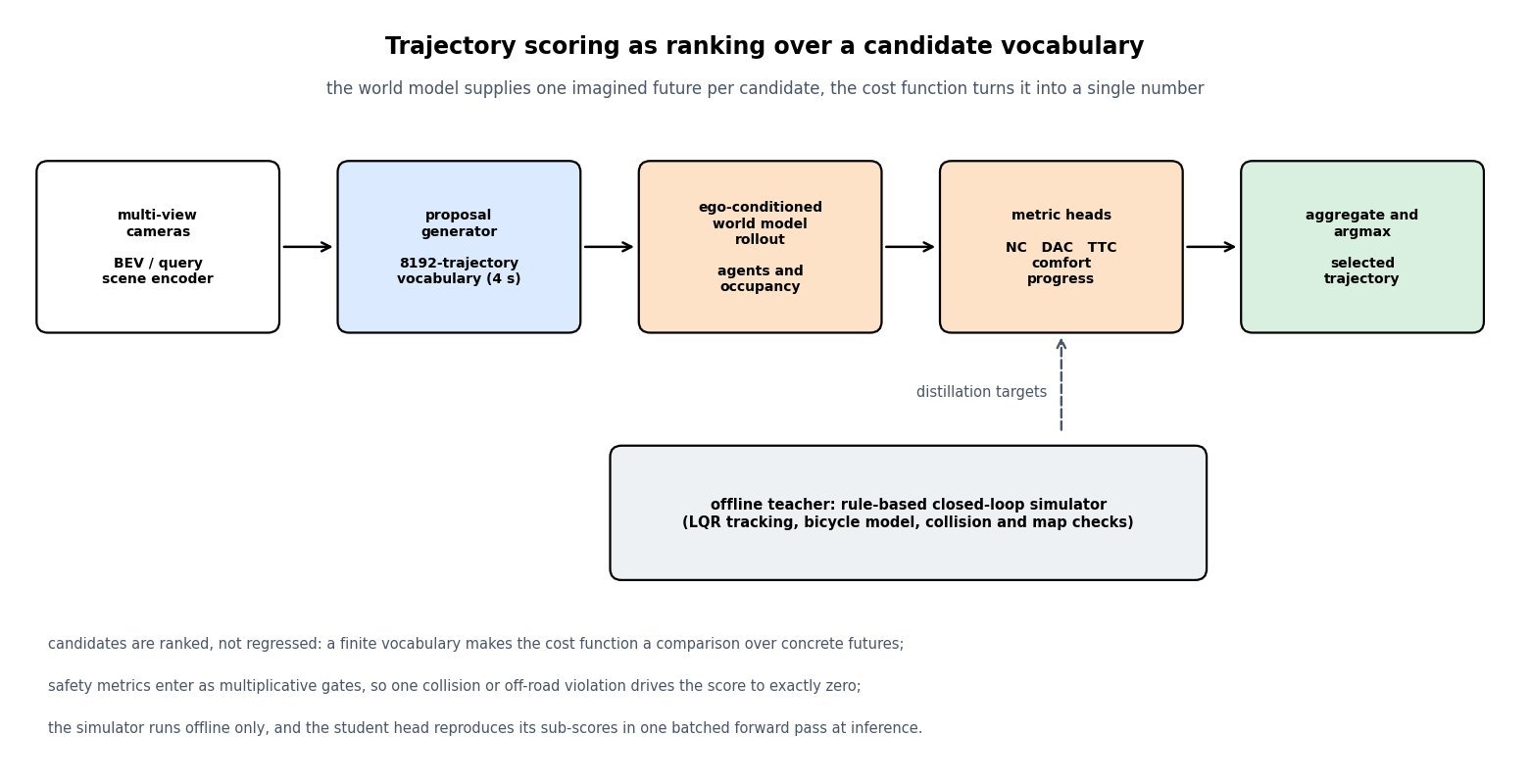


 is the executed trajectory and
  the candidate vocabulary, typically a few thousand clustered 4-second trajectories sampled at 10 Hz.
 is the sensor history,
  the ego-conditioned world model, and
  the imagined future over horizon
  under that specific
  .
. extracts metric
  is its value, bounded to the unit interval so that scores are comparable across scenes.
 are the gate metrics (no at-fault collision, drivable-area compliance) whose product
  vetoes a candidate outright.
 are the weights of the soft metrics (time-to-collision, comfort, ego progress) aggregated by
  , which only re-ranks candidates that passed every gate.


 perspective images, each of which has thrown away the depth of every pixel, into a single metric grid in the ego frame where one cell always means the same physical patch of ground. Every method must invent the missing depth, and the two families differ only in which direction they move information. Forward projection, introduced by Lift-Splat-Shoot (LSS), predicts a categorical depth distribution per pixel, lifts each pixel into a frustum of
  feature map at roughly 0.5 m resolution, which is why detection, map segmentation, occupancy and planning heads can be shared, and both add temporal fusion by warping the previous BEV feature into the current ego frame before merging.
 and the camera-to-ego rigid transform are exactly known, so the only unknown is the scalar range along each ray.
 over
over  by the ego pose delta and fusing it into
  is what makes velocity estimation and short-occlusion memory possible from cameras alone.
 with LiDAR-projected depth, rather than letting the detection loss shape it, is the single largest quality lever for the forward family.
 does not pick one depth; it spreads that feature over all


 is the BEV feature at grid cell
  in the ego frame, and
  is the set of frustum points whose ego coordinates fall inside that pillar.
 is the homogeneous pixel coordinate,
  the camera intrinsic matrix, and
  the camera-to-ego extrinsic rotation and translation.
 over a fixed range such as 1 m to 60 m in 1 m steps, giving
  .
. and
and  its context feature, so
  is the outer-product lift.
 anchor heights along a vertical pillar, each anchor is projected into every camera, and only the cameras whose image plane actually contains the projection contribute. Deformable attention then samples a handful of learned offsets around each projected location, so cost scales with the number of queries rather than with image resolution times depth bins, and a query near a lane boundary can shift its sampling points to where the evidence is instead of trusting a predicted depth. The trade-off is that the geometry is now an attention prior rather than a hard constraint: if extrinsics are wrong, the network can still learn to compensate, which is convenient during training and dangerous during deployment because the failure is silent.


 is the cross-attention output written into BEV cell
  is the learned query plus its 2D positional encoding.
 is the
  , with
  a common choice spanning roughly -5 m to 3 m.
 is the full projection of camera
  is a sub-pixel image location and
  the multi-scale feature map of that camera.
 is the set of cameras whose frustum contains at least one anchor, so the average is taken only over hit views and empty views contribute nothing.
 is deformable attention, which samples a few learned offsets around


 and must reconstruct that same topology inside its latent on every frame, which is statistically much harder but works on roads nobody has surveyed. The practical result is a swap of error sources rather than a strict improvement: the map-based system inherits map staleness and localization error, the mapless system inherits data hunger and weaker long-horizon geometric consistency.
 with an extra exogenous input, while mapless factorizes as
  and must carry topology in the recurrent state.


 is the latent scene state produced by encoder
  from the observation window
  the true ego pose,
  the estimate produced by localization, and
  the operator that crops and transforms
  is localization error. It is not observation noise: it rigidly shifts the entire conditioning input, so a 0.5 m lateral bias moves every lane boundary by 0.5 m.
 is the candidate ego action, which is what makes both models action-conditioned and therefore usable for planning rather than passive video prediction.
 are the two parameter sets;
  the per-step loss, typically reconstruction plus a KL or diffusion denoising term.