
What is Structure from Motion (SfM), and how do deep learning models such as DUSt3R, MASt3R, and VGGT replace traditional keypoint matching and bundle adjustment pipelines?
Answer
Structure from Motion is the problem of recovering both the 3D geometry of a scene (structure) and the camera poses that observed it (motion) from a set of unordered 2D images, up to a global similarity transform. The classical solution is a long pipeline of separately engineered stages: detect keypoints, match descriptors across image pairs, reject outliers with RANSAC on an epipolar constraint, register cameras incrementally with PnP and triangulation, and finally run bundle adjustment, a sparse nonlinear least-squares refinement of all cameras and points against reprojection error. The learned replacements collapse that chain into a regression problem. DUSt3R takes two uncalibrated images and directly predicts dense pointmaps, one 3D point per pixel for both images expressed in the coordinate frame of the first camera, so depth, intrinsics, and relative pose fall out of the output instead of being estimated by geometry. MASt3R adds a dense local-feature head so the same network also emits pixel-accurate correspondences, and VGGT generalizes the idea to many views at once, returning cameras, depth maps, pointmaps, and point tracks for tens or hundreds of frames in a single forward pass with no optimization loop at inference time.
(1) What SfM Actually Solves: recover camera intrinsics and extrinsics plus scene points from images alone, with scale unobservable without an external reference. Everything downstream (MVS, SLAM, NeRF, Gaussian splatting) depends on those poses.
(2) The Classical Chain Is Brittle At Its Joints: keypoints → matching → RANSAC → incremental registration → bundle adjustment. Each stage discards information, and a failure at the front (textureless walls, repeated facades, tiny baselines) cannot be recovered later.
(3) Pointmap Regression Replaces Triangulation: DUSt3R regresses  and
and  in one shared frame, so the network solves calibration, depth, and relative pose jointly instead of chaining three estimators.
(4) MASt3R Restores Pixel-Level Precision: a 24-dimensional dense descriptor head trained with an InfoNCE matching loss plus fast reciprocal matching gives sub-pixel correspondences that pure 3D regression blurs, and MASt3R-SfM builds a full reconstruction pipeline on top with no RANSAC.
(5) VGGT Removes The Optimizer: alternating frame-wise and global self-attention over all views, with camera and register tokens, yields cameras, depth, pointmaps, and tracks feed-forward in seconds. Bundle adjustment becomes an optional post-hoc refinement rather than the core algorithm.
(6) The Trade-off Is Priors Versus Guarantees: learned models succeed where geometry is degenerate (near-zero baseline, no texture, minimal overlap) but their accuracy is bounded by training data, output is up to scale, and global attention is quadratic in total token count.
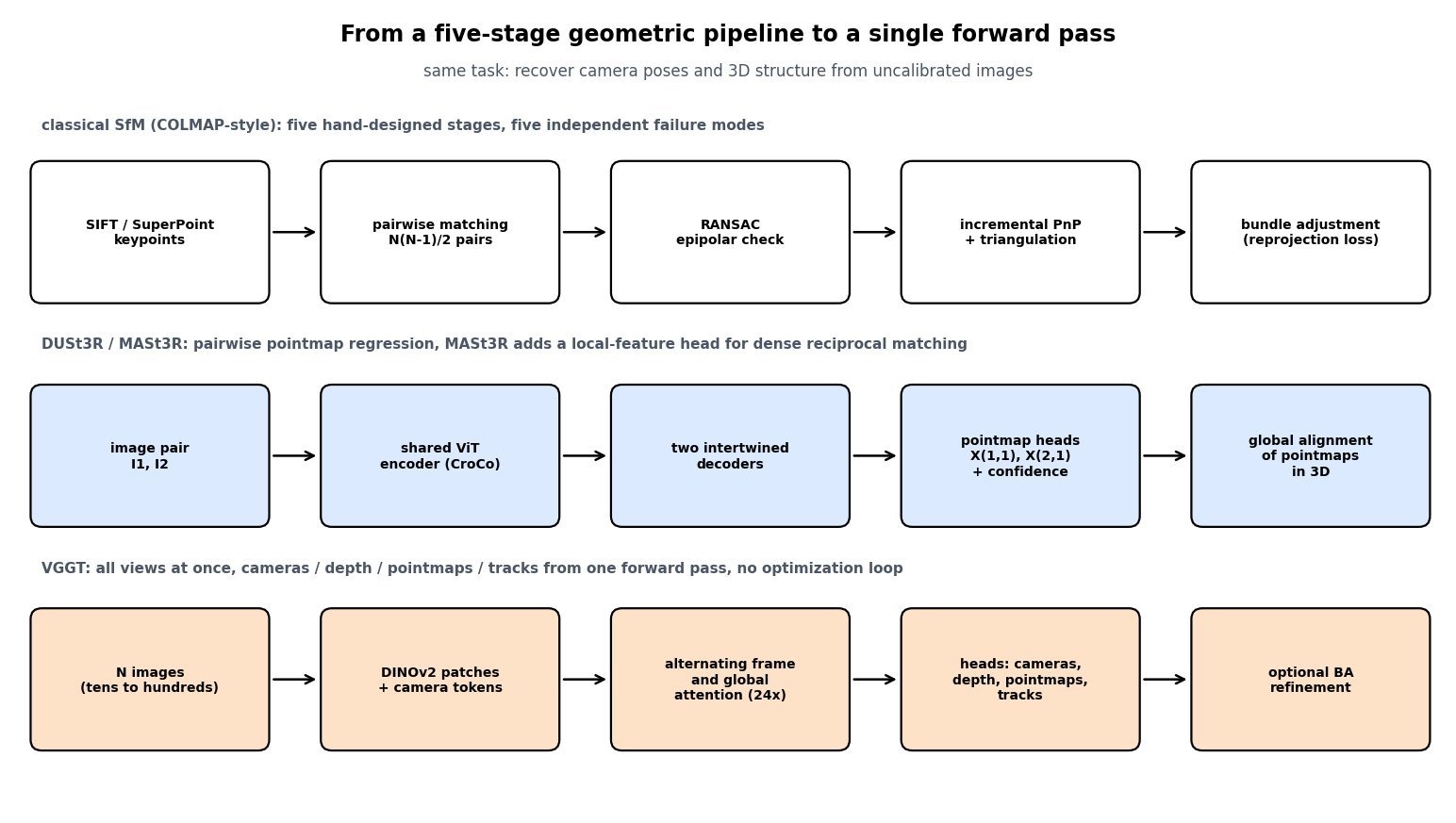
Figure 1: The same task, three levels of learned integration. The classical row has five hand-designed stages with five distinct failure modes; DUSt3R keeps only a lightweight 3D global alignment over pairwise predictions; VGGT keeps nothing optimization-based at all, and bundle adjustment survives only as an optional refinement.
The conceptual pivot is the pointmap. A depth map is defined only relative to its own camera, so combining two of them requires knowing intrinsics and relative pose first. A pointmap for image  expressed in the frame of camera 1, written
  , already lives in a shared space. Once both images are mapped into that space, the classical unknowns are read out rather than solved for: focal length comes from fitting a pinhole model to the ray field of , relative pose comes from Procrustes alignment or PnP between and camera 2’s own rays, and correspondence becomes a nearest-neighbour query in 3D rather than a descriptor comparison. That is why DUSt3R needs neither intrinsics nor an initial pose guess, and why it degrades gracefully instead of failing outright when overlap is small.
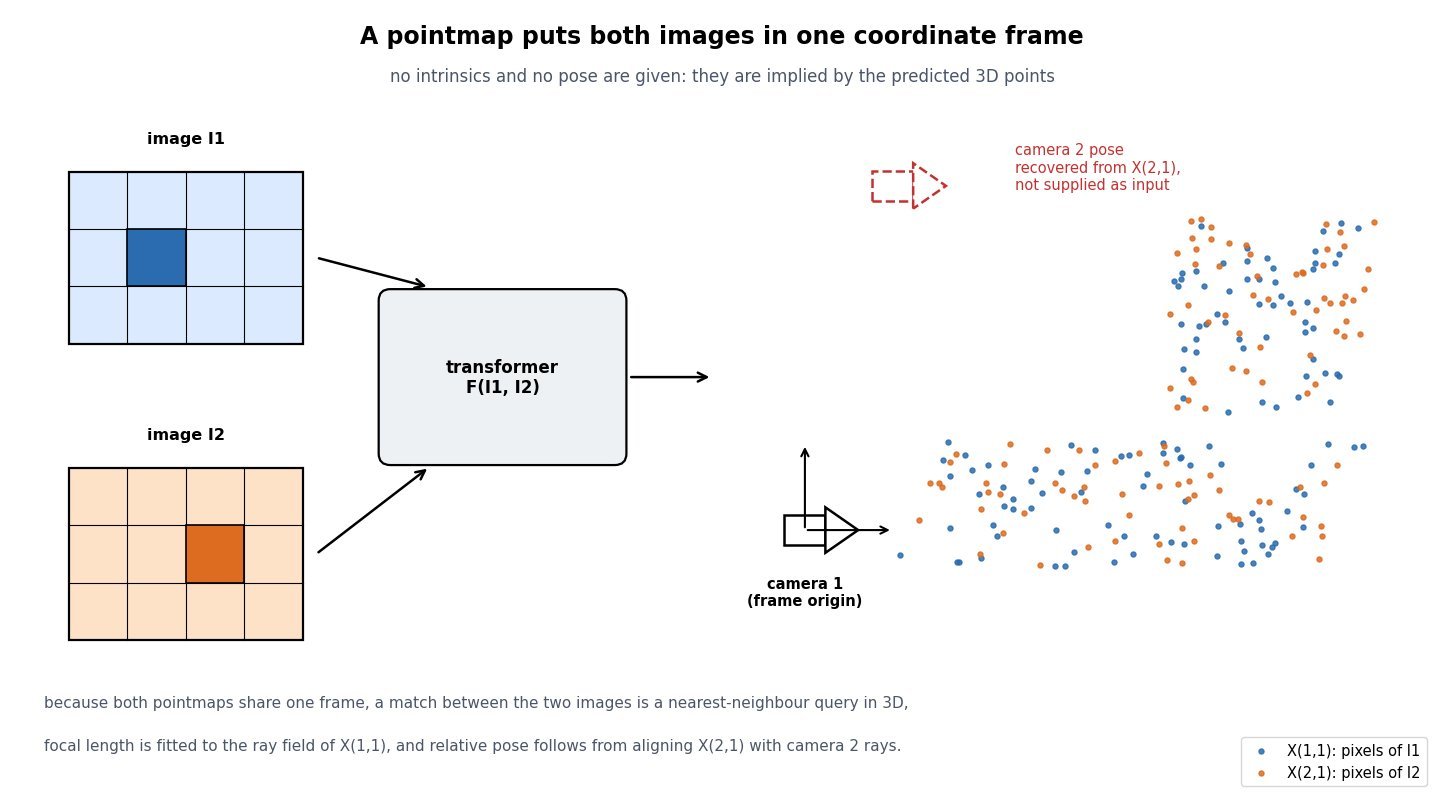
Figure 2: Both pointmaps are regressed in one coordinate frame, the frame of camera 1. Because pixels of  land directly in that frame, the relative pose is implied by the output rather than required as input, and a match between the two images is just a pair of nearby 3D points.
Classical Objective (Bundle Adjustment):


Where:
 is the total reprojection error, minimized over cameras and points jointly by Levenberg-Marquardt with a Schur-complement trick on the sparse normal equations.
- is a triangulated scene point and the 2D keypoint where camera observed it.
- is the visibility set, that is the surviving inlier matches; every match RANSAC rejected is simply absent, so the objective can only refine, never repair, the front end.
- are the intrinsics, rotation, and translation of camera , all unknown and all coupled through the same residuals.
 is the total reprojection error, minimized over cameras and points jointly by Levenberg-Marquardt with a Schur-complement trick on the sparse normal equations.
 is a triangulated scene point and
  the 2D keypoint where camera
  observed it.
 is the visibility set, that is the surviving inlier matches; every match RANSAC rejected is simply absent, so the objective can only refine, never repair, the front end.
 are the intrinsics, rotation, and translation of camera
 Learned Objective (DUSt3R Pointmap Regression):


Where:
- is the transformer that consumes the raw pair with no camera parameters, built from a shared ViT encoder and two decoders that exchange information by cross-attention.
- is the pointmap of view in the frame of camera 1, so is what encodes the relative pose, and is the per-pixel confidence.
- indexes valid pixels, is the ground-truth point, and are scale normalizers (mean distance to the origin) that make the loss scale-invariant.
- weights the log-confidence regularizer, letting the network downweight sky, transparent surfaces, and non-overlapping regions instead of hallucinating them with full certainty.
- Multi-view reconstruction then optimizes a 3D alignment loss over a graph of pairwise predictions, not a reprojection loss, which is why the global step takes seconds rather than the minutes a full bundle adjustment needs.
 is the transformer that consumes the raw pair with no camera parameters, built from a shared ViT encoder and two decoders that exchange information by cross-attention.
 is the per-pixel confidence.
 is the ground-truth point, and
  are scale normalizers (mean distance to the origin) that make the loss scale-invariant.
 weights the log-confidence regularizer, letting the network downweight sky, transparent surfaces, and non-overlapping regions instead of hallucinating them with full certainty.
VGGT changes the scaling story. Instead of predicting pairs and stitching them, it patchifies all  frames with a DINOv2 backbone, appends per-frame camera tokens and register tokens, and then alternates two attention types for 24 blocks: frame-wise attention that reasons within one image, and global attention that reasons across every token of every image. The first frame’s camera token is given a distinct embedding, which is how the network fixes the output coordinate frame to camera 1 without any positional trick. Heads then decode a 9-dimensional camera parametrization (rotation quaternion, translation, field of view), a DPT depth map, a pointmap, and dense tracking features, all supervised directly.
Feed-Forward Multi-View Prediction (VGGT):


Where:
- holds camera ‘s pose and intrinsics, its depth map, its pointmap, and its tracking features, all produced in one forward pass.
- is the token count per frame at 518-pixel input with 14-pixel patches, and the total sequence length that global attention must span.
- is the model width; alternating the cheap frame-wise term with the expensive global term is what keeps hundreds of views tractable, and the quadratic global term is what eventually exhausts GPU memory.
 holds camera
  its depth map,
  its pointmap, and
  its tracking features, all produced in one forward pass.
 is the token count per frame at 518-pixel input with 14-pixel patches, and
  the total sequence length that global attention must span.
 is the model width; alternating the cheap frame-wise term with the expensive global term is what keeps hundreds of views tractable, and the quadratic global term is what eventually exhausts GPU memory.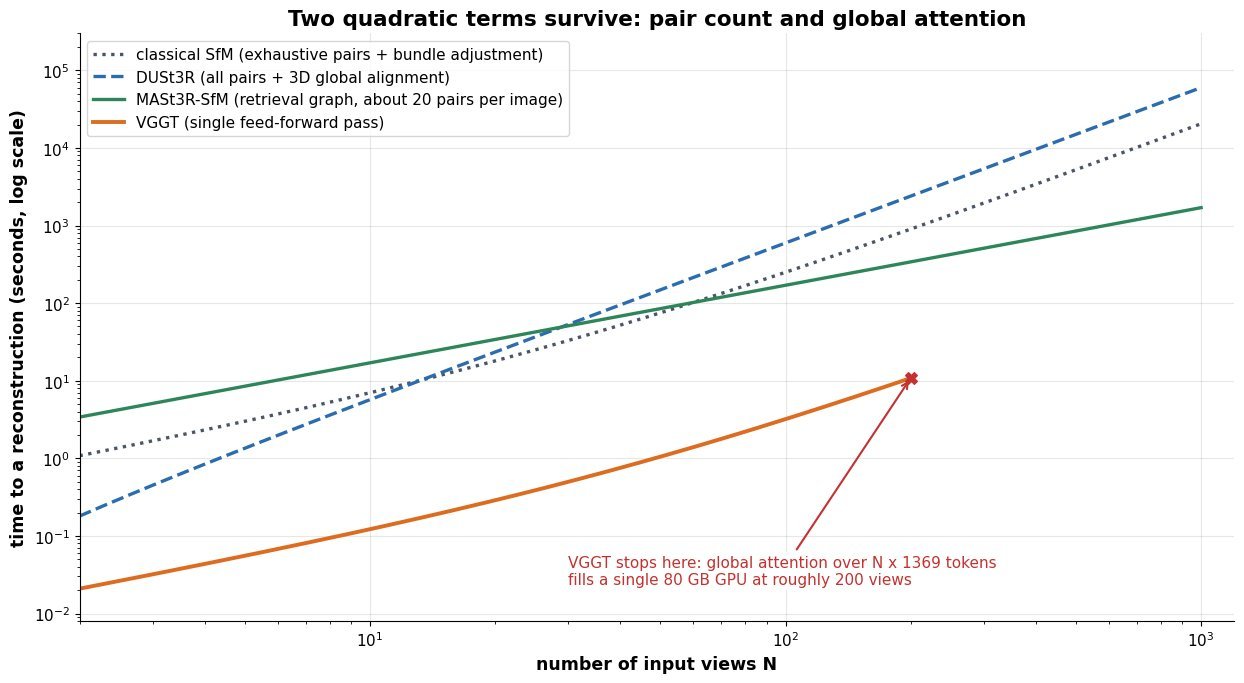
Figure 3: Feed-forward inference wins by orders of magnitude at small and medium view counts, but two quadratic terms remain in the field: exhaustive pairing (which retrieval-based graphs in MASt3R-SfM sparsify to roughly  pairs) and global attention (which sets VGGT’s memory ceiling). VGGT timings follow the published single-GPU measurements; the other curves are illustrative scaling.
| Property | Classical SfM (COLMAP-style) | DUSt3R / MASt3R | VGGT |
|---|---|---|---|
| Required input | Images, ideally with EXIF focal priors and good overlap | An uncalibrated image pair, no intrinsics, no pose init | One to hundreds of uncalibrated, unordered images |
| Core computation | Descriptor matching, RANSAC, and nonlinear least squares | Pairwise transformer inference plus a 3D global alignment | A single forward pass of alternating frame and global attention |
| Correspondence source | Explicit keypoint descriptors with geometric verification | Nearest neighbours in 3D, plus a dense descriptor head in MASt3R | A tracking head over global features, no matching stage |
| Scaling in views | Quadratic pairing, plus repeated bundle adjustment as views register | Quadratic in pairs unless a retrieval graph sparsifies it | Quadratic in total tokens, memory-bound rather than time-bound |
| Dominant failure mode | Hard failure on textureless, repetitive, or low-baseline input | Drift when many pairwise predictions must be fused | Out-of-distribution scenes and a hard memory ceiling on view count |
| Metric scale | Up to scale unless a known baseline or GPS is supplied | Up to scale by construction (scale-normalized loss) | Up to scale, with scale partly inherited from training priors |
 prior boxes to every feature-map location and predicts four normalized deltas per prior, so a predicted box only exists relative to a tiled prior whose scales and aspect ratios were chosen in advance from dataset statistics. An anchor-free head has no prior: FCOS predicts the four positive distances from a location to the sides of the object it belongs to, while CornerNet and CenterNet predict heatmap peaks (two corners, or one center) plus a small size and offset regression read off at the peak. Because the reference disappears, the matching rule must change too, so IoU thresholds against priors are replaced by spatial containment plus a per-level size range, and modern detectors replace both with prediction-aware dynamic assignment. Training stability shifts rather than simply improving: anchor-free heads drop the unbounded log-space targets and the anchor hyperparameters, but they need centerness or IoU-aware quality weighting, per-level normalization of the distance targets, and an explicit tie-break for locations that fall inside two objects.
 priors per location cuts predictions per level by 9x, which changes the positive/negative ratio the loss has to survive.


 is the predicted box and
  the matched anchor, so the four deltas are undefined without an assignment step.
 are the anchor-based targets; the logarithm makes size ratios additive and keeps targets near zero when the prior already fits, but it is unbounded on both sides for a badly matched prior.
 is the image-space center of a feature location and
  its level stride, typically 8 up to 128 across P3 to P7.
 are the ground-truth corners; requiring all four of
  is exactly the point-in-box positive test that replaces the IoU threshold.
![c \in (0,1]](https://s0.wp.com/latex.php?latex=c+%5Cin+%280%2C1%5D&bg=ffffff&fg=000&s=2&c=20201002) is centerness, multiplied into the classification score at inference so boxes regressed from near an object border are down-ranked before NMS.
is centerness, multiplied into the classification score at inference so boxes regressed from near an object border are down-ranked before NMS. only if
  falls inside that level’s size interval
  , which is the anchor-free replacement for choosing anchor scales.


 and has no notion of object identity, so two touching cars collapse into a single connected “car” region. Instance segmentation does the opposite: it detects and masks each countable object separately with a confidence score, but it only covers thing classes, ignores amorphous stuff such as road, sky, and vegetation, and its masks may overlap each other or leave pixels uncovered. Panoptic segmentation is the union of the two: every pixel receives one pair
  of class plus instance id, stuff classes get a single segment with no id, things get one segment per object, and the output is a strict partition of the image with no overlaps and no unlabeled pixels except an explicit void region. Which formulation you pick follows the consumer of the output, not fashion. A planner that needs to count and track individual vehicles needs ids, whereas a free-space or sky-replacement module only needs a region mask.


 is a pixel,
  its class, and
  its instance id, which is undefined (shared) for stuff classes and unique per object for thing classes.
 is the
  its class, and
  its confidence; the
  masks are independent, so they may overlap and their union need not cover the image.
 ,
,  , and
, and  in PQ count segments, not pixels, with a ground-truth segment
  and a prediction
  matched when
  ; that threshold makes the matching provably unique because panoptic segments cannot overlap.
 is segmentation quality, the mean IoU of matched pairs, and
  is recognition quality, the F1 score over segments; PQ is reported per class and then averaged, and often split into
  and
and  .
. in mIoU counts pixels of class


 , so the model can only ever emit one of the
  over
over  rows; Grounding DINO scores each query against each text token and applies a sigmoid per pair, so categories do not compete for a shared probability mass.
 ; on the right it is a string that enters the network beside the pixels, so language influences which regions are proposed at all, not only how a finished proposal is labeled.
 and GIoU box terms. The payoff is that a Swin-T model reaches about 48.4 AP zero-shot on COCO without seeing a single COCO image, and roughly 27 AP on LVIS minival where the long tail is exactly what a fixed 80-way head cannot express.


 is the closed-set posterior for RoI
  is its pooled RoIAlign feature; the row count of
  is the
  ) and
) and  is the
  is the sigmoid, so every region-token pair is an independent binary decision; nothing forces the scores of a query to sum to one across the prompt.
 is the phrase-level score obtained by taking the maximum over that phrase’s tokens.
 and
and  with
with  BERT sub-word tokens, which is the hard cap on how large a prompt vocabulary can be in one forward pass.
 is not normalized across phrases, a single global confidence threshold that is right for “person” is usually wrong for “loose cable”, so production systems keep a per-phrase threshold table. The common industrial pattern is not to serve the open-vocabulary model at all: use it plus a segmenter as an auto-labeler to bootstrap a dataset, then train or distill a fast closed-set detector for the frames-per-second and cost envelope the product actually needs.
 patch tokens, and emits a single image embedding of shape
  that is computed once and cached. A tiny prompt encoder maps whatever the user supplies (clicks, a box, a coarse mask, text) into 256-dimensional tokens, and a two-block two-way cross-attention mask decoder reads the cached embedding together with those tokens to produce three mask logits plus three predicted IoU scores in roughly 50 ms. Generalization to unseen categories comes from the task definition rather than from any category machinery: the objective is “return a valid mask for this prompt”, there is no classification head and no fixed label set, so the model only ever learns a geometry-to-region mapping, supervised by 1.1B masks over 11M images (SA-1B) that a model-in-the-loop data engine collected without class labels. The one thing a category-free interface cannot resolve is ambiguity, and SAM handles it by predicting three nested candidates and back-propagating only the lowest-loss one.
 point grid with NMS and stability filtering. Ambiguity is the residual difficulty. A single click on a shirt pocket is consistent with the pocket, the shirt, and the person, so a single-output model trained with an averaged loss learns a blurred compromise. SAM emits three masks and only the one with the lowest loss receives gradient, which forces the three slots to specialize by scale.


 is the cached image embedding,
  the ViT-H encoder applied to the 1024×1024 image
  , and
, and  an optional coarse mask prompt whose convolutional embedding is added elementwise.
 is the token for sparse prompt
  of its coordinates plus a learned embedding
  for foreground point, background point, box corner, or text.
 prompt tokens plus three learned mask tokens
  and one IoU token
  .
. is the updated image feature map and
  the updated tokens after two blocks of two-way cross-attention;
  is a pair of transposed convolutions giving a
  map.
map. is mask
  with every spatial location of
  , then bilinearly resized to 1024×1024.
 and
and  are combined in a 20:1 ratio, and only the argmin slot receives gradient; the IoU head is trained separately with an MSE loss against the realized IoU.


 tokens, while the decoder is linear in the
  tokens it carries, which is why 32 clicks cost 1.75 s with caching but 6.4 s if the ViT is re-run each time. Automatic mask generation exploits the same asymmetry: a
 bits (10 to 18 in practice), while a continuous patch vector carries roughly
  bits of activation, three orders of magnitude more.
 is non-differentiable, so VQ needs a straight-through estimator plus codebook and commitment losses, whereas continuous encoders train by plain backpropagation.
 -normalized codes, dead-code re-initialization, and an entropy bonus on the assignment distribution. Continuous encoders have none of this machinery, but they also cannot be sampled from, since there is no distribution over
  that a softmax can express, which is precisely why continuous-latent generation requires a diffusion or flow model rather than a token classifier.


 is the input image,
  the encoder, and
  one continuous patch vector from the encoder grid; keeping
  and stopping here is the continuous path.
 for
for  are the learned codebook vectors,
  is the quantized vector fed to the decoder
  , and the residual
  is information the model can never recover.
 is the stop-gradient operator and
  (typically
  ) weights the commitment loss that pulls encoder outputs toward their assigned codes.
 ; only the reconstruction term survives in a plain VQ-VAE.


 compresses the image to 256 ids of 14 bits each, about 448 bytes, while a ViT-L/14 tower keeps 256 patch vectors of 1024 bf16 activations, about 512 KiB. That ratio is the whole argument: it is why a discrete sequence is short enough to model autoregressively alongside text, and equally why an OCR-heavy or chart-reading task should not be routed through it.
 entries because of codebook collapse, whereas lookup-free and FSQ-style quantizers keep scaling toward the continuous-latent floor.
 , so the difference is not the objective but the distribution the training pairs are drawn from. Offline DPO consumes a dataset collected once from some behavior policy, which makes it a purely supervised procedure: four log-probability forward passes per pair, no decoding, and reference log-probs that can be cached before training starts. Online DPO decodes two fresh completions from the current policy at every step, has them ranked by a preference oracle (reward model, LLM judge, or human), and applies the DPO gradient to that on-policy pair, so the data distribution moves as the model moves. The generalization gap follows directly from this. DPO’s derivation only pins the implicit reward down where the data has support, and a frozen dataset’s support stops moving while the policy keeps drifting, so on unfamiliar prompts the model is being shaped by an extrapolated reward that no label ever corrected. On-policy sampling forces the coverage mismatch back toward 1 by construction, so the KL-regularized objective is enforced exactly at the responses the model will actually emit.
 from a fixed
  while online draws them from
  and labels them on the fly.


![\mathcal{L}(\theta) = -\mathbb{E}\left[\log \sigma(\Delta)\right]](https://s0.wp.com/latex.php?latex=%5Cmathcal%7BL%7D%28%5Ctheta%29+%3D+-%5Cmathbb%7BE%7D%5Cleft%5B%5Clog+%5Csigma%28%5CDelta%29%5Cright%5D&bg=ffffff&fg=000&s=3&c=20201002)


 is the implicit reward that DPO optimizes in place of an explicit reward model, and
  .
. the preferred completion,
  the rejected one, and
  their implicit-reward margin.
 is the per-pair gradient weight: pairs the model already ranks correctly contribute almost nothing.
 is the contrastive direction.

 , the worst-case density ratio between the target policy and the data-collecting policy. On out-of-distribution prompts,
 from option token logits, which carries more information per comparison than a human click and lets you distil graded preference strength.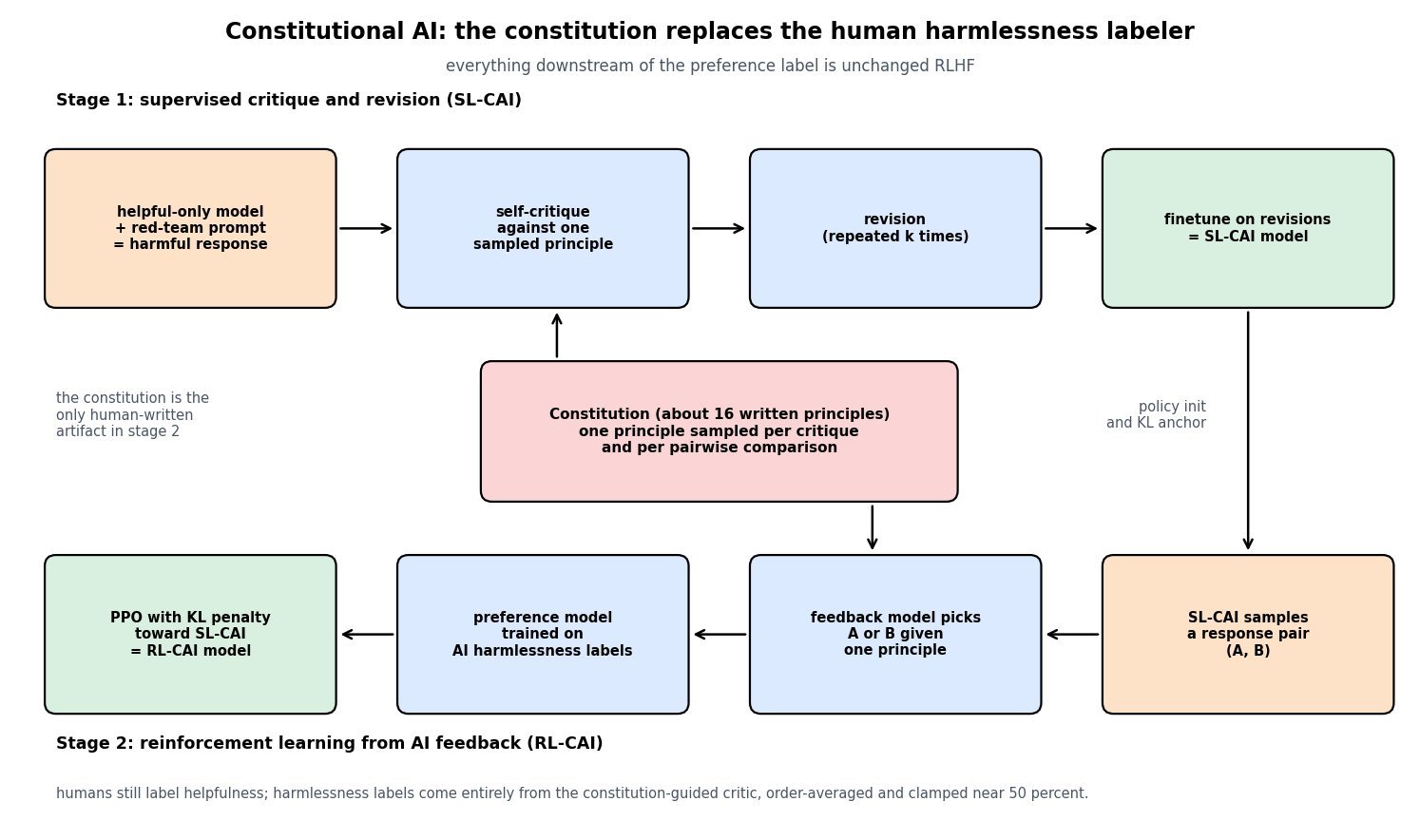


![J(\theta) = \mathbb{E}\left[r_\phi(x,y)\right] - \beta\,\mathrm{KL}\!\left(\pi_\theta \,\|\, \pi_{\mathrm{ref}}\right)](https://s0.wp.com/latex.php?latex=J%28%5Ctheta%29+%3D+%5Cmathbb%7BE%7D%5Cleft%5Br_%5Cphi%28x%2Cy%29%5Cright%5D+-+%5Cbeta%5C%2C%5Cmathrm%7BKL%7D%5C%21%5Cleft%28%5Cpi_%5Ctheta+%5C%2C%5C%7C%5C%2C+%5Cpi_%7B%5Cmathrm%7Bref%7D%7D%5Cright%29&bg=ffffff&fg=000&s=3&c=20201002)
 is the response after
  is the helpful-only model doing both the critique and the rewrite.
 is one principle sampled uniformly from the constitution
  , typically around 16 short written rules.
 and
and  are the critic’s logits for the option tokens of the multiple-choice question, and
  and
and  are the probabilities assigned to the same candidate under the two presentation orders, and
  is the order-debiased label actually stored.
 is the preference model,
  the standard Bradley-Terry loss, unchanged from RLHF.
 sets how far the policy may drift before the KL penalty dominates the reward.


 parameters in the attention projections and about
  in the MLP, so a fixed budget pins the product
  and the only remaining freedom is the aspect ratio
  . Cutting depth by 4x buys only 2x width, which is why the two axes are so asymmetric in practice. Depth buys serial computation: each layer is one more composition step, and multi-hop reasoning and compositional generalization improve with layers in a way that width cannot replicate. Width buys parallel capacity and hardware efficiency: larger GEMMs, higher arithmetic intensity, clean tensor-parallel sharding, and a smaller KV cache per token because the cache grows linearly in
  . Empirically the pretraining loss is remarkably insensitive to shape across the middle of the range, so the decision is usually settled by systems constraints rather than by quality. Depth is the axis that costs you latency and training stability, and width is the axis that costs you head redundancy, embedding budget, and eventual depth starvation.
 , so width is an expensive axis and depth is a cheap one. Doubling
  output-projection init, Pre-LN or DeepNet-style residual scaling, and they show more loss spikes and attention rank collapse.
 adds directly to time per token even though total FLOPs are unchanged.
 , which at a 128k vocabulary swamps a sub-billion model, so on-device work favors deep and thin shapes.
 , which is the whole trade-off in one picture: width is quadratically expensive, so moving from 64 layers to 16 layers pays for only a 2x wider residual stream. Real production shapes cluster in the middle band, roughly
  between 60 and 160.


 matches the same count).
 .
. is KV-cache bytes per token, with
  key-value heads, head dimension
  , and
, and  bytes per element. Under GQA with a fixed head count it is proportional to
  is per-token decode latency,
  the achievable HBM bandwidth, and
  the fixed serial cost per layer from kernel launches and collective synchronization.
 term is identical across shapes and only the


 in fp16, each layer stores 4 KiB per token, so the 64-layer shape carries 4x the KV cache of the 16-layer shape and supports a proportionally smaller batch at the same context length. On the latency side, a plausible tensor-parallel-8 deployment has roughly
  microseconds per layer once you count two all-reduces plus launch overhead, which turns depth into 2.56 ms of pure serial cost at 64 layers against 0.64 ms at 16 layers, on top of an identical weight-read term.

 FLOPs of arithmetic, so a batch of one runs at a tiny fraction of peak FLOPs and the GPU is idle waiting on memory. Adding sequences to the same forward pass reuses that single weight read for more tokens, so throughput climbs steeply until the KV-cache reads and finally the matmuls take over. Static batching’s effective batch size decays as its short members retire, so it spends most of its time in the low-intensity regime; continuous batching holds the batch near
  and stays in the high-intensity regime. Reported end-to-end gains follow from this: Orca measured up to 36.9x throughput over a static FasterTransformer baseline at matched latency, and vLLM measured a further 2x to 4x from paged memory alone.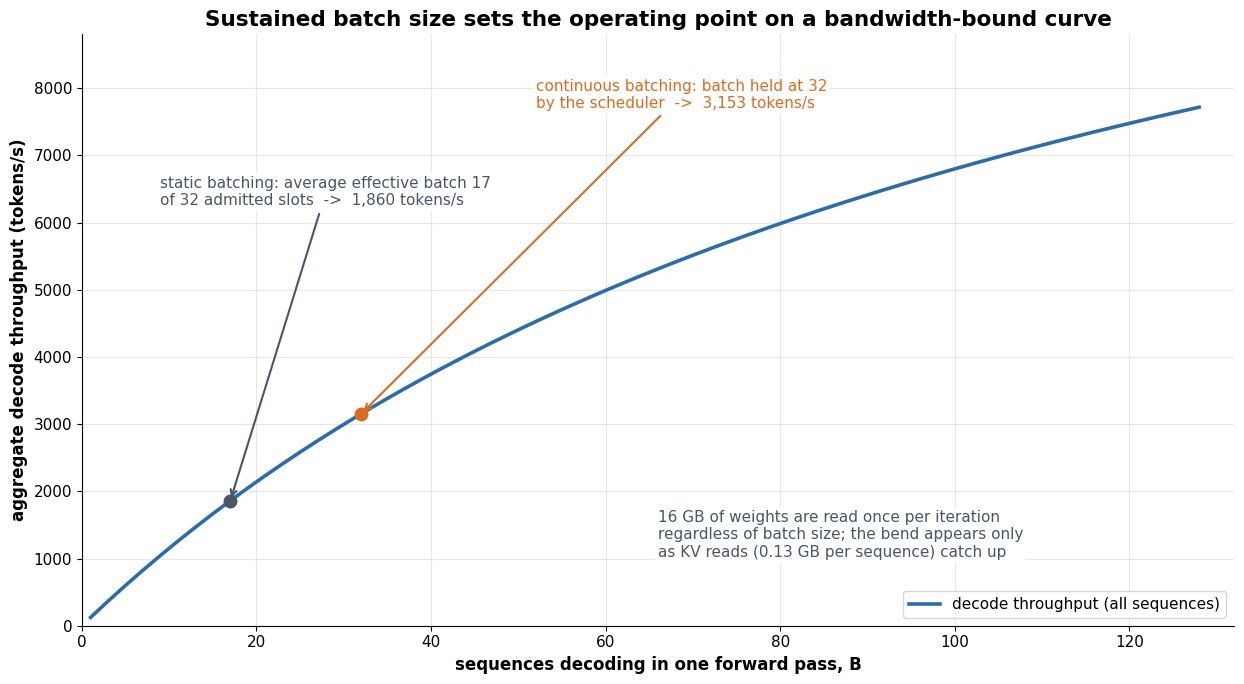


 is the fraction of batch slot-iterations that produce a token under static batching, with
  the output length of request
  ; it is exactly 1 only when all lengths are equal.
 is KV bytes per token, where
  is layers,
  key/value heads (small under GQA),
  head dimension,
  is achievable HBM bandwidth.
 is the mean context length in the running batch and
  is aggregate decode throughput in tokens per second; it is concave in
  is HBM left after weights and activations, so


 GB of KV, divided by 2000 GB/s. Nearly doubling the sustained batch costs only 11% more time per step and yields 1.7x the tokens per second, which is the whole economic case for iteration-level scheduling: the extra sequences ride along in memory traffic that was already being paid.