
How do you detect and mitigate bias in LLM outputs, and what pipeline of classifier scoring, threshold calibration, and mitigation strategies can be applied?
Answer
Bias is not a single scalar you can read off a model, so detection begins by fixing a measurement protocol rather than by picking a classifier. The standard construction is a counterfactual prompt set in which only a demographic token changes, several sampled generations per prompt under fixed decoding parameters, and a scorer ensemble that turns each generation into numbers (toxicity, regard, sentiment, stereotype agreement, refusal). The quantity that matters is then a gap between groups with a confidence interval, not an absolute score, because every scorer has an offset that cancels when you subtract. Only after the gaps are measured does thresholding enter, and a single global threshold is almost always wrong because the guard classifier has its own group-dependent error rates. Mitigation is a ladder from cheap and reversible to expensive and durable: system-prompt constraints, decode-time filtering with rewrite, preference tuning on paired data, and finally changes to the pretraining or SFT mixture. The hardest part in production is that the detector and the model must be evaluated together, since a biased guard silently converts fairness work into unequal censorship.
(1) Counterfactual Prompt Design: generate matched pairs where only the group term varies, so any score difference is attributable to that token rather than to topic or length.
(2) Scorer Ensemble, Not One Classifier: a toxicity head, a regard/sentiment head, a rubric-driven LLM judge, and a refusal detector disagree in useful ways; a single classifier both misses stereotype-without-toxicity and over-flags reclaimed language.
(3) Gaps With Uncertainty: report  with a bootstrap confidence interval per slice, because a 2-point gap on 40 prompts is noise and a 2-point gap on 4,000 prompts is a launch blocker.
(4) Threshold Calibration Per Slice: choose the operating point from a per-group FPR target on benign text, and record how far apart the group thresholds have to be; that distance is itself a bias metric of the guard.
(5) Mitigation Ladder: system prompt → decode-time filter and rewrite → counterfactual data augmentation and DPO → data-mixture change, in increasing cost, latency impact, and durability.
(6) Guard The Guard: toxicity classifiers show measured dialect bias, so evaluate the detector on group-labelled benign text before you trust any gate it powers.

Figure 1: The measurement half of the pipeline is online and the mitigation half is offline. The gate on the right acts on a single generation, while the aggregation block is the only place where a bias claim can legitimately be made, because bias lives in a distributional gap and not in any individual score.
Two implementation details decide whether the numbers mean anything. First, decoding must be frozen across the counterfactual arms: temperature, top-p, seed policy, and sample count identical, otherwise you are measuring sampling variance. Second, refusals must be scored separately. A model that answers a question about one group and declines the matched question about another has a large refusal-rate gap while showing a near-zero toxicity gap, and a pipeline that only tracks toxicity will report the model as clean. On the mitigation side, the same discipline applies in reverse: any intervention must be re-measured on the identical prompt set plus a general-capability suite, because prompt-level and decode-time fixes routinely buy a lower gap at the price of higher refusal on benign requests, which is a regression that no bias dashboard shows.
Mathematical Formulation:
![s = f_{\phi}(x, y) \in [0, 1]](https://s0.wp.com/latex.php?latex=s+%3D+f_%7B%5Cphi%7D%28x%2C+y%29+%5Cin+%5B0%2C+1%5D&bg=ffffff&fg=000&s=3&c=20201002)
![\Delta_{ab} = \mathbb{E}[s \mid g = a] - \mathbb{E}[s \mid g = b]](https://s0.wp.com/latex.php?latex=%5CDelta_%7Bab%7D+%3D+%5Cmathbb%7BE%7D%5Bs+%5Cmid+g+%3D+a%5D+-+%5Cmathbb%7BE%7D%5Bs+%5Cmid+g+%3D+b%5D&bg=ffffff&fg=000&s=3&c=20201002)


Where:
 is the scorer output for prompt and generation , produced by a guard classifier or judge with parameters that are separate from the model under test.
- is the group or slice label attached to the prompt (demographic term, dialect, language), and are the two arms of a counterfactual pair.
- is the group gap, the primary detection statistic; it is reported with a bootstrap interval over prompts, not over samples, since samples within a prompt are correlated.
- is the gate threshold and the tolerated false-flag rate on benign text, so is the smallest threshold meeting that budget within group .
- indexes confidence bins with items out of ; is the mean score and the empirical label rate, so ECE measures whether a score of 0.7 actually means 70% harmful.
 is the scorer output for prompt
  and generation
  , produced by a guard classifier or judge with parameters
  that are separate from the model under test.
 is the group or slice label attached to the prompt (demographic term, dialect, language), and
  are the two arms of a counterfactual pair.
 is the gate threshold and
  the tolerated false-flag rate on benign text, so
  is the smallest threshold meeting that budget within group
  indexes confidence bins with
  items out of
  ;
;  is the mean score and
  the empirical label rate, so ECE measures whether a score of 0.7 actually means 70% harmful.
Worked Calibration Example (5,000 benign sentences per group):


The same threshold of 0.50 therefore flags benign text from group  roughly four times as often, and equalizing the false-flag rate at
  requires thresholds 0.18 apart. That spread is the diagnostic: it says the guard classifier, not the generator, is the largest bias source in the stack, and the correct response is usually to fix the classifier’s training data rather than to ship group-conditional thresholds.

Figure 2: A single operating point produces two different error rates. Reading the gate at fixed threshold hides the disparity, while reading it at fixed false-flag rate exposes it as a horizontal distance between the two curves, which is the quantity to drive toward zero when you retrain the guard.
| Property | Prompt / system level | Decode-time filter and rewrite | Training-time (CDA, DPO) |
|---|---|---|---|
| Where it acts | Instruction and few-shot context, no weight change | Guard score on the sampled output, then re-sample or refuse | Weights, via augmented pairs or preference optimization |
| Cost to ship | Hours, revertible with a config push | One extra forward pass per output, plus rewrite latency on flags | Days of data work and a full eval cycle per iteration |
| Durability | Low, defeated by paraphrase and long context drift | Medium, bounded by the guard’s own recall and calibration | High, the behaviour itself moves rather than being masked |
| Dominant failure mode | Over-refusal on benign group-related questions | Inherits the classifier’s dialect bias, so filtering is unequal | Capability regression and reward hacking of the preference signal |
| What to measure after | Refusal-rate gap on benign prompts per slice | Per-group FPR at fixed threshold, plus added p95 latency | Counterfactual gap, general benchmarks, and win rate versus baseline |
 from the checkpoint at step
  on a fresh replica; if the spike does not reproduce, the batch is not the cause.
 can grow without bound; the softmax saturates, one head collapses onto a single position, and the gradient through that head becomes both tiny and extremely sharp. In parallel, the output logits drift so that
  wanders, which makes the cross-entropy surface stiff in a direction the optimizer cannot see from the loss value alone. Case A has a different mechanism: in bf16 or when optimizer state is stored in low precision, the Adam second moment for a rarely-activated parameter block (embeddings for rare tokens are the classic example) can decay toward the epsilon floor, after which one moderate gradient produces an update whose effective step size is orders of magnitude larger than intended. The debugging pipeline is therefore always the same: detect → localize → replay → mitigate, with instrumentation decided before the run rather than after the first spike.


 is the training loss at step
  , and
, and  and
and  are the mean and standard deviation over a trailing window of
  steps (a few hundred works well); this is the spike detector that should fire an alert, not a human eye on a dashboard.
 are the parameters,
  the scheduled learning rate, and
  and
and  the bias-corrected first and second Adam moments with decays
  and
and  .
. is the update ratio, the per-block quantity to log alongside the gradient norm, because it exposes the actual step size the optimizer is taking rather than the size of the gradient.
 is the ratio a single outlier gradient can produce, roughly
  for
for  and
and  ; this bound holds only while
  dominates
  , and it is epsilon underflow that breaks it.
 is the pre-softmax attention logit for query
  and key
  with head dimension
  ; tracking
  per layer is the earliest available warning of the creeping-divergence mode.
 is the softmax partition function over vocabulary size
  , and
, and  ) that pins
  bound is the reason “one weird document blew up the run” is usually wrong: with healthy second moments, Adam already damps a single 30x outlier gradient to less than a normal step. What actually hurts is a sequence of correlated large gradients, or a block whose
 , so padding a batch whose mean length is 27 tokens out to 128 burns roughly 79% of the tokens on
 . With three prefetching workers writing into pinned buffers, host work is fully hidden behind compute after an 18 ms warm-up and the GPU runs back to back. No kernel was made faster here; only the schedule changed.


 is the fraction of wall-clock time the GPU spends executing kernels, capped at 1, with
  for a blocking loop and
  for an overlapped prefetch pipeline.
 is per-batch host time (tokenize, collate, copy) and
  is per-batch device time for the forward, or forward plus backward when training.
 is the dominant FLOP count per batch with
  the batch size,
  the padded sequence length, and
  the hidden width; the
  term is attention and the
  term is the projections and feed-forward.
 is the fraction of computed tokens that are padding, with
  the mean true length and
  the padded length;
  term dominates.


 drops below

 , which is why a 200-prompt smoke test can never clear a production gate.

![\hat{e} = \frac{1}{N} \sum_{i=1}^{N} \mathbf{1}[ g(p_i) = s_i ]](https://s0.wp.com/latex.php?latex=%5Chat%7Be%7D+%3D+%5Cfrac%7B1%7D%7BN%7D+%5Csum_%7Bi%3D1%7D%5E%7BN%7D+%5Cmathbf%7B1%7D%5B+g%28p_i%29+%3D+s_i+%5D&bg=ffffff&fg=000&s=3&c=20201002)

![\Pr[M(D) \in S] \leq e^{\epsilon} \Pr[M(D') \in S] + \delta](https://s0.wp.com/latex.php?latex=%5CPr%5BM%28D%29+%5Cin+S%5D+%5Cleq+e%5E%7B%5Cepsilon%7D+%5CPr%5BM%28D%27%29+%5Cin+S%5D+%2B+%5Cdelta&bg=ffffff&fg=000&s=3&c=20201002)
 the set of same-format candidates it is ranked against, so
  (30 bits for a 9-digit-scale secret) is the maximum exposure.
 is the model’s perplexity of a candidate;
  means the true secret is the model’s single most likely completion.
 is the empirical extraction rate,
  the
the  is the 95% upper confidence bound on the per-probe leak probability, which is the number a risk gate should be written against.
 is the training mechanism,
  and
and  two datasets differing in one record, and
  the differential privacy budget that bounds any single record’s influence on the released weights.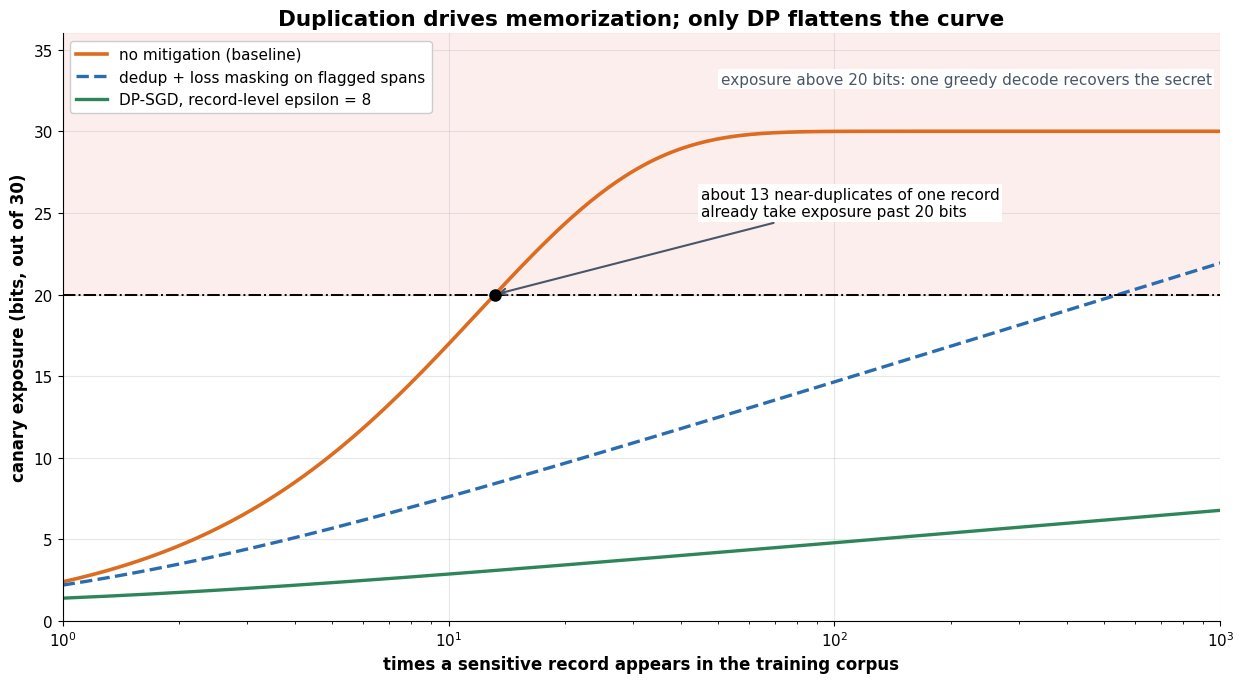
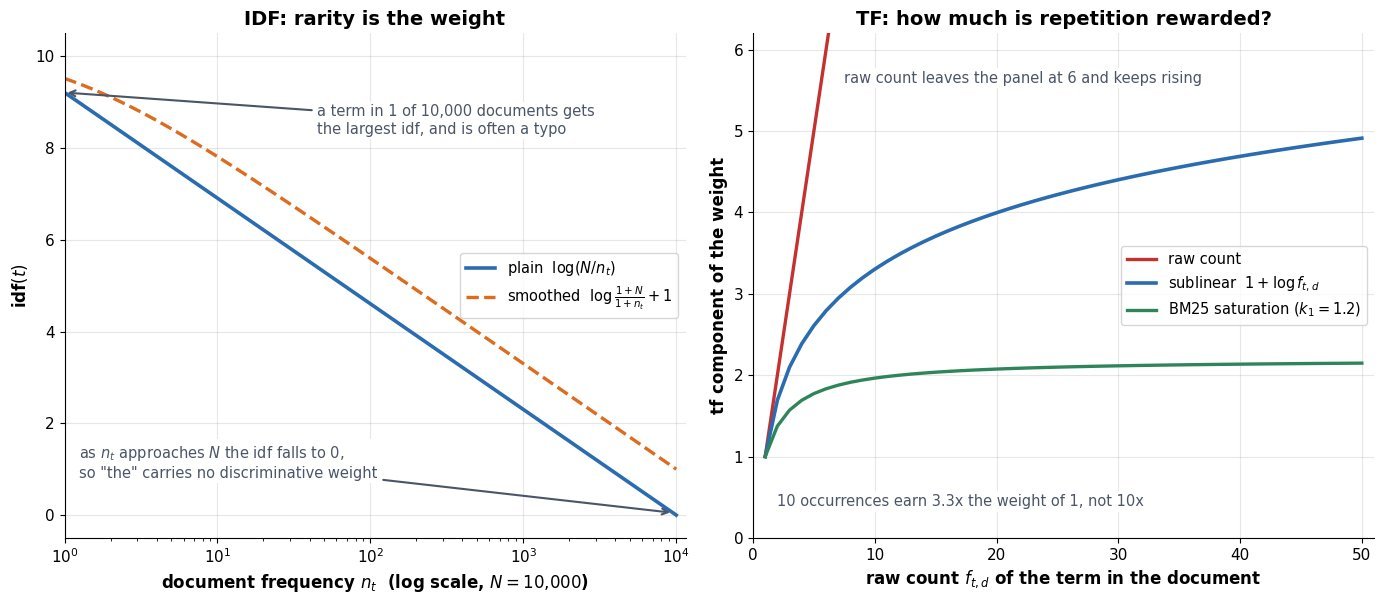
 so that ten occurrences do not count ten times as much as one. The inverse document frequency factor is a global corpus statistic,
  , which pushes function words such as “the” toward zero and lifts rare, discriminative terms. Multiplying the two produces the classic “frequent here, rare elsewhere” signal, and L2 normalization turns a plain dot product into cosine similarity. The result is extremely sparse (typically over 99.9% zeros), exactly interpretable per term, and requires no training beyond counting. Its weaknesses are structural rather than fixable by tuning, because every term is its own orthogonal dimension, so “car” and “automobile” share zero similarity, word order and negation are discarded, and any term outside the fitted vocabulary is silently dropped.
 or BM25 saturation caps the reward for saying the same word again.
 statistics are frozen at fit time, so corpus drift, duplicated documents, and tiny corpora all distort the weights.


 is the unnormalized weight of term
  is the final L2-normalized document vector.
 is the raw count of
  ; terms with zero count keep weight zero, which is what makes the vector sparse.
 .
. is the smoothed variant used by scikit-learn, which adds one to both counts to tolerate unseen terms and adds a constant so a term present everywhere still keeps a small nonzero weight.
 is the query treated as a short pseudo-document, so retrieval scoring is just a cosine between two sparse vectors over shared nonzero coordinates.


 .
. with
with 
 times the spread turns that signal into a reward the policy cannot profit from. A KL penalty to the frozen reference policy plus periodic relabeling of fresh on-policy samples keeps the optimizer inside the RM’s zone of competence.
 or below, early stopping on held-out pairwise accuracy, plus label smoothing or a margin term and an auxiliary language-modeling loss to keep the backbone from collapsing.
 to
to  members whose pretraining seeds differ disagree most off-distribution, which is exactly where reward hacking begins.
 score delays the over-optimization peak instead of merely detecting it.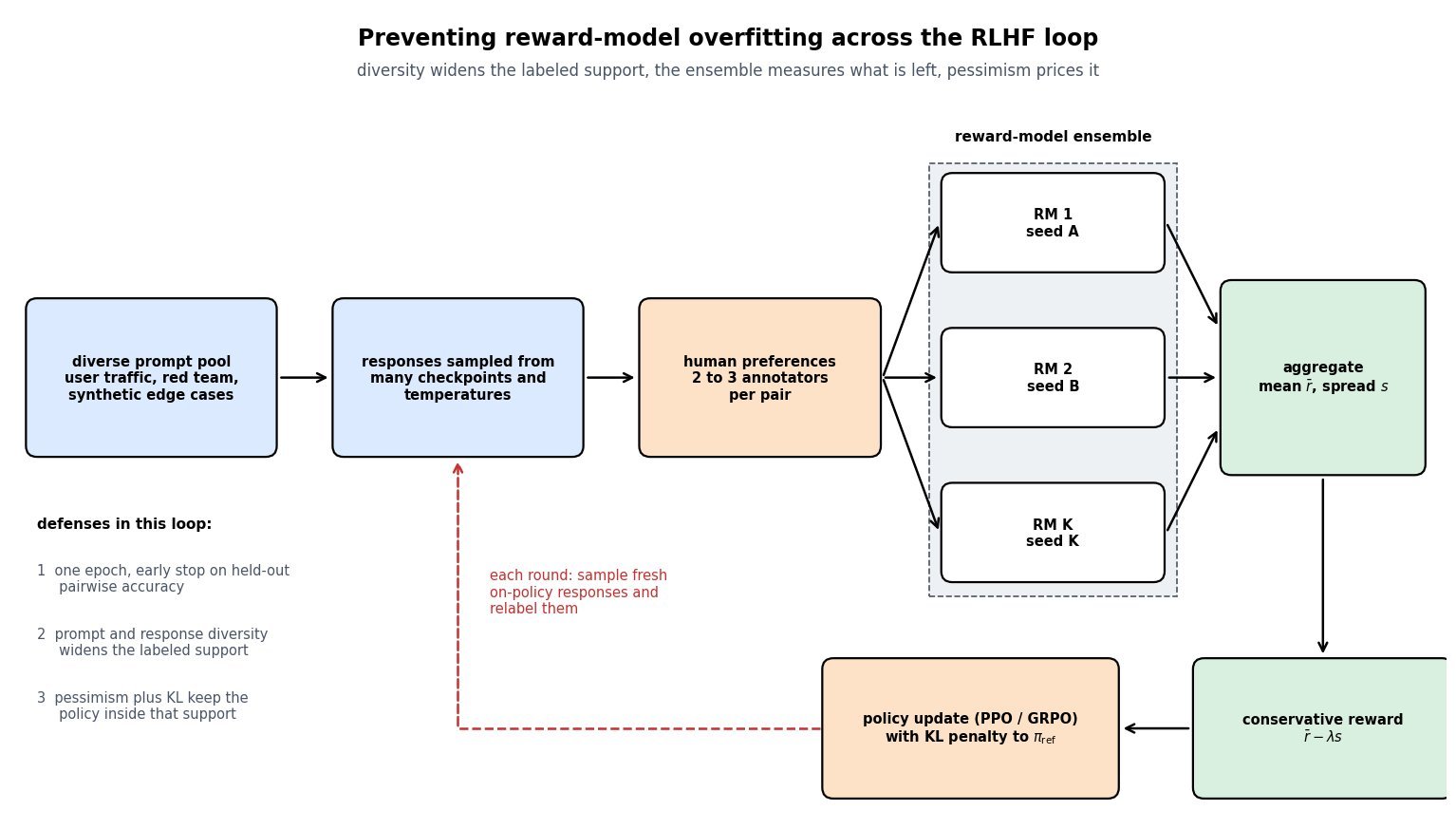


![J(\pi) = \mathbb{E}_{\pi}[r_{\mathrm{LCB}}] - \beta D_{\mathrm{KL}}](https://s0.wp.com/latex.php?latex=J%28%5Cpi%29+%3D+%5Cmathbb%7BE%7D_%7B%5Cpi%7D%5Br_%7B%5Cmathrm%7BLCB%7D%7D%5D+-+%5Cbeta+D_%7B%5Cmathrm%7BKL%7D%7D&bg=ffffff&fg=000&s=3&c=20201002)
 is the score margin between the preferred response
  and the rejected response
  for prompt
  is the Bradley-Terry negative log-likelihood.
 are the RM parameters: a pretrained or SFT backbone with a scalar head, usually trained for one epoch so
  is the score of ensemble member
  , and
, and  their mean, which is also a mild variance reduction on the reward itself.
 is the ensemble spread, used as an epistemic uncertainty proxy: it stays small on the labeled support and grows on responses no annotator ever judged.
 is the pessimism coefficient, commonly in the range
  to
to  ;
;  recovers plain mean aggregation.
 is the KL coefficient (typically
  to
to  ) and
) and  the divergence from the frozen reference policy, which bounds how far the policy may travel from the RM’s support.
 rather than of training steps.

 and
and  is deleted. The loop then repeats on whatever is left: sort → pick the max → suppress → repeat. The algorithm rests on two assumptions, that confidence ranks localization quality and that a high IoU means two boxes describe the same object. Both fail in crowds, where the best box on a partially occluded neighbour can sit above
  cap in front to bound the cost.
 sort plus up to
  pairwise IoU tests, which is why production stacks cap candidates and run a batched CUDA kernel.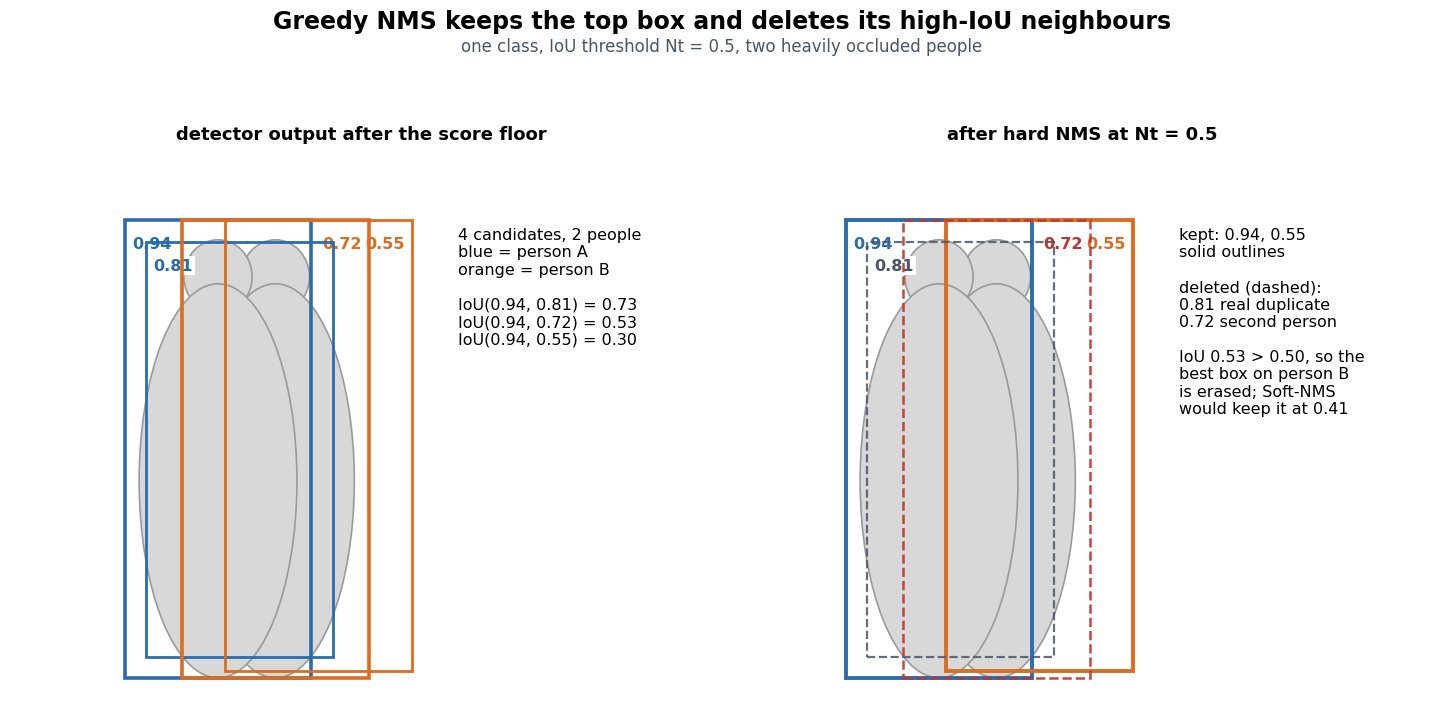


![s_i \leftarrow s_i \cdot \mathbf{1}[\mathrm{IoU}(M, b_i) \leq N_t]](https://s0.wp.com/latex.php?latex=s_i+%5Cleftarrow+s_i+%5Ccdot+%5Cmathbf%7B1%7D%5B%5Cmathrm%7BIoU%7D%28M%2C+b_i%29+%5Cleq+N_t%5D&bg=ffffff&fg=000&s=3&c=20201002)


 is the current candidate set for one class,
  a box in it with score
  , and
, and  .
. ; line 5 is Gaussian Soft-NMS, applied to every remaining box with no threshold at all.
 ; a smaller
  is the Euclidean distance between the two box centers and
  the diagonal of the smallest box enclosing both, so
  lies in
  and is scale-invariant.


 is a one-line change at inference and needs no retraining, whereas swapping backbone weights per weather condition doubles the validation surface.


 is the fused feature tensor consumed by the task heads, and
  is the raw feature map of sensor
  , with
  its degradation-conditioned version.
![q_m \in [0,1]](https://s0.wp.com/latex.php?latex=q_m+%5Cin+%5B0%2C1%5D&bg=ffffff&fg=000&s=2&c=20201002) is the absolute quality score produced by a small monitor head
is the absolute quality score produced by a small monitor head  with logistic output
  and
and  are the FiLM scale and shift vectors, and
  is channel-wise multiplication.
 is a content-dependent attention logit from the ordinary fusion module, so the gate combines what is informative with what is trustworthy.
 values rather than by the weights.


 is the Mahalanobis drift at frame
  of a mid-level feature map and the clean-data reference
  with covariance
  .
. is the CUSUM statistic with slack
  and
and  is the reprojection residual in pixels for correspondence
  , where
  is the observed image point,
  the 3D point from LiDAR or a second camera,
  the extrinsic transform, and
  the projection using current intrinsics.
 patch grid emerging from the last block is already a linearly separable semantic map rather than an intermediate code that only a trained decoder can read. The property that keeps this true at 7B parameters and 1.689B curated images is Gram anchoring: late in training DINOv3 adds a loss that matches the student’s patch-token Gram matrix to that of an earlier EMA teacher, pinning the patch-to-patch similarity structure while global features keep improving. Register tokens remove the high-norm artifact patches that otherwise pollute attention maps, and axial RoPE with frequency jittering makes the same weights usable at resolutions far above the training crop. The result is that read-out becomes non-parametric: k-NN on the CLS token classifies, and cosine similarity between patch embeddings segments, with no gradient ever entering the backbone. A single linear layer on the frozen features reaches roughly 88% ImageNet-1k top-1 and around 56 mIoU on ADE20k, which is why “frozen backbone plus tiny head” is a competitive deployment strategy rather than a baseline.
 similarity matrix, not the absolute features, lets representations keep drifting globally while patch-similarity geometry stays sharp.


 is the image-level cross-view self-distillation loss on the CLS token and
  the patch-level masked-latent loss, with
  holds the student’s
  -normalized patch features and
  the same for the Gram teacher, an earlier EMA checkpoint evaluated at higher resolution and downsampled.
 are the patch-patch cosine similarity matrices, so the loss constrains relations between patches and not the patch vectors themselves.
 is the number of patch tokens for an
  input at patch size 16, and
  per view.
 is the normalized embedding of test patch
  and
and  a normalized reference embedding, taken from an annotated patch, a class prototype, or a cluster centroid.
 is the predicted label for patch
 looks like in image space. Zero-shot dense segmentation is nothing more than thresholding or arg-maxing maps like these, so map sharpness is the capability: the right-hand panel, typical of dense degradation, produces masks that bleed into the background even though the model’s classification accuracy is higher.
 the cross-view layer is numerically identical to the single-view layer, so the model is a strict superset of its monocular predecessor rather than a compromise.
 blocks, exactly what a monocular model computes, repeated in parallel. A cross-view layer fills in the off-diagonal blocks, and those off-diagonal entries are the whole mechanism, because a token on a wall corner in view 3 can now match the same corner in view 1 and inherit its depth ordering. Because the projection matrices are unchanged, the same weights serve both scopes and the model never has to learn a separate matching operator. The cost of filling those blocks is the reason view count dominates the budget, and it is also the reason non-overlapping views buy nothing: the off-diagonal blocks exist, but there is no correspondence for them to find, so the relative scale between two disjoint clusters of views stays unconstrained.
 to
to  , a factor of exactly
 ![Z = [\,X_1; X_2; \ldots; X_N\,]](https://s0.wp.com/latex.php?latex=Z+%3D+%5B%5C%2CX_1%3B+X_2%3B+%5Cldots%3B+X_N%5C%2C%5D&bg=ffffff&fg=000&s=3&c=20201002)


 holds the tokens of view
  and
and  is the single concatenated sequence the transformer actually sees.
 are the projections restricted to one view, while
  are the same projections applied to all of
  ; the weights are shared, only the scope differs.
 indexes pixels,
  indexes views,
  is tokens per view for patch size
  is the predicted depth and
  the predicted ray map (origin and unit direction) expressed in a shared frame, so
  is a 3D point in that frame and the camera pose follows from fitting
  .
. and
and  count attention token pairs per layer, so their ratio is


