
What is CLIP, and how does contrastive image-text training enable zero-shot classification?
Answer
CLIP (Contrastive Language-Image Pre-training) is a dual-encoder model: an image encoder (a ViT or ResNet) and a text encoder (a Transformer) each map their input to a vector in one shared embedding space, and the vectors are L2-normalized so their inner product is a cosine similarity. Training uses a batch of  image-caption pairs scraped from the web (400M pairs for the original model), computes the full
  similarity matrix, and applies a symmetric InfoNCE loss that pushes the diagonal entries up and the
  off-diagonal entries down. Nothing in that objective mentions class labels, so the learned text encoder is a general classifier generator: at test time you write each candidate class as a sentence such as “a photo of a golden retriever”, encode it, and the resulting unit vectors act as the rows of a linear classifier weight matrix. Classification is then one matrix multiply followed by an argmax over cosine similarities, which is why a new label set costs a text-encoder forward pass rather than a training run. The best original model (ViT-L/14@336px) reaches 76.2% zero-shot top-1 on ImageNet, matching a supervised ResNet-101 with an identical 76.2% ImageNet top-1 that saw 1.28M labeled images, and it is far more robust under distribution shift.
(1) Two Encoders, One Space: each modality has its own encoder plus a linear projection into a shared  -dimensional space; there is no cross-attention between them, so image and text embeddings can be computed and cached independently.
(2) Symmetric InfoNCE Over The Batch: the loss is cross-entropy applied twice, once along rows (image picks its caption) and once along columns (caption picks its image), averaged.
(3) Learned Temperature: the logit scale  is a trained scalar initialized to a temperature of 0.07 and clipped at 100, which controls how hard the softmax pushes against near-miss negatives.
(4) Prompts Become Classifier Weights: zero-shot inference replaces the learned classification head with text embeddings of class descriptions, so the label set is defined at inference time, not at training time.
(5) Batch Size Is Part Of The Objective: negatives come only from the current batch, so the original model trained at  across many GPUs with the similarity matrix sharded.
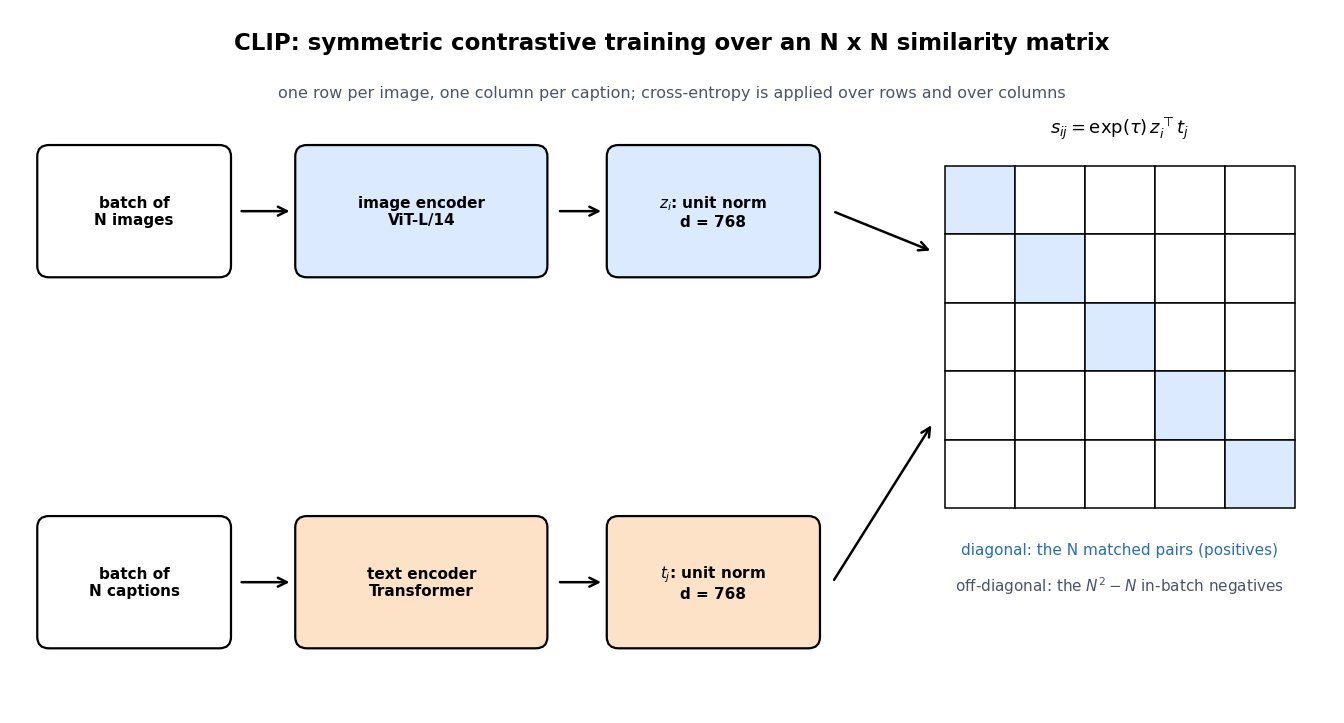
Figure 1: Each training step builds the full similarity matrix; the diagonal entries are the true pairs and every other entry is an in-batch negative, which is why one step at supplies over a billion contrastive comparisons.
Three details separate a working CLIP from a broken one. Normalization is load-bearing: without it the model can shrink the loss by inflating embedding norms instead of improving alignment, and the learned temperature then has no fixed scale to calibrate against. Prompt wording matters more than people expect, because captions in the training data are sentences, not bare nouns: using “a photo of a {label}” instead of the raw class name adds about 1.3 points on ImageNet, and ensembling 80 prompt templates by averaging their normalized text embeddings adds roughly 3.5 points for almost no inference cost, since the averaged vectors are computed once and cached. Finally, label naming is part of the model: polysemous class names such as “boxer” (dog breed or athlete) or “crane” (bird or machine) must be disambiguated in the prompt, which is a form of engineering that has no analogue in a supervised classifier with integer labels.
Mathematical Formulation:


Where:
 and
and  are the unit-norm embeddings of image
  and caption
  , both in
  with
with  for ViT-L/14.
 is the image encoder plus its projection and
  the text encoder plus its projection; the two share no weights.
 is the scaled cosine similarity and
  the learned logit scale; since
  lies in
 ![[-1, 1]](data:image/svg+xml;base64,PHN2ZyB4bWxucz0iaHR0cDovL3d3dy53My5vcmcvMjAwMC9zdmciIHdpZHRoPSI0MyIgaGVpZ2h0PSIxNyIgdmlld0JveD0iMCAwIDQzIDE3Ij48cmVjdCB3aWR0aD0iMTAwJSIgaGVpZ2h0PSIxMDAlIiBzdHlsZT0iZmlsbDojY2ZkNGRiO2ZpbGwtb3BhY2l0eTogMC4xOyIvPjwvc3ZnPg==) , the scale alone sets the sharpness of the softmax.
, the scale alone sets the sharpness of the softmax. index the batch;
  normalizes each row and
  the same expression with the softmax taken over columns.
 is the zero-shot prediction for a query image with embedding
  , and
, and  is the (optionally prompt-ensembled and renormalized) text embedding of class
  ; the temperature drops out of the argmax.
- Required initial condition:
 at step 0, clamped so that
  throughout training to prevent the logits from exploding.
 and
and  are the unit-norm embeddings of image
  and caption
  , both in
  with
with  for ViT-L/14.
 is the image encoder plus its projection and
  the text encoder plus its projection; the two share no weights.
 is the scaled cosine similarity and
  lies in
 ![[-1, 1]](https://s0.wp.com/latex.php?latex=%5B-1%2C+1%5D&bg=ffffff&fg=000&s=2&c=20201002) , the scale alone sets the sharpness of the softmax.
, the scale alone sets the sharpness of the softmax. index the batch;
  normalizes each row and
  the same expression with the softmax taken over columns.
 is the zero-shot prediction for a query image with embedding
  , and
, and  is the (optionally prompt-ensembled and renormalized) text embedding of class
  ; the temperature drops out of the argmax.
 at step 0, clamped so that
  throughout training to prevent the logits from exploding.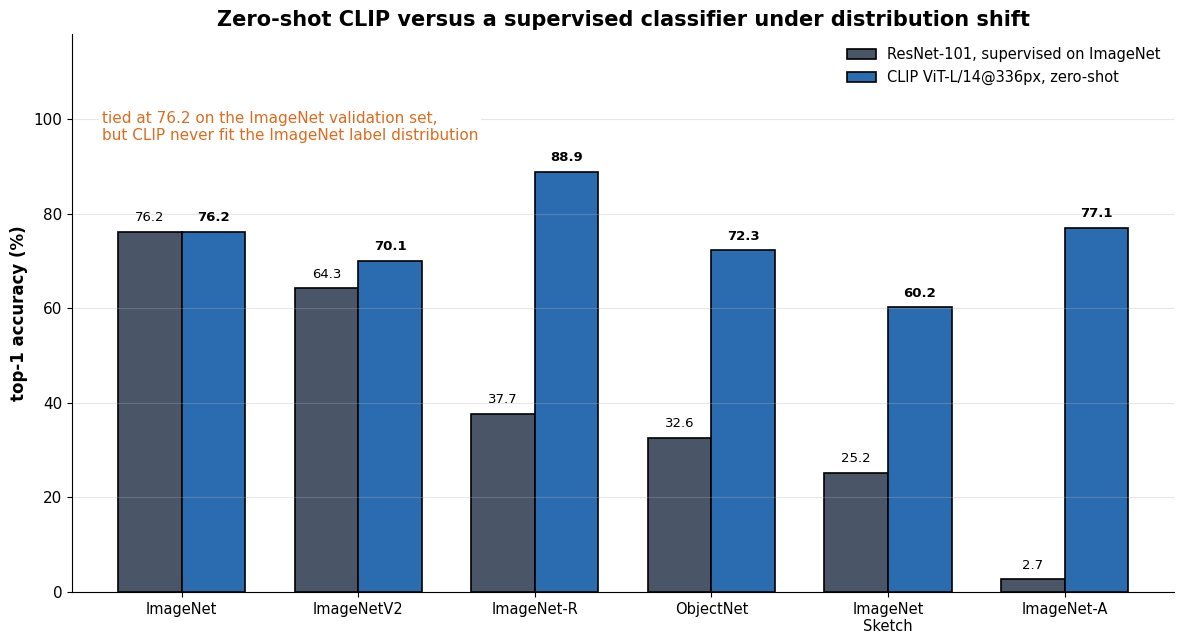
Figure 2: Matched at 76.2% on the ImageNet validation set, the two models diverge sharply under shift: zero-shot CLIP keeps 77.1% on ImageNet-A and 60.2% on Sketch, where the supervised model drops to 2.7% and 25.2%, evidence that never fitting the ImageNet label distribution is itself a robustness mechanism.
| Property | Zero-shot CLIP (ViT-L/14@336px) | Supervised classifier (ResNet-101) |
|---|---|---|
| Task supervision | Zero labeled examples for the task, 400M noisy web pairs for pretraining | 1.28M hand-labeled images for exactly this label set |
| Adding a class | Encode one more prompt and append the vector, no gradient step | Collect labels, then retrain or refit the head |
| ImageNet top-1 | 76.2% | 76.2% |
| ImageNet-A top-1 | 77.1% | 2.7% |
| Specialized domains | Weak: near chance on tumor-patch classification, poor on counting and satellite land use | Strong once in-domain labels exist |
| Inference cost | One image forward pass plus a  matmul against cached text vectors matmul against cached text vectors | One forward pass through a fixed head |
Leave a Reply