
What is the feature map in Convolutional Neural Networks?
Answer
A feature map is the output produced when one convolutional filter slides across its input: a 2D grid of activations whose values encode where and how strongly a specific pattern (an edge orientation, texture, or object part) appears at each spatial location. A convolutional layer applies many filters in parallel, so its output is a stack of feature maps, one per filter, forming the layer’s channels.
(1) Output of One Filter: Each feature map is generated by a single filter convolving over the input; the layer output stacks one map per filter, so 64 filters produce 64 channels.
(2) Location and Strength: A high activation at position (i, j) means the filter’s pattern (e.g., a vertical edge or a corner) is strongly present around that location.
(3) Evolving Semantics with Depth: Early maps respond to edges and textures, middle maps to parts and shapes, and deep maps to whole objects with class-specific meaning.
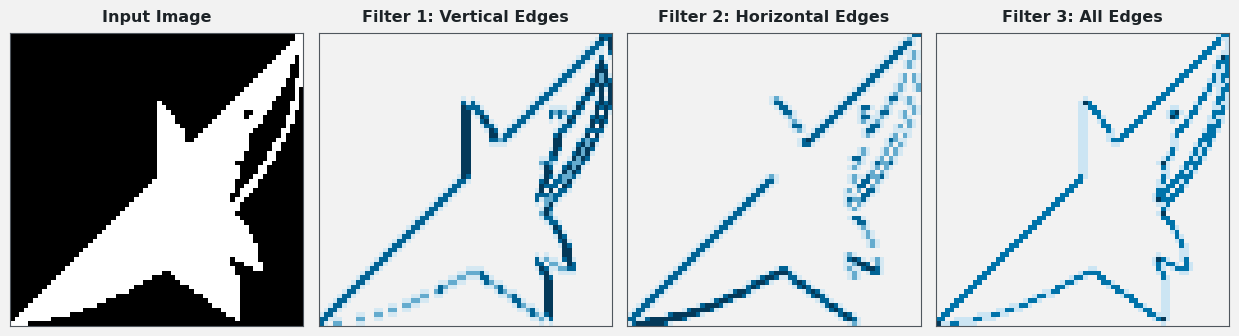
Figure 1: Three filters applied to the same input produce three different feature maps; each lights up where its own pattern (vertical, horizontal, or any edge) appears.
Mathematical Formulation:


Where:
 is the activation of feature map
  at spatial position
  .
. are the weights of filter of size
  ;
;  is its bias.
 is the input activation;
  and
and  are the input and output channel counts.
 is the activation of feature map
  at spatial position
  .
. are the weights of filter
  ;
;  is its bias.
 is the input activation;
  and
and  are the input and output channel counts.
Hierarchical Representation: As activations flow deeper, each new feature map is computed from the previous layer’s maps, so neurons see progressively larger receptive fields and combine simpler patterns into richer ones, the foundation of a CNN’s representational power.
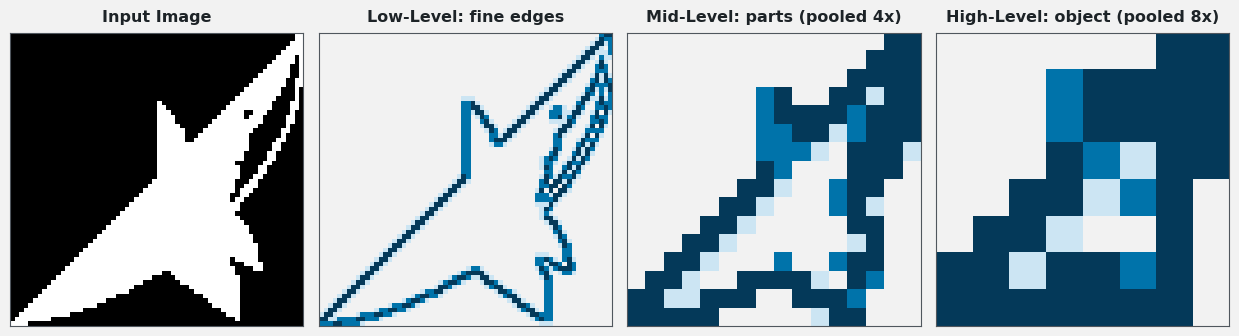
Figure 2: Depth turns fine edges into parts and finally into an object-level representation. Resolution drops while semantic content rises.
Leave a Reply