
What are the challenges of temporal visual grounding (predicting the start and end timestamps of a language query inside a long, untrimmed video, as in video search features built on models like InternVideo2 or TimeChat)?
Answer
Temporal visual grounding (also called temporal sentence grounding or moment retrieval) maps one natural-language query onto a single interval  inside an untrimmed video, and almost every difficulty follows from one mismatch: the metric is far more precise than the signal you can afford to look at. Benchmarks report R@1 at IoU 0.7 against a human-drawn span, yet the target moment is often a few percent of a video that runs for minutes, its boundaries are genuinely ambiguous (annotators disagree by seconds about when “opens the fridge” starts), supervision is a single positive span among thousands of candidate windows, and compute forces you to subsample frames so hard that the achievable temporal resolution can be coarser than the tolerance the metric grants. Worse, the standard datasets carry strong temporal location priors, so a model that never looks at the video can score respectably and mask the fact that no grounding is happening at all. Cross-modal features add their own problem, because image-level encoders describe objects well and describe verbs, ordering, and completion poorly, which is exactly the information a query like “right after he sits down” depends on.
(1) Tolerance Scales With The Moment, Not The Video: at  a correctly sized 4-second moment tolerates a rigid boundary shift of only 0.71 s, so short moments demand sub-second precision while long ones are almost free.
(2) Boundary Ambiguity Lives In The Labels: event onsets and offsets are not crisp, so inter-annotator IoU sits well below 1.0 and an L1 boundary regression fits annotation noise past a certain accuracy.
(3) Sampling Stride Trades Precision Against Cost: sampling at  fps sets a hard error floor near
  seconds, but keeping high makes
  large and early cross-modal fusion costs
  .
.
(4) Features Are Weak On Temporal Semantics: frozen CLIP-style per-frame embeddings encode appearance, so verbs, order, and “before/after” relations are nearly invisible without motion-aware or video-pretrained features.
(5) Location Priors Let Blind Models Win: on Charades-STA and ActivityNet Captions the ground-truth spans cluster in predictable places, so query-only or prior-only baselines are competitive and out-of-distribution splits expose the gap.
(6) Supervision Is Sparse And Assumes One Span: a single positive interval creates extreme foreground/background imbalance, and queries matching several disjoint intervals or none at all break single-span heads outright.
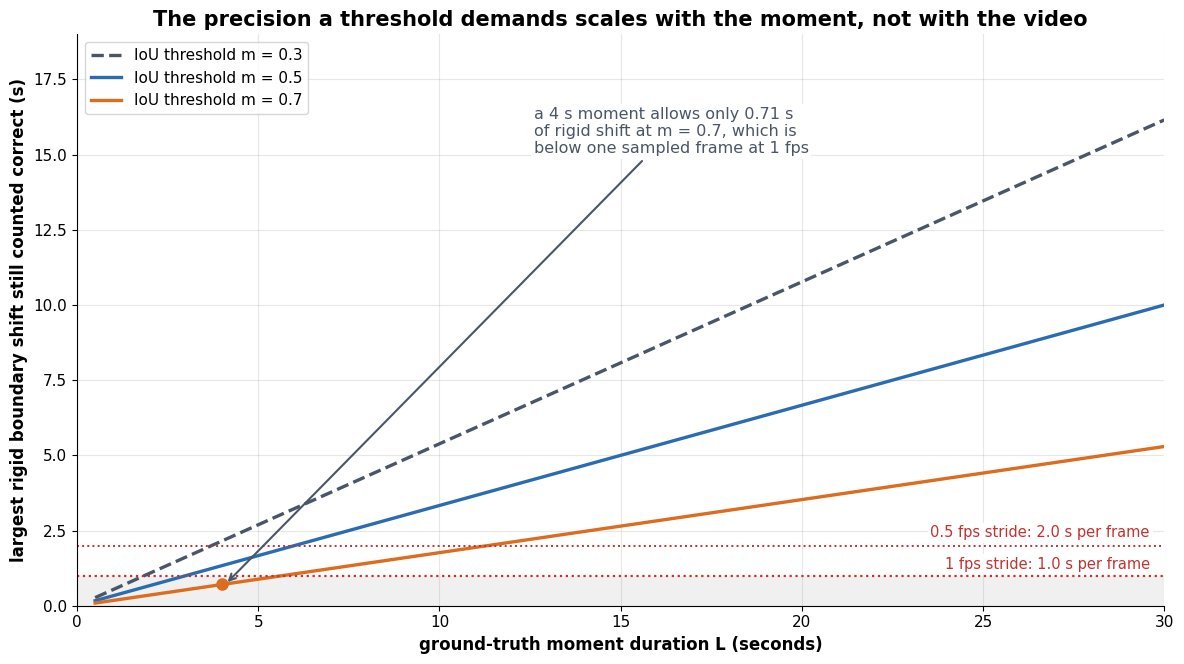
Figure 1: The tolerance the metric grants is proportional to the moment duration, so a strict threshold on short moments asks for a precision that the frame sampling stride cannot deliver. Below the dotted lines, the demanded accuracy is finer than one sampled frame, and no amount of head tuning recovers it.
Mathematical Formulation:


![\mathrm{Acc}_{m} = \frac{1}{Q} \sum_{q=1}^{Q} \mathbf{1}[\mathrm{IoU}_{q} \geq m]](https://s0.wp.com/latex.php?latex=%5Cmathrm%7BAcc%7D_%7Bm%7D+%3D+%5Cfrac%7B1%7D%7BQ%7D+%5Csum_%7Bq%3D1%7D%5E%7BQ%7D+%5Cmathbf%7B1%7D%5B%5Cmathrm%7BIoU%7D_%7Bq%7D+%5Cgeq+m%5D&bg=ffffff&fg=000&s=3&c=20201002)


Where:
 is the annotated span and the prediction, both in seconds; and are the 1D intersection and union, and the handles disjoint spans.
- is the ground-truth duration, the IoU threshold, and the largest rigid shift of both boundaries that still passes, obtained from .
- indexes queries and is the usual R@1, IoU=m metric, a hard indicator that is flat inside the tolerance band and gives no gradient-like signal about how close a miss was.
- normalized by video length, and the loss weights; the L1 term is scale-sensitive and the IoU term is scale-free, which is why both appear in DETR-style grounding heads.
- is the video duration, the sampling rate, and the number of frame tokens; a 20-minute video at gives , and self-attention over it costs per query.
 the prediction, both in seconds;
  and
and  are the 1D intersection and union, and the
  handles disjoint spans.
 is the ground-truth duration,
  the IoU threshold, and
  the largest rigid shift of both boundaries that still passes, obtained from
  .
. indexes queries and
  is the usual R@1, IoU=m metric, a hard indicator that is flat inside the tolerance band and gives no gradient-like signal about how close a miss was.
 normalized by video length,
  and
and  the loss weights; the L1 term is scale-sensitive and the IoU term is scale-free, which is why both appear in DETR-style grounding heads.
 is the video duration,
  gives
gives  , and self-attention over it costs
 The design space has moved through three families and is now entering a fourth: sliding-window proposal ranking (dense candidate spans scored against the query, as in 2D-TAN), proposal-free span prediction (per-frame start and end distributions, as in VSLNet), DETR-style set prediction (learnable moment queries plus Hungarian matching with an L1 and IoU loss, as in Moment-DETR and CG-DETR), and video LLMs that emit timestamps as text or as dedicated time tokens. Each family inherits the same structural problems in a different shape: proposal methods make the imbalance explicit and cap resolution at the window grid, span prediction is cheap but assumes exactly one contiguous answer, set prediction handles multiple moments and a no-moment class but needs enough data to learn the matching, and LLM-based grounders quantize time into a token vocabulary and therefore trade fine boundary precision for reasoning ability. Scaling to hour-long input is a separate axis, because early fusion concatenates query and video tokens and blows up memory with  , while late fusion keeps the video encoding query-independent so features can be cached and reused across thousands of queries.
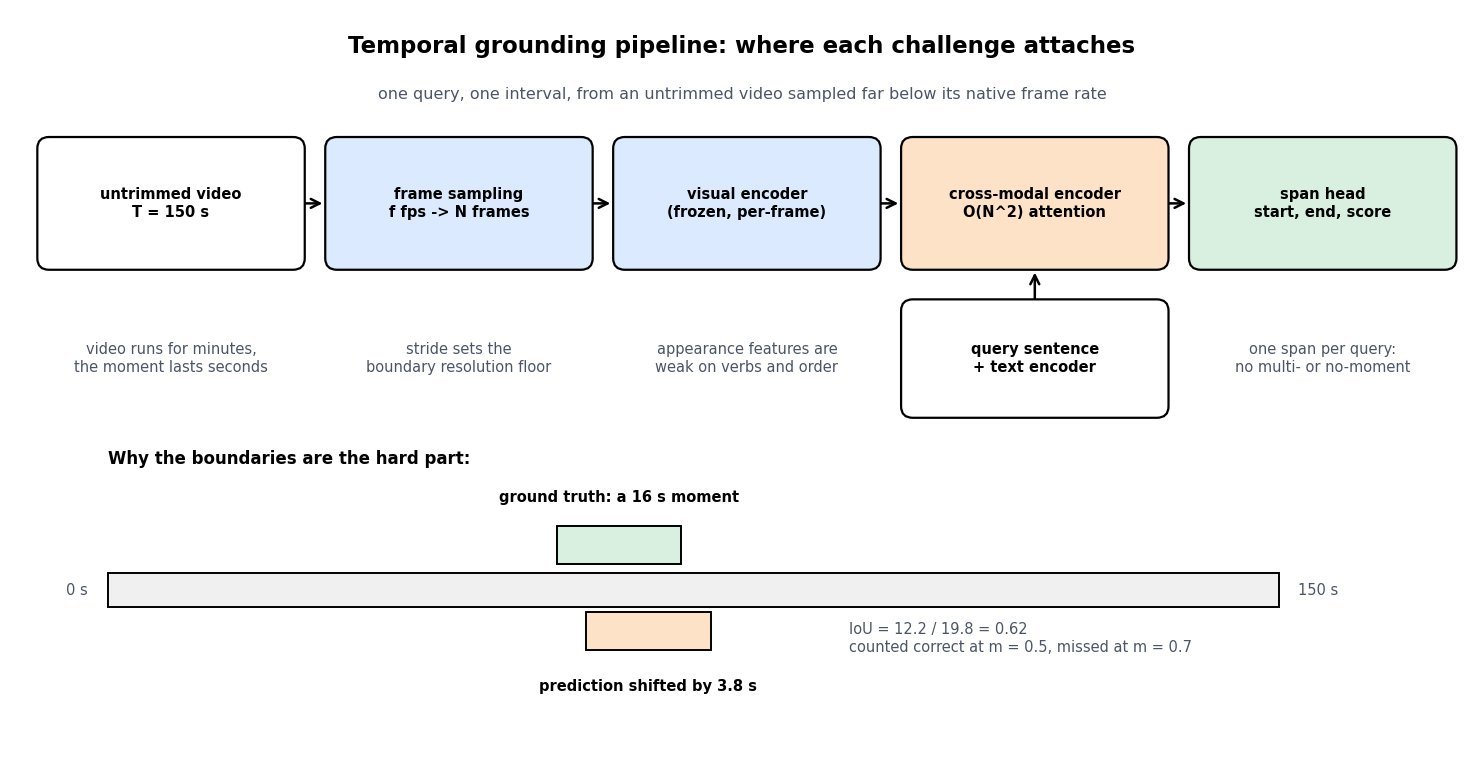
Figure 2: Each pipeline stage contributes its own failure mode: the sampling stride fixes the resolution floor, the frozen per-frame encoder discards motion and ordering, early fusion makes cost quadratic in frame count, and a single-span head cannot express multiple or absent moments. The bottom timeline shows why the threshold choice dominates reported numbers: the same prediction passes at  and fails at .
| Property | Charades-STA | ActivityNet Captions | QVHighlights | MAD |
|---|---|---|---|---|
| Typical video length | about 30 s | about 120 s | 150 s clips | full movies, about 110 min |
| Typical moment length | about 8 s | about 36 s | tens of seconds | about 4 s |
| Moment share of video | roughly a quarter | roughly a third | small but non-trivial | well under 0.1 percent |
| Moments per query | one | one | often several disjoint | one |
| Dominant difficulty | strong location prior, blind baselines score well | long vague spans, annotation bias | set prediction plus saliency, no-moment cases | extreme needle in a haystack, memory and caching |
 visual tokens before a single word of the prompt. The merge itself comes in two families. Token-level fusion concatenates all view tokens into one LLM context and tags each token with a camera-identity, extrinsic-pose, and timestamp embedding, letting attention discover the cross-view correspondence itself; this is the route taken by surround-view multimodal models such as Waymo’s EMMA. Geometric fusion instead defines 3D query points (BEV cells or object queries), projects each one into every camera using calibrated intrinsics and extrinsics warped by ego motion to a common query time, and merges the sampled features with per-camera weights, so a point seen by two overlapping cameras is fused once rather than described twice.
 , so odometry or IMU quality bounds fusion accuracy.
 while self-attention grows as
  , so doubling the camera count quadruples attention FLOPs.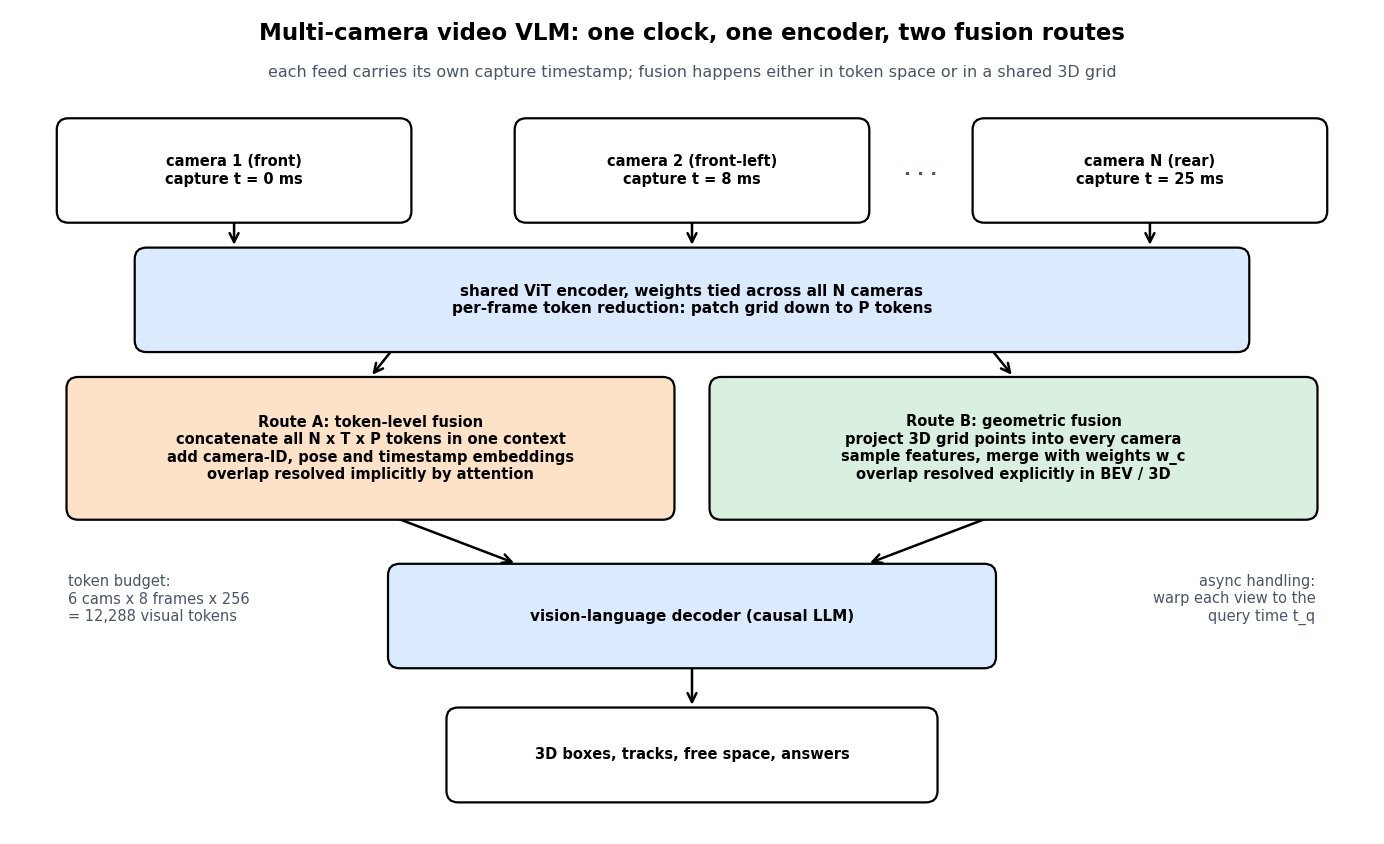


 is the visual token count entering the decoder, with
  tokens per frame after reduction.
 is a 3D query point in the ego frame (a BEV cell center or a learned object query) and
  is the same point expressed in camera
  ‘s frame at that camera’s own capture time.
 is the fixed extrinsic from ego to camera
  is the ego-motion transform from the query time to the capture time, obtained from wheel odometry, IMU, or visual odometry.
 is the intrinsic matrix,
  the perspective projection,
  the resulting pixel location, and
  the encoder feature sampled there by bilinear interpolation.
 is the visibility mask (point inside the frustum and unoccluded),
  the per-camera confidence weight from depth uncertainty and incidence angle, and
  a guard so uncovered cells stay zero instead of dividing by zero.
 is ego speed and
  the timestamp offset, so
  is the spatial error incurred by ignoring compensation; the numeric line uses
  m/s (60 km/h) and a 25 ms offset expressed in seconds.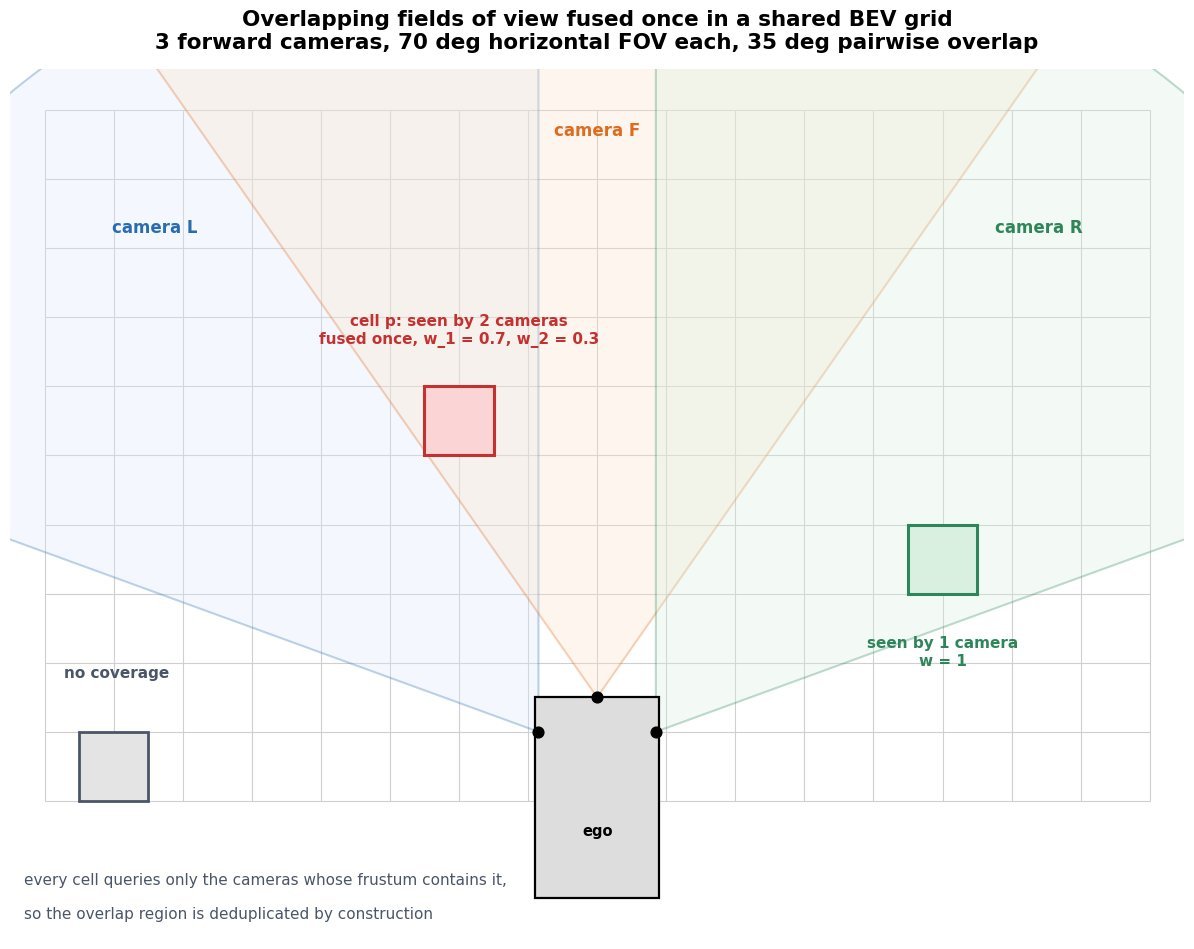

 to
to  before the softmax, so patches inside the referred region get a boost and patches outside get suppressed or hard-masked to
  . A fourth, architecture-free trick draws the prompt in pixel space (ViP-LLaVA’s overlaid arrows and circles, Set-of-Mark’s numbered masks) and lets the vision encoder’s own self-attention pick it up, which is the only option when the model is a frozen API. The choice is a trade among spatial precision, sequence growth, and how much grounding supervision you can afford to train on.
 is added elementwise to the pre-softmax scores, leaving the
  cost and the KV cache unchanged, and a per-head
  can be learned.
 outside the region removes exactly the surrounding evidence that relational questions need, and a fully masked row produces a degenerate softmax.
 pair is enough for counting and referring, and it avoids the box-regression ambiguity for deformable objects.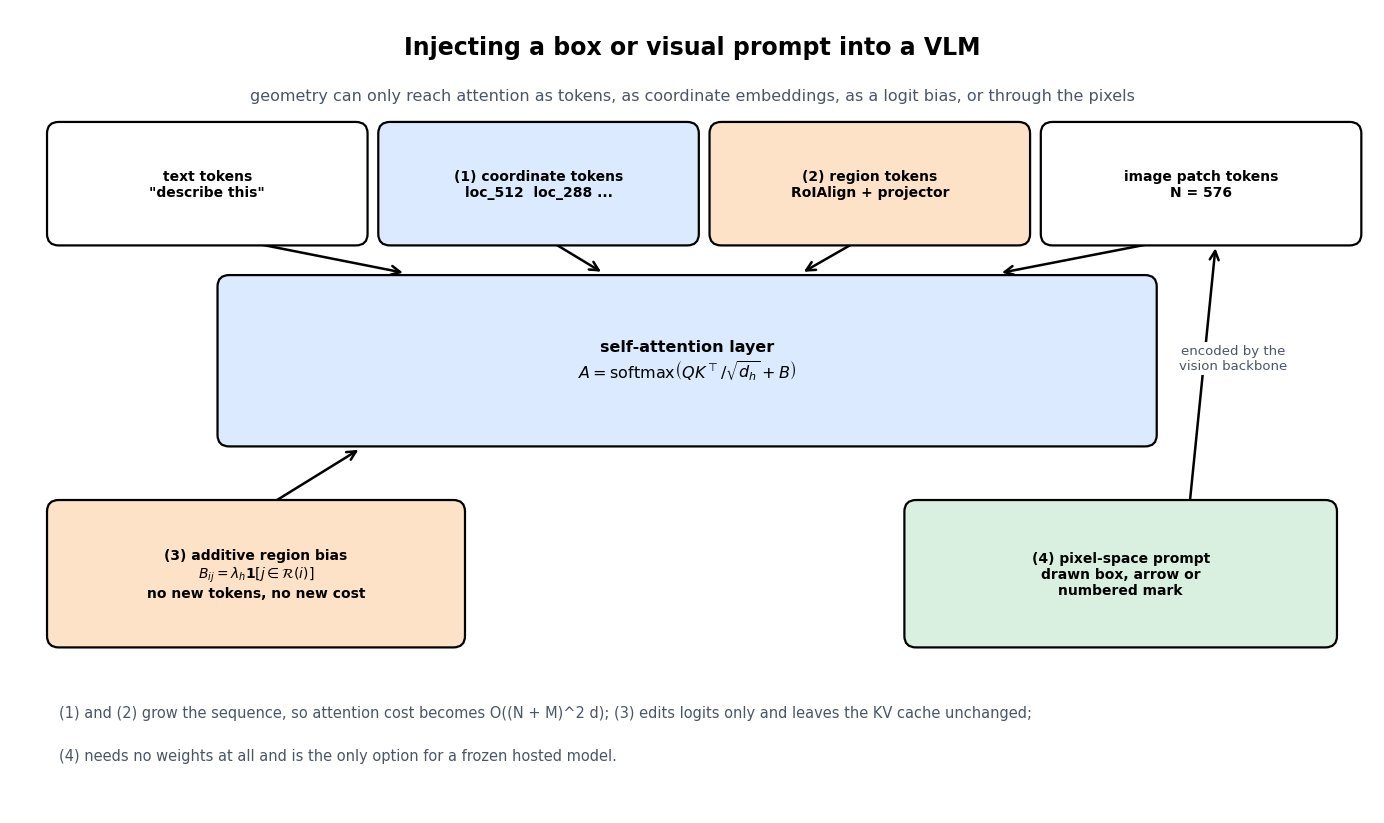

![\psi(b) = [\, x_1,\, y_1,\, x_2,\, y_2 \,] / S](https://s0.wp.com/latex.php?latex=%5Cpsi%28b%29+%3D+%5B%5C%2C+x_1%2C%5C%2C+y_1%2C%5C%2C+x_2%2C%5C%2C+y_2+%5C%2C%5D+%2F+S&bg=ffffff&fg=000&s=3&c=20201002)
![Z^{(0)} = [\, E_{txt};\; e_r;\; E_{img} \,]](https://s0.wp.com/latex.php?latex=Z%5E%7B%280%29%7D+%3D+%5B%5C%2C+E_%7Btxt%7D%3B%5C%3B+e_r%3B%5C%3B+E_%7Bimg%7D+%5C%2C%5D&bg=ffffff&fg=000&s=3&c=20201002)

![B_{ij} = \lambda_h \, \mathbf{1}[\, j \in \mathcal{R}(i) \,]](https://s0.wp.com/latex.php?latex=B_%7Bij%7D+%3D+%5Clambda_h+%5C%2C+%5Cmathbf%7B1%7D%5B%5C%2C+j+%5Cin+%5Cmathcal%7BR%7D%28i%29+%5C%2C%5D&bg=ffffff&fg=000&s=3&c=20201002)

 is the region token appended to the prompt, and
  is the full input sequence of text, region, and image-patch embeddings.
 is the vision-encoder feature map,
  the box in pixels,
  the image side used for normalization, and
  the normalized coordinate vector.
 projects the pooled region feature into the language-model width and
  embeds the coordinates; both are the only new parameters this path needs.
 are the query and key projections of
  ,
,  the per-head dimension, and
  the attention matrix over all
  positions.
 the set of positions that query
  is encouraged to attend to (the patches overlapping the referred box), and
  the per-head bias strength;
  recovers plain attention and
  gives a hard mask.
 the number of added region or coordinate tokens, and
  the model width, so token-based injection is quadratic in
 for.
for. costs text-benchmark quality and turns
 FLOPs, and in native early fusion those tokens must be interleaved image-text documents; the supply of such data at web-text quality is far smaller than the text corpus, so teams either repeat data or dilute the text share and watch reasoning benchmarks regress. Late fusion sidesteps this entirely because the expensive part is already paid: aligning a connector on a couple of billion tokens with a frozen backbone is three orders of magnitude cheaper than a from-scratch native run at the same parameter count. On top of the data problem, dense early fusion suffers capacity contention, since gradients from visual reconstruction and from language modeling compete for the same MLP weights, and sparsity is the standard fix: a mixture-of-experts stack with modality-aware routing gives each modality its own parameters while keeping active FLOPs fixed, which is why recent native models are almost always sparse. Early fusion does win on the systems side (no separate vision tower to shard, no encoder-LLM pipeline bubble, and a single tokenizer path), and it is the only option when the target task requires interleaved generation or genuinely fine-grained grounding that a pooled 576-token projection has already destroyed.
![y = \mathrm{LLM}_{\phi}([\,h_v;\, E_t(x)\,])](https://s0.wp.com/latex.php?latex=y+%3D+%5Cmathrm%7BLLM%7D_%7B%5Cphi%7D%28%5B%5C%2Ch_v%3B%5C%2C+E_t%28x%29%5C%2C%5D%29&bg=ffffff&fg=000&s=3&c=20201002)
![y = T_{\theta}([\,z_1, z_2, \ldots, z_T\,])](https://s0.wp.com/latex.php?latex=y+%3D+T_%7B%5Ctheta%7D%28%5B%5C%2Cz_1%2C+z_2%2C+%5Cldots%2C+z_T%5C%2C%5D%29&bg=ffffff&fg=000&s=3&c=20201002)


 is the generated output; the first two equations are the late-fusion path and the third is the early-fusion path, where a single stack
  consumes the whole interleaved sequence.
 the text;
  is the pretrained vision encoder,
  the text embedding, and
  the connector, typically the only trained matrix during alignment.
 for
for  are the interleaved tokens, either VQ image codes or linear patch projections placed in the same sequence as text tokens.
 the training tokens, and
  the training FLOPs;
  is the Chinchilla compute-optimal ratio, which for
  demands about 2T tokens.
 is the layer count and
  shows that image tokens entering the shared stack are charged quadratically, not linearly.
![r \in [0,1]](https://s0.wp.com/latex.php?latex=r+%5Cin+%5B0%2C1%5D&bg=ffffff&fg=000&s=2&c=20201002) is the image-token fraction of the pretraining mixture, so
is the image-token fraction of the pretraining mixture, so  is the surviving text budget; at fixed
 under the compute-optimal token rule, while connector alignment scales linearly in
  , which is what makes concatenation legal.
 prefill over the combined length.


 is the
  the raw unit behind it (a sub-word, an image tile, or a short audio window).
 is the front end for modality
  and
and  its projection to the model width
  is the text token count,
  the number of image tiles or sampled frames at 258 tokens each, and
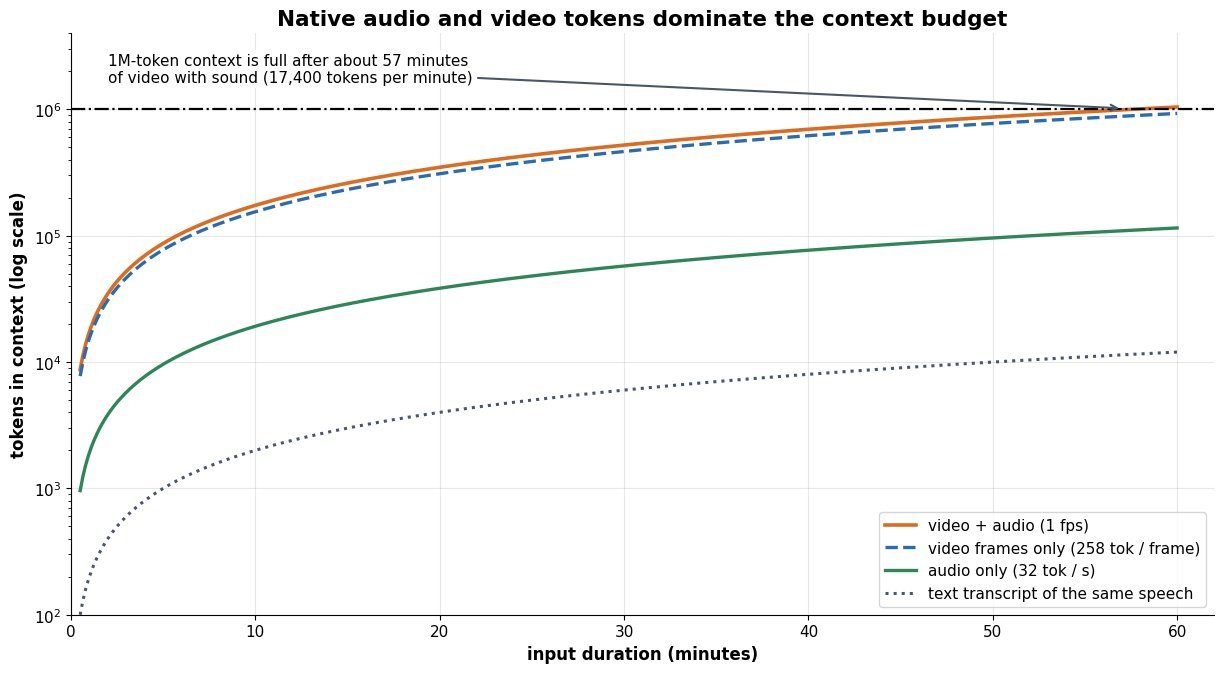
  the audio duration in seconds at 32 tokens each.
 is the generated output drawn from one next-token distribution whose vocabulary may include discrete image and audio codes alongside sub-words.


 or
or  , with exactly one learned position embedding per patch. Squashing a
  receipt or slide into that square applies anisotropic scaling (0.30x horizontally against 0.90x vertically), which shears glyphs and bar charts before the encoder sees a single pixel, while interpolating the position-embedding grid up to native resolution is both off-distribution and quadratically expensive in attention. Dynamic high-resolution slicing, the AnyRes family used by LLaVA-NeXT, UReader, Monkey, MiniCPM-V and InternVL 1.5, avoids both by never changing the encoder’s input size: it picks a tile grid whose aspect ratio best matches the image, resizes the image to exactly
  , cuts it into
  native-resolution tiles that are encoded independently, and appends a downsampled full-image thumbnail to restore the global layout that slicing destroys. Because the target width and height are both integer multiples of the same tile size chosen to match the input ratio, the horizontal and vertical scale factors are (nearly) equal, so the resize is isotropic and no geometry is distorted. What remains is a budgeting problem: the token count grows linearly in tiles, so token compression and a cap
  on the tile product decide how much resolution you can actually afford.
 and pick the one minimizing the log-ratio mismatch against
  , which is exactly the quantity that becomes anisotropic shear if you get it wrong.
 , so the frozen CLIP or SigLIP tower runs at its pretraining resolution with no position-embedding interpolation and no distribution shift.
 tiles of
  rather than
  for one giant grid, a
  patch neighborhood into one embedding, cutting 1024 patches per 448 tile to 256 tokens; without it a 12-tile page costs over 13k tokens.
 and a
and a  arrangement look identical downstream.
 is only exactly isotropic when the chosen grid ratio equals the image ratio; otherwise a residual anisotropy survives, equal to the log mismatch, and it is bounded by how fine your candidate set is. With
  a 4:3 photo still carries 0.29 of residual log-anisotropy because the exact
  grid needs 12 tiles, which is why InternVL 1.5 raises
  with at most 4 tiles plus a base view spends
  tokens per image, and InternVL 1.5 with 12 tiles plus a thumbnail spends
  only because pixel shuffle compresses each tile fourfold.


 is the selected tile grid, and
  the candidate set of grids whose tile product stays within the budget
  and
and  are the original image width and height, and
  and
and  are the per-axis scale factors of the resize, and
  means the resize is isotropic and geometry is preserved exactly.
 accounting for the global thumbnail.
 is the patch size (typically 14) and
  gives
gives  tokens per tile.
 is identical to minimizing
 latents, and newly inserted gated cross-attention layers let the frozen LM read those latents without ever lengthening its own sequence. The consequences are structural rather than cosmetic. Early fusion makes cost quadratic in the joint length
  and demands full multimodal pre-training, but it gives uniform bidirectional-within-causal mixing, unlimited image ordering, and (with discrete VQ image tokens) the ability to generate images from the same head. Cross-attention decouples image count from the text sequence and protects a strong frozen LLM, at the price of a hand-designed conditioning path, per-image attention masks that weaken multi-image relational reasoning, and no route to image output.
 tokens per image, so eight images add 4608 positions and roughly
  the attention cost of a text-only forward pass.
 latents, read through gated layers whose gate starts at zero so the frozen LM is initially unchanged.


 are the image height and width and
  is the visual tokens per image: at
  this is
  .
. is the number of text tokens,
  is the self-attention cost, quadratic in
  block and cross terms with all existing tokens.
 the latent count (
 is linear in
  untouched.
 are the frozen LM hidden states at layer
  and
and  a learned scalar gate initialized to zero, so
  makes the inserted block an identity at step 0 and training degrades the language model gradually rather than abruptly.
 because its cost is linear in
  . Patch pooling recovers most of the gap without leaving the sequence, which is the modern compromise.
 ; resampling is cheapest and constant-cost but imposes a hard information bottleneck; cross-attention keeps text throughput almost untouched and protects a frozen LLM, at the price of new parameters and a more complex training recipe.
 per layer, a resampler pays
  with
with  , and cross-attention pays
  only in the inserted layers.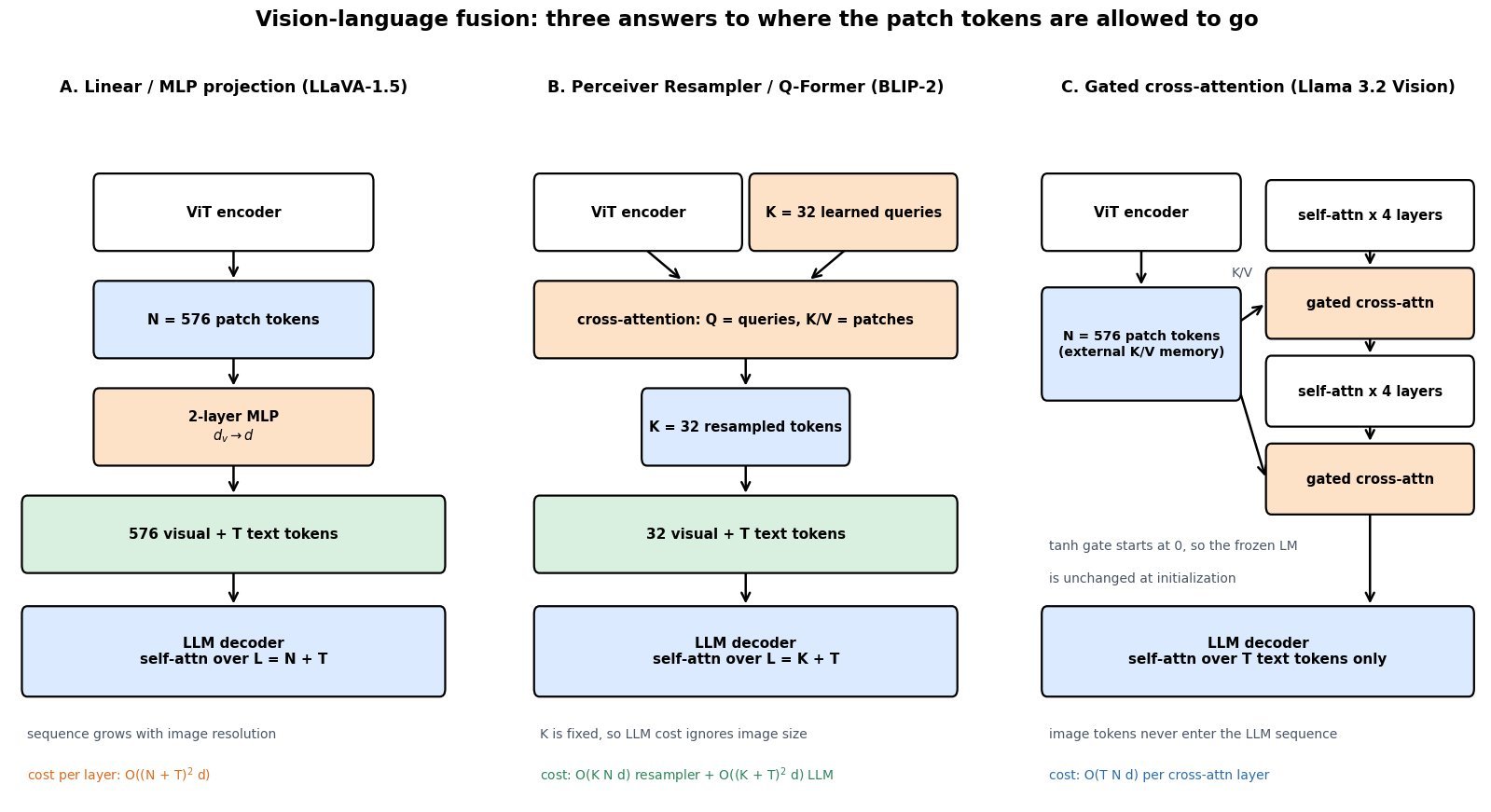


 is the projected visual sequence, with
  the connector weights and
  a GELU nonlinearity; a single
  for ViT-L/14 at 336 px),
  the vision width.
 are the learned latent queries and
  is the text hidden state inside the LLM and
  the scalar gate parameter, initialized so that
  and the pretrained language behavior is exactly preserved at step zero.
 . At
. At  visual tokens, concatenation costs about
  the text-only baseline because the whole stack pays
  since only 8 of 32 layers see the image and they scale as
  , and a 64-latent resampler stays near
  because the LLM never sees more than
  positions.
 grows roughly linearly with prompt length; decode generates one token per forward pass and is memory-bandwidth-bound, so
  is floored by the time to stream the weights and KV cache out of HBM. Measurement must happen at the streaming boundary and be reported as a distribution, namely p50, p95 and p99 merged from histograms and bucketed by input and output length, because a p99 computed over a mix of 200-token and 100k-token prompts is meaningless. Reduction is metric-specific: prefix caching and chunked prefill cut TTFT, FP8 quantization and speculative decoding cut ITL, and the variance work is almost entirely about removing things that can stall the decode loop, namely unchunked prefills, KV cache preemption, and queueing above roughly 70% utilization. The metric that actually decides capacity is goodput, the request rate you can sustain while both the TTFT and ITL SLOs hold at p99, not raw tokens per second.
 per request, and merge t-digest or HDR histograms across replicas instead of averaging per-replica p99s.
 and
and  , because past about 70% utilization the queue term dominates and no kernel optimization will help.


![T_{itl}^{spec} \approx \frac{T_{step}}{\mathbb{E}[n_{acc}]}](https://s0.wp.com/latex.php?latex=T_%7Bitl%7D%5E%7Bspec%7D+%5Capprox+%5Cfrac%7BT_%7Bstep%7D%7D%7B%5Cmathbb%7BE%7D%5Bn_%7Bacc%7D%5D%7D&bg=ffffff&fg=000&s=3&c=20201002)

 is end-to-end request latency,
  the mean inter-token latency (its reciprocal is the perceived tokens per second of one stream).
 and
and  are prompt and completion token counts,
  the achieved (not peak) FLOP/s; the factor 2 counts one multiply and one add per parameter per token.
 and
and  are the weight and KV cache bytes read per decode step and
  is per-device HBM bandwidth, so this inequality is the bandwidth floor on ITL that no batching removes.
 is one verification forward pass and
 ![\mathbb{E}[n_{acc}] \geq 1](https://s0.wp.com/latex.php?latex=%5Cmathbb%7BE%7D%5Bn_%7Bacc%7D%5D+%5Cgeq+1&bg=ffffff&fg=000&s=2&c=20201002) the expected accepted tokens per step under speculative decoding, which divides effective ITL but widens its distribution.
the expected accepted tokens per step under speculative decoding, which divides effective ITL but widens its distribution. is offered request rate,
  and
and  the TTFT and ITL SLO thresholds, and
  the resulting goodput, the only capacity number worth putting in a dashboard.
 B FLOPs, roughly 287 TFLOPs, which at an achieved 3.2 PFLOP/s is about 90 ms; a 32k-token prompt is 16 times that, which is exactly why long-context traffic destroys a shared TTFT SLO unless prefixes are cached or prefill is disaggregated. Note that FP8 weights halve
  and therefore the ITL floor, but barely move TTFT, while prefix caching can cut TTFT by an order of magnitude on a 1500-token shared system prompt and does nothing for ITL.
 , where
  is the column-wise L2 norm, the trainable vector
  is initialized to
  , and the low-rank product
  is added to the direction before renormalization. The motivation comes from a weight decomposition analysis: when full fine-tuning updates a layer, the magnitude change
  and the direction change
  are negatively correlated (a large rotation with only slight rescaling, or the reverse), while plain LoRA shows a positive, roughly proportional relation, so it can essentially only push both quantities in the same direction. Giving magnitude its own
  parameters removes that coupling, and the renormalization makes the gradient reaching the directional component orthogonal to the current direction, which is the classic weight-normalization conditioning effect: the low-rank branch can rotate the weight without simultaneously inflating its scale. In practice this buys a learning pattern that mirrors full fine-tuning, noticeably better accuracy at low rank (the DoRA paper reports about a 3 to 4 point average gain over LoRA on the eight commonsense-reasoning benchmarks with LLaMA-7B, and matching LoRA at half the rank in its ablations), and zero inference overhead, because
  collapses back into one merged matrix.
 ; DoRA splits the same layer into a scalar-per-column scale and a normalized direction, so scale and rotation are optimized by separate tensors.
 and
and  the adapted layer reproduces
  bit-for-bit, so training starts from the pretrained function with no loss spike.
 , which removes the radial component of the directional gradient and bounds its effective step.
 projection, and pays off most at
  to
to  .
.
 receive gradients; the frozen direction is perturbed by
  points fall on a line with positive slope. Full fine-tuning has
  free parameters and shows the opposite pattern, with subtle magnitude changes accompanying substantial directional change. DoRA recovers that behavior with
  , because a badly scaled low-rank branch is renormalized away instead of blowing up the weight norm, and much flatter accuracy-versus-rank curves, because a rank-4 direction plus a full-rank magnitude still spans useful updates.


 is the adapted weight actually used in the forward pass, and
  is the frozen pretrained weight it starts from.
 the unnormalized direction, with
  and
and  the initialization that makes
  at step 0.
 (initialized to zero) and
  are the LoRA factors with rank
  .
. indexes output columns,
  indexes training checkpoints, and
  row vector.
 is that column norm, and
  is the orthogonal projector that strips the radial part of the gradient, so the directional update is norm-preserving to first order.
 and
and  are the magnitude and direction change metrics whose correlation is plotted in Figure 2, with
 ![\Delta D_t \in [0,2]](https://s0.wp.com/latex.php?latex=%5CDelta+D_t+%5Cin+%5B0%2C2%5D&bg=ffffff&fg=000&s=2&c=20201002) because it is one minus a cosine similarity.
because it is one minus a cosine similarity.