How do generative world models generate realistic, high-resolution multi-view camera outputs (e.g., 8 ring cameras on a vehicle) with spatial and temporal coherence?
Answer
Modern driving world models are latent video diffusion models rather than per-camera image generators. A causal video tokenizer compresses every camera stream (roughly 16x spatially and 4x temporally), and one diffusion transformer denoises a single latent tensor that holds all 8 views and all frames of the clip simultaneously, so coherence is a property of the sampling process instead of a post-hoc fix. Spatial agreement between neighbouring cameras comes from two ingredients: cross-view attention inside every block, and camera-geometry conditioning that tells each token where its camera points, usually as per-pixel Plücker ray embeddings built from the intrinsics and extrinsics of that rig. Temporal agreement comes from a temporal attention axis plus a shared ego-action and agent-layout condition that all 8 views must obey, so a braking maneuver or a crossing pedestrian appears in every camera at the same instant. High resolution is bought with a cascade instead of brute force: the transformer works in a small latent grid, and a separate diffusion upsampler restores full per-view pixels, while long horizons come from autoregressive rollout over overlapping context frames.
(1) Latent, Not Pixel, Diffusion: a learned video tokenizer removes most spatial and temporal redundancy first, so the generator never denoises 8 megapixel-scale streams directly.
(2) One Joint Tensor Over Views And Time: the state being denoised is  , which is why views cannot drift into independent hallucinations.
(3) Factorized 4D Attention: spatial attention within a view-frame, cross-view attention across the ring at a fixed time, and temporal attention across time within a view, roughly 126x cheaper than full joint attention at 8 views and 16 frames.
(4) Geometry As A First-Class Condition: Plücker rays per pixel (plus optional epipolar-constrained attention) let one model serve rigs with different camera counts, mounting positions, and fields of view.
(5) Shared Layout And Action Control: 3D agent boxes, an HD map or BEV raster, and the ego trajectory are broadcast to every view, so all cameras render the same world state rather than eight plausible worlds.
(6) Cascade And Rollout: a super-resolution diffusion stage supplies pixels and an overlapped sliding window supplies duration, at the cost of error accumulation over long horizons.

Figure 1: One tokenizer, one transformer, one upsampler. The only thing that makes this a multi-view model rather than eight video models is the cross-view attention axis and the shared conditioning bundle; the token budget of 215,040 latents per clip is what forces the attention to be factorized.
The cross-view axis is where naive designs fail, and geometry explains why. Ring cameras overlap only with their immediate neighbours, so attending from the rear camera to the front camera buys almost nothing while costing the same as a useful pair; restricting cross-view attention to ring-adjacent views keeps essentially all of the benefit. Inside an adjacent pair, a point visible in view  cannot be anywhere in view
  : the fundamental matrix of the calibrated rig confines it to a single epipolar line, which is why epipolar-band attention is a legitimate sparsification rather than a heuristic. Conditioning carries the rest of the load. Because the ego action and the 3D agent boxes are shared, the front-left and front cameras are both being asked to render the same car at the same metric position, and the overlap region then agrees on colour, exposure, geometry, and occlusion because both views were denoised from the same layout under attention that could compare them at every layer.
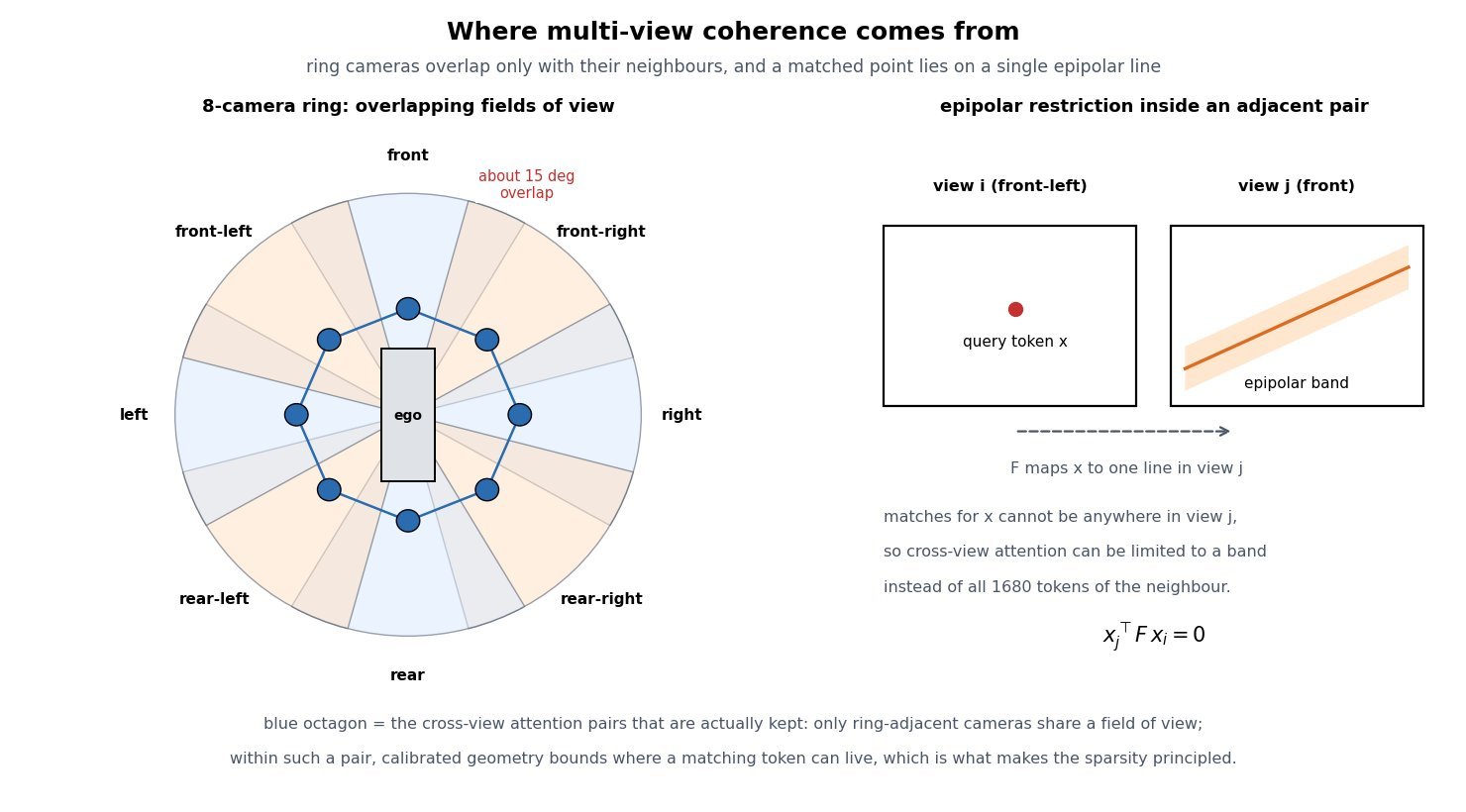
Figure 2: Coherence is a geometry problem before it is a modelling problem. Only ring-adjacent pairs share a field of view, and within a pair the epipolar constraint bounds where a matching token can live, so both the sparsity pattern and the conditioning signal are dictated by the calibrated rig.
Mathematical Formulation:


![\mathcal{L}(\theta) = \mathbb{E}\left[\lVert \epsilon - \epsilon_{\theta}(z_t, t, c) \rVert^2\right]](https://s0.wp.com/latex.php?latex=%5Cmathcal%7BL%7D%28%5Ctheta%29+%3D+%5Cmathbb%7BE%7D%5Cleft%5B%5ClVert+%5Cepsilon+-+%5Cepsilon_%7B%5Ctheta%7D%28z_t%2C+t%2C+c%29+%5CrVert%5E2%5Cright%5D&bg=ffffff&fg=000&s=3&c=20201002)


Where:
 is the joint latent tensor being denoised, with views, latent frames, tokens per view-frame, and latent channels.
- is the per-view pixel resolution and the combined tokenizer and patch downsampling factor, giving a latent map.
- is the total sequence length if the clip were flattened, the number that decides whether full attention is affordable.
- is the sampled noise, the noised latent at level , and the diffusion transformer.
- bundles the conditioning: per-view rays , ego action (speed and curvature), agent and map layout , and the overlapping context latents from the previous window.
- is the Plücker embedding of the ray through pixel , with unit direction and camera origin , so extrinsics and intrinsics enter as a 6-channel image instead of a flat vector.
 is the joint latent tensor being denoised, with
  views,
  latent frames,
  tokens per view-frame, and
  latent channels.
 is the per-view pixel resolution and
  the combined tokenizer and patch downsampling factor, giving a
  latent map.
 is the total sequence length if the clip were flattened, the number that decides whether full attention is affordable.
 is the sampled noise,
  the noised latent at level
  , and
, and  the diffusion transformer.
 , ego action
  (speed and curvature), agent and map layout
  , and the overlapping context latents
  from the previous window.
 is the Plücker embedding of the ray through pixel
  , with unit direction
  and camera origin
  , so extrinsics and intrinsics enter as a 6-channel image instead of a flat vector.
Attention Cost Per Block:


Factorization therefore costs about 0.8% of full joint attention at this shape, and almost all of the remaining cost is ordinary within-frame spatial attention. The cross-view and temporal axes together add under 1.5% on top of the spatial term, which is the practical reason multi-view coherence is affordable at all: the expensive part of the model is generating each image, not keeping the images consistent.

Figure 3: Full joint attention over the flattened clip grows as  while the factorized form grows close to linearly in
  , so the gap widens with every camera added to the rig. Adding a ninth or tenth view is a routine cost in the factorized design and prohibitive in the joint one.
| Property | Independent per-view generation | Factorized view + time attention | Full joint 4D attention |
|---|---|---|---|
| Attention pairs per block | 3.61e8 (spatial only) | 3.66e8, about 1.4% overhead | 4.62e10, roughly 126x more |
| Overlap agreement | None; only the shared layout condition, so seams disagree | Enforced on ring-adjacent pairs, optionally epipolar-banded | Enforced globally, mostly on pairs that never overlap |
| Temporal behaviour | Per-view only; the eight views desynchronize over rollout | Temporal axis plus one shared action keeps views in lockstep | Strongest in principle, but memory caps the clip length |
| Failure signature | Objects appear in one camera and vanish in its neighbour | Slow drift of far-field content and appearance across rollout | Out-of-memory or a clip too short to be useful for simulation |
| Practical verdict | Useless for BEV or occupancy training data | The production choice for ring-camera world models | Research ablation at small resolution or few frames |
 latent actions, and the tiny codebook is not a detail but the mechanism: at 3 bits per step the code physically cannot smuggle the next frame through it. At inference the LAM encoder is thrown away, a key press is mapped onto one of the
  learned codes, and the dynamics model rolls the world forward autoregressively, which turns passive video into a playable environment.
 produces one discrete code per transition, standing in for the action label that the dataset never had.
 bits, forcing it to describe a control decision rather than pixels.


 is vector quantization onto a codebook of
  is the inverse-dynamics encoder, which is the only component allowed to see the future frame, and
  are its parameters.
 are the observed past frames (in practice their VQ tokens),
  is the true next frame, and
  is the prediction.
 is the forward dynamics model, a masked video-token transformer or a diffusion decoder, conditioned on the past plus
  is the reconstruction objective, extended in practice by the usual commitment and codebook terms; no action label appears in it, which is why unlabeled video is sufficient.
 is the capacity bound that prevents frame leakage, giving 3 bits per step when
  is the controllability metric, comparing a rollout driven by the inferred code against one driven by a random code
  drawn from the same codebook.

 token grid over a 1024-entry visual codebook already carries about 2,560 bits, roughly three orders of magnitude more than the action code, so the encoder has no route to cheat and the dynamics model must genuinely keep a model of the scene in its context. That ratio is the design knob you actually tune: too small and the environment is unresponsive, too large and it stops being an environment at all.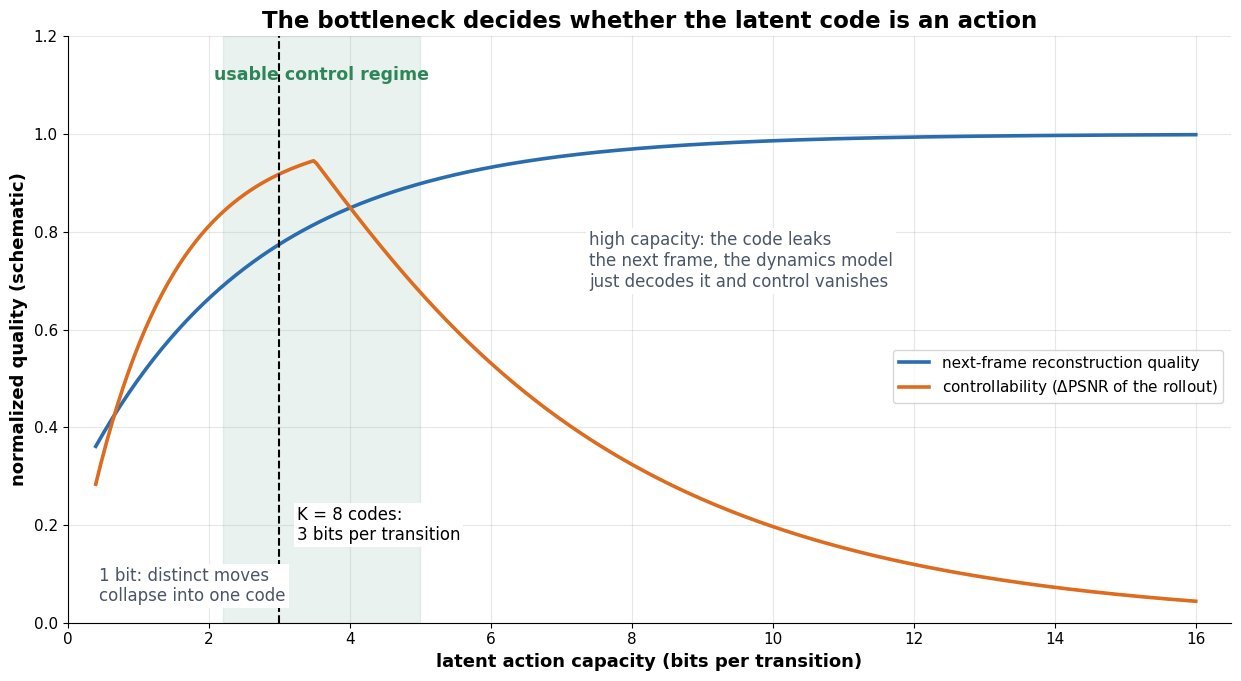
 -step horizons) solve temporal inconsistency and compounding error drift?
 future joint-position targets rather than one action. It is trained as a conditional VAE (CVAE) with an
  reconstruction loss on the chunk plus a KL term on a small style latent
  chunk decisions, so the number of places where the policy can leave the training distribution shrinks by a factor of
  behaviour-cloning bound falls to roughly
  . Chunking also removes per-step temporal inconsistency, because the actions inside a chunk are generated jointly from one latent and one observation, so the policy cannot flip between two valid modes on consecutive 20 ms steps. To avoid a visible discontinuity when a new chunk starts, ACT still queries the network every step and blends the overlapping predictions with temporal ensembling.
 instead of
  , so
, so  sequential decisions, and compounding error grows with the number of decisions, not with the number of motor commands.
 gives one clean decisive mode.
 , which keeps reaction latency at one control step while removing chunk-boundary jumps.
 : the
: the  output is produced non-autoregressively in about 0.01 s. The whole policy is roughly 80M parameters trained from scratch per task on about 50 demonstrations, which is the interesting part: the gain does not come from scale or pretraining, it comes from changing what a single prediction means.
 . At test time


 is the predicted action chunk, here
  for a bimanual 6-DoF-plus-gripper arm pair.
 are the four camera images at time
  the measured joint positions, together forming the only observation the chunk is conditioned on.
 in training and set to
  indexes positions inside the chunk, each produced by its own learned decoder query.
 weights the KL term; a large
  decision points, each contributing error
  . The same factor cuts inference calls, which is why a chunked policy can afford a much heavier network per decision.


 , where index
  is the oldest prediction. That value of
  keeps the weights nearly uniform (1.00, 0.99, 0.98, …), so new observations are folded in immediately while the average stays smooth; a larger


![[-1,1]](https://s0.wp.com/latex.php?latex=%5B-1%2C1%5D&bg=ffffff&fg=000&s=2&c=20201002) removes the scale mismatch between a 0.08 m gripper stroke and a 0.03 m one.
removes the scale mismatch between a 0.08 m gripper stroke and a 0.03 m one. steps outputs
  numbers whose meaning is embodiment-dependent at every position.


 from the camera views
  , the instruction
  , and the embodiment context
  (robot id, proprioceptive state, control rate).
 is the head for embodiment group
  , with its own output dimension
  and chunk horizon, so
  .
. are the mixture weights over
  embodiment groups, set by capped sampling rather than raw episode counts, and
  is the behaviour-cloning loss on group
  is that group’s gradient with respect to the shared parameters only; head parameters
  receive gradient from one group and cannot conflict by construction.
 is the PCGrad projection of
  onto the normal plane of
  , applied only when the cosine is negative and symmetrically for
  .
.

![[-1, 1]](https://s0.wp.com/latex.php?latex=%5B-1%2C+1%5D&bg=ffffff&fg=000&s=2&c=20201002) . In the RT-2 and OpenVLA line each normalized dimension is uniformly discretized into 256 bins and the bin index is mapped onto reserved token ids, typically the 256 least-frequently-used entries of the existing SentencePiece or Llama vocabulary, so an action literally becomes a short string of tokens appended to the same causal sequence that holds the image patches and the instruction. Nothing about the architecture changes: the same causal self-attention, the same softmax, and the same cross-entropy loss that predict the next sub-word now predict the next joint delta, which is exactly what lets a VLA inherit internet-scale pretraining. The cost is a quantization floor plus one sequential decoder step per degree of freedom, which is why newer systems keep the shared prefix but replace the discrete head with a continuous action expert that emits a whole chunk of future actions through diffusion or flow matching in a single pass.
. In the RT-2 and OpenVLA line each normalized dimension is uniformly discretized into 256 bins and the bin index is mapped onto reserved token ids, typically the 256 least-frequently-used entries of the existing SentencePiece or Llama vocabulary, so an action literally becomes a short string of tokens appended to the same causal sequence that holds the image patches and the instruction. Nothing about the architecture changes: the same causal self-attention, the same softmax, and the same cross-entropy loss that predict the next sub-word now predict the next joint delta, which is exactly what lets a VLA inherit internet-scale pretraining. The cost is a quantization floor plus one sequential decoder step per degree of freedom, which is why newer systems keep the shared prefix but replace the discrete head with a continuous action expert that emits a whole chunk of future actions through diffusion or flow matching in a single pass. -dimensional action vector with fixed slot semantics, and unused slots are zero-padded so one model can serve several embodiments.
 and
and  bins, which is what keeps the joint action coherent rather than per-axis independent.
 chunk of real numbers. Both write into the identical fixed-slot action vector, including the mode flag that selects arm, base, or episode termination.


 is the action at control step
  .
. is the raw value of dimension
  its clipped version;
  and
and  are the per-dimension percentiles estimated on the training corpus.
![u_i \in [-1, 1]](https://s0.wp.com/latex.php?latex=u_i+%5Cin+%5B-1%2C+1%5D&bg=ffffff&fg=000&s=2&c=20201002) is the normalized value and
is the normalized value and  the bin index, so the grid holds 256 levels per dimension.
 overwrites the 256 least-used token ids at the tail of that vocabulary.
 indexes the action dimensions in a fixed canonical order.


 m resolves to about 0.39 mm per bin, which is fine for pick and place and marginal for connector insertion, but an eight-step chunk of an 11-dimensional action costs 88 sequential decoder passes, which caps a 7B VLA at roughly 3 to 10 Hz on a single accelerator. The alternative keeps the shared prefix and attaches a small action expert whose tokens are continuous rather than discrete: starting from noise, it integrates a learned velocity field for a handful of solver steps and emits the whole chunk at once, which is how flow-matching policies reach 50 Hz dexterous control. Crucially, both the categorical head and the flow head are distributional, and that matters more than resolution: when two different behaviours are equally valid, a plain L2 or Gaussian regression head averages them into an action that belongs to neither mode.


 in-batch similarity matrix, with
  negatives per anchor and a learned temperature, optimized symmetrically image-to-text and text-to-image.
![\mathrm{[CLS]}](https://s0.wp.com/latex.php?latex=%5Cmathrm%7B%5BCLS%5D%7D&bg=ffffff&fg=000&s=2&c=20201002) state, and it is nearly useless unless the negatives are hard negatives mined from the ITC similarity distribution.
state, and it is nearly useless unless the negatives are hard negatives mined from the ITC similarity distribution.
 joint forward passes for a gallery of
  captions, which is why ALBEF and BLIP use ITC to shortlist


 and
and  are the L2-normalized projections of the image
  is a cosine similarity in
  is the learned temperature (CLIP initializes it at 0.07 and clamps it), which controls how sharply the softmax concentrates on the hardest negatives.
 index the batch, and the diagonal
  holds the positives;
  is the same expression with the softmax taken down the column.
 is the fused
  the match label, with the negative pair drawn from the ITC row rather than uniformly.
 the unmasked context, and
  the true word piece at position


 ITC candidates needs 160,000, about 31 times cheaper than the exhaustive version and still recovering most of the accuracy gain. That arithmetic, not any statement about representational quality, is why production retrieval systems keep ITC in the serving path and treat ITM as an offline or second-stage model.
 and the alt-text otherwise;
  GPU-hours.


 is the synthetic caption sampled from the captioner
  conditioned on image
  , and
, and  is the caption actually used for example
 ![p \in [0,1]](https://s0.wp.com/latex.php?latex=p+%5Cin+%5B0%2C1%5D&bg=ffffff&fg=000&s=2&c=20201002) is the mixing ratio, the single hyper-parameter that decides how much of the corpus the captioner rewrites.
is the mixing ratio, the single hyper-parameter that decides how much of the corpus the captioner rewrites. and
and  are the image and text towers producing normalized embeddings,
  is the batch size supplying the in-batch negatives.

 seconds of single-GPU time, roughly 14,000 GPU-hours, or about half a day on a 1,000-GPU cluster. That is a real but one-time preprocessing cost, amortized over every subsequent training run on the corpus, which is why recaptioning is usually cheaper than the ablation sweeps it replaces. The recurring costs are subtler: longer captions mean more text-encoder tokens per step, and a frozen captioner freezes a snapshot of one model’s competence into the dataset.
 synthetic to 0.2 original, or an LLM fusion of both strings as in CapsFusion, retains the named entities and factual hooks that only alt-text carries.


 is the CLIP cosine between the image embedding
  and caption embedding
  , and
, and  for a ViT-B/32 scorer or a percentile such as the top 30%.
 is the raw pool (12.8B pairs in CommonPool),
  the CLIP-gated set, and
  the final corpus after intersecting with the cluster filter
  and benchmark decontamination, giving roughly
  pairs.
 is the captioner VLM and
  the dense synthetic caption it samples for image
  ;
; ![\alpha \in [0,1]](https://s0.wp.com/latex.php?latex=%5Calpha+%5Cin+%5B0%2C1%5D&bg=ffffff&fg=000&s=2&c=20201002) is the mixing probability of using the synthetic caption instead of the original alt-text
is the mixing probability of using the synthetic caption instead of the original alt-text  is pure synthetic and
  is the raw web baseline.
 only, with the image
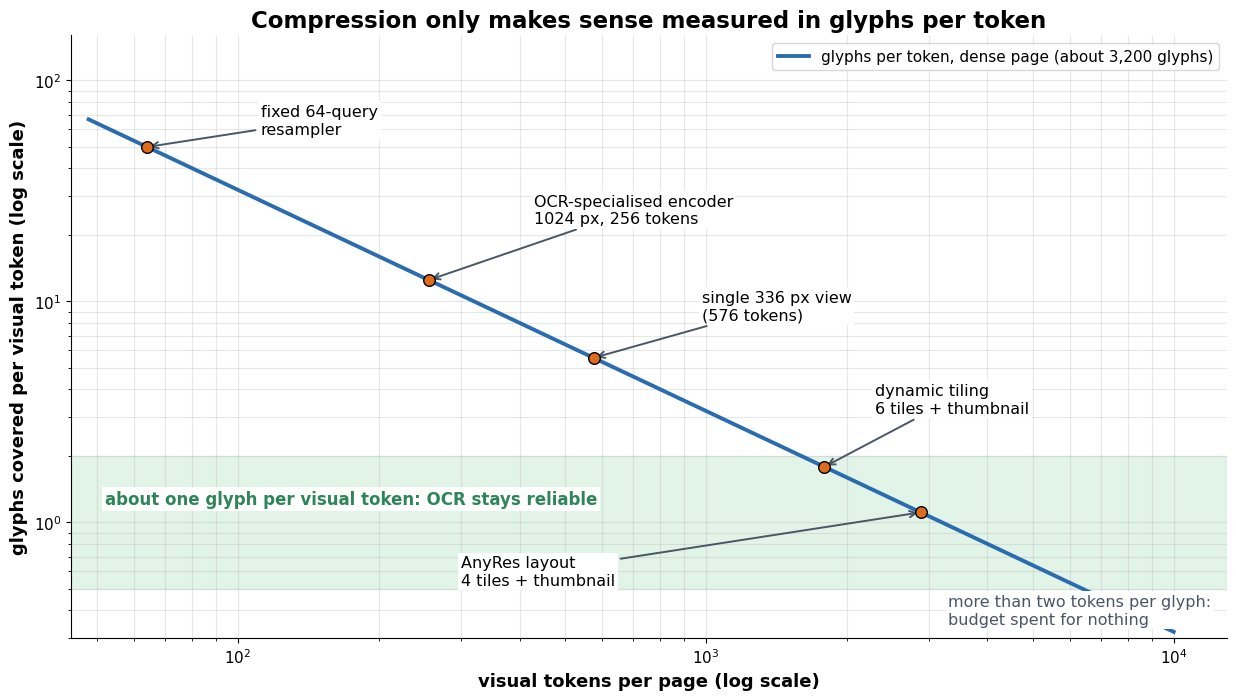
  visual tokens, while LLaVA-1.6’s AnyRes scheme tiles a high-resolution image into four crops plus a global thumbnail, giving
  tokens. That five-fold increase is what unlocks DocVQA and ChartQA, and it also means the instruction mixture must contain enough high-resolution document data to justify the tokens, otherwise the model pays the cost without learning to use the detail.

 prefill.


 is the number of visual tokens the encoder emits for one page, which is what actually enters the LLM context.
 are the rasterized page height and width in pixels (
 for A4 at 150 DPI), and
  is the effective patch stride after a 2×2 merge of 14×14 patches.
 is the attention cost before the first output token, quadratic in
  ; the KV cache grows linearly, so a 20-page document is a memory problem as well as a compute one.
 is the per-page success rate of pipeline stage
  running detection, recognition, layout, reading order, and table structure.
 is the end-to-end page accuracy: five stages that each succeed 95% of the time leave only about 77% of pages fully clean, and this multiplicative compounding is the structural argument for a single-stage model.
 block of patch embeddings into one vector of width
  and projects it back to
  length reduction still lets every output token point at a known rectangle of the page.
 tokens rather than one giant grid.


 is the patch count the vision encoder produces from a resized input of size
  with patch size
  is the number of tokens actually handed to the language model.
 is the spatial merge factor; pixel unshuffle with
  concatenates 4 patch embeddings into width
  and projects back to
  is the original page resolution and
  is the glyph count on the page and
  is the practical safety line for character-accurate reading.
 is the text prompt length and