
How do world models handle multi-modal future distributions when a car at an intersection could turn left, turn right, or go straight, as in driving world models like Wayve’s GAIA?
Answer
The future at an intersection is genuinely multi-modal, so the first thing a world model must avoid is regression to the conditional mean. The minimizer of a squared-error objective is ![\mathbb{E}[x \mid c]](https://s0.wp.com/latex.php?latex=%5Cmathbb%7BE%7D%5Bx+%5Cmid+c%5D&bg=ffffff&fg=000&s=2&c=20201002) , which means a network that has perfectly learned that left, straight, and right are all plausible will output their average: a path down the median that no driver would ever take. The fix is architectural rather than a loss-weighting trick. A world model is built as a conditional sampler, not a point predictor, so drawing from it returns one internally consistent future at a time and the multimodality appears across draws rather than inside a single blurred output. Three mechanisms dominate in practice: a stochastic latent sampled at every rollout step (Dreamer-style RSSM), ancestral sampling of discrete tokens over a learned video codebook (GAIA-1-style), and iterative denoising from Gaussian noise (GAIA-2-style latent diffusion). Trajectory-level stacks add a fourth: a small set of anchors or mixture components with explicit probabilities, trained with a winner-take-all loss so each head owns one maneuver.
, which means a network that has perfectly learned that left, straight, and right are all plausible will output their average: a path down the median that no driver would ever take. The fix is architectural rather than a loss-weighting trick. A world model is built as a conditional sampler, not a point predictor, so drawing from it returns one internally consistent future at a time and the multimodality appears across draws rather than inside a single blurred output. Three mechanisms dominate in practice: a stochastic latent sampled at every rollout step (Dreamer-style RSSM), ancestral sampling of discrete tokens over a learned video codebook (GAIA-1-style), and iterative denoising from Gaussian noise (GAIA-2-style latent diffusion). Trajectory-level stacks add a fourth: a small set of anchors or mixture components with explicit probabilities, trained with a winner-take-all loss so each head owns one maneuver.
(1) Squared Error Averages Modes: any L2-trained deterministic head converges to the mean of the modes, and at a T-junction that mean is a physically impossible maneuver even though it minimizes the loss.
(2) Sample, Do Not Average: the model defines  and multimodality is expressed by independent draws, each of which must remain a single coherent maneuver from first frame to last.
(3) Stochastic Latents: an RSSM splits state into a deterministic recurrent part  and a sampled part
  (DreamerV3 uses 32 categoricals of 32 classes), so branching happens once per step and is then carried forward consistently.
(4) Discrete Token Sampling: quantize frames into codebook tokens and sample autoregressively with temperature or top-p, which turns mode choice into ordinary categorical sampling at the price of a long token sequence per second of video.
(5) Explicit Mode Heads:  anchored components with probabilities
  give the planner a calibrated, enumerable set of maneuvers instead of an opaque sampler, at the cost of a fixed mode budget.
(6) Metrics Must Reward Coverage: single-sample L2 rewards mode averaging, so evaluation moves to  , maneuver recall, and probability calibration, with
  the standard budget on the Waymo Open Motion Dataset.

Figure 1: The same scene under two objectives. The L2 optimum is the pointwise average of the three maneuvers, so it drifts up the middle of the junction and matches none of them, while 12 draws from a stochastic model are individually legal and jointly cover all three modes. Nothing is wrong with the averaged model’s likelihood estimate of the mean; the problem is that the mean is not an admissible trajectory.
Where the randomness enters decides how the model behaves in a rollout. In a latent state-space model the sample is a small categorical latent drawn once per timestep, so a single decision at the junction propagates through the recurrent state and the decoded frames stay consistent for the rest of the horizon; the risk is posterior collapse, where the KL term is tuned so aggressively that the prior stops carrying maneuver information and rollouts become deterministic again. In a discrete autoregressive model the sample is a token, and mode choice is spread over hundreds of tokens per frame, which makes temperature a global blur-versus-diversity knob: too low and every rollout goes straight, too high and lane geometry falls apart. Diffusion models place the randomness in the initial noise vector, giving the best sample fidelity and the most controllable conditioning, but they pay 20 to 50 network evaluations per sample and cannot easily produce a probability for each maneuver. Explicit mixture heads sit at the opposite end: a Wayformer-style model emits Gaussian components with softmax weights in one forward pass of a few milliseconds, which is what a downstream planner actually wants, but six is a hard ceiling on expressible futures.

Figure 2: All three families implement the same idea with different noise sources, and the tree shows why it works: a draw at the first branch commits to a maneuver, later draws only refine speed and gap acceptance, and the leaf probabilities recover the marginal maneuver distribution (0.28 left, 0.45 straight, 0.27 right). A deterministic model collapses this tree to its centroid.
Mathematical Formulation:
![f^{*}(c) = \mathbb{E}[x \mid c]](https://s0.wp.com/latex.php?latex=f%5E%7B%2A%7D%28c%29+%3D+%5Cmathbb%7BE%7D%5Bx+%5Cmid+c%5D&bg=ffffff&fg=000&s=3&c=20201002)


Where:
 is the future to be predicted (a trajectory of waypoints or a sequence of frames) and is the squared-error optimum, which is the conditional mean and therefore not generally a valid maneuver.
- is the conditioning context: past observations, lane graph, ego speed, and traffic-light state.
- indexes mixture components or anchors, with weights summing to one, means , and covariances ; is the standard benchmark budget.
- is the stochastic latent whose prior carries the mode choice; marginalizing it makes multi-modal even when is unimodal.
- indexes rollout steps or tokens, and the product form is the ancestral sampling factorization used by discrete-token world models.
 is the future to be predicted (a trajectory of waypoints or a sequence of frames) and
  is the squared-error optimum, which is the conditional mean and therefore not generally a valid maneuver.
 is the conditioning context: past observations, lane graph, ego speed, and traffic-light state.
 indexes mixture components or anchors, with weights
  , and covariances
  ;
;  is the stochastic latent whose prior
  carries the mode choice; marginalizing it makes
  is unimodal.
 indexes rollout steps or tokens, and the product form is the ancestral sampling factorization used by discrete-token world models.
Why L2 Prefers The Impossible Path (two equally likely 8 m lateral outcomes):


Committing to a real maneuver scores twice as badly as predicting the physically impossible average, which is the whole reason single-output regression is untrustworthy here. Mode-based training removes the incentive by only penalizing the closest component and learning the weights separately, and rollout models remove it by making the loss a likelihood rather than a distance.
Mode-Based Training And Scoring:


The evaluation side matters as much as the model. Reporting a single-sample average displacement error silently rewards mode averaging, so benchmarks score and  over samples, plus a mAP-style metric that requires the probabilities to be calibrated and not just the geometry to be covered. That combination is deliberate: alone can be gamed by spraying diverse but implausible samples, while likelihood alone can be won by a model that puts all its mass on “straight” because straight is the majority class at most intersections. In production the planner consumes both, treating each mode as a separate scenario to cost, so a mode that is missing from the sample set is a scenario the planner never considers.

Figure 3: Drawing more samples only helps if the samples differ. A mode-collapsed sampler flattens out near 1.8 m because sample 6 repeats sample 1, while a diverse sampler keeps improving; the bar panel shows the consequence the planner feels, namely how often the maneuver the other car actually performed is present anywhere in the predicted set.
| Property | Anchored mixture head | Latent state-space (RSSM) | Discrete token AR | Latent diffusion |
|---|---|---|---|---|
| Source of multimodality | K anchors with softmax weights | Categorical latent drawn each step | Temperature or top-p token sampling | Initial Gaussian noise vector |
| Cost per future | One forward pass gives all K | T cheap recurrent steps | Hundreds of tokens per frame | 20 to 50 denoising steps |
| Explicit probabilities | Yes, directly usable by a planner | Only via repeated sampling | Sequence likelihood, hard to read | No tractable density |
| Expressible futures | Capped at K (usually 6) | Combinatorial in latent codes | Unbounded, pixel-level detail | Unbounded, highest fidelity |
| Dominant failure | Dead heads under winner-take-all | Posterior collapse, deterministic rollouts | Low temperature collapses to majority mode | Latency, and no calibrated mode weights |
 , such as brake onset two seconds earlier, and roll the scene forward under that intervention. The hard part is not the ego kinematics, which a closed-form formula settles in one line; the hard part is that every other agent’s logged trajectory becomes invalid the instant the ego behaves differently, so a naive non-reactive log replay manufactures collisions that could never have happened. A world model supplies the missing conditional distribution
  , generating plausible reactions for surrounding traffic either as trajectories over a structured scene or as generated sensor frames, and because those reactions are stochastic the answer is a distribution over outcomes estimated from many sampled rollouts rather than a single verdict.
 averages over all scenes that could occur, while the counterfactual
  conditions on the evidence of this exact log, so the same pedestrian keeps the same intent.
 rollouts with confidence intervals, since one lucky rollout is not evidence of avoidance.


![\Delta R = R(\tau) - \mathbb{E}[R(\tau')]](https://s0.wp.com/latex.php?latex=%5CDelta+R+%3D+R%28%5Ctau%29+-+%5Cmathbb%7BE%7D%5BR%28%5Ctau%27%29%5D&bg=ffffff&fg=000&s=3&c=20201002)
 and
and  are the observed log, meaning the recorded sensor stream plus tracks and the ego actions that were actually executed.
 is the counterfactual policy and
  its action, here a brake command issued 2 s earlier than in the log;
  is the simulated joint state of ego plus neighbours.
 is the world model transition, the only component that can supply neighbour responses to an action that was never taken.
 is the counterfactual outcome variable (contact, impact speed, minimum TTC) and its distribution is estimated from
  .
. is a scalar risk or severity functional, so
  is the risk actually removed by the intervention, and it can be negative when the new action introduces its own hazard.


 m, so 0.67 s of extra warning already avoids contact, and everything beyond that buys margin rather than outcome. The engineering value of the simulator therefore lies in the second-order effects that closed-form kinematics cannot see, above all the induced risk from an earlier, harder, cause-free deceleration in front of a following vehicle.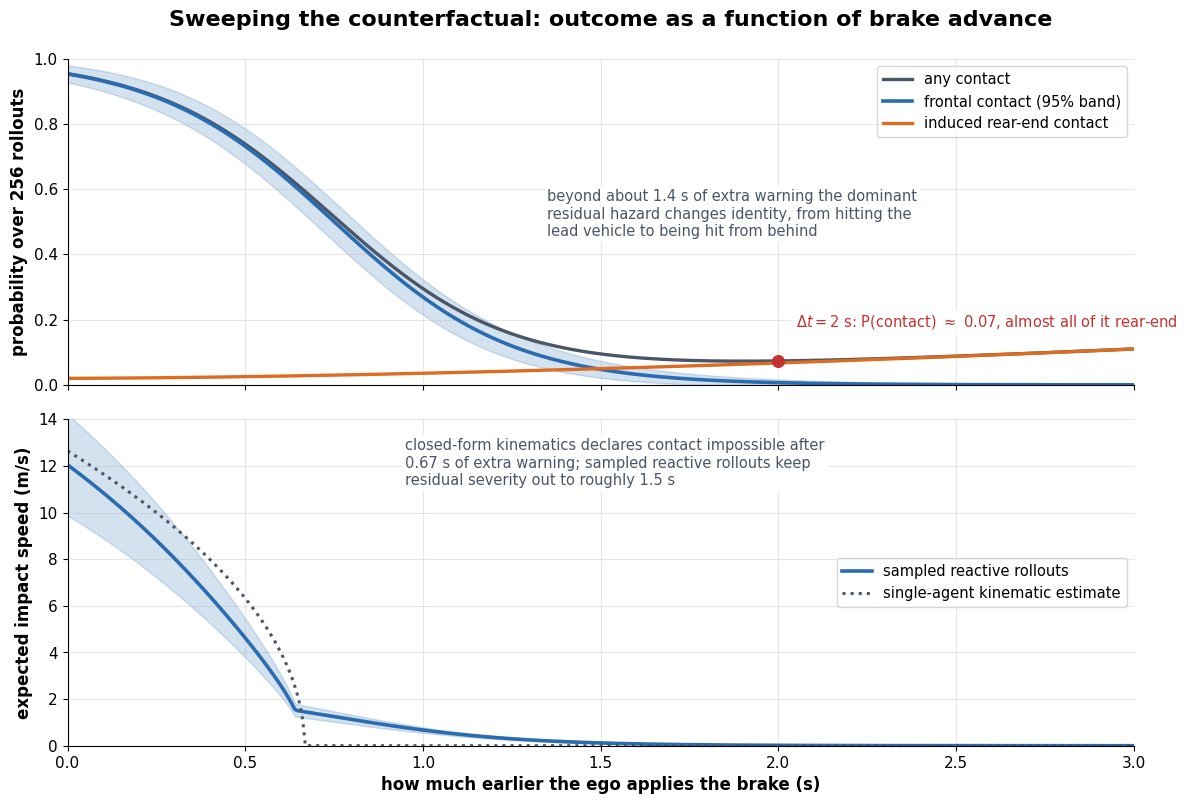
 , so the camera pose enters as a projection matrix instead of a conditioning token the network may ignore.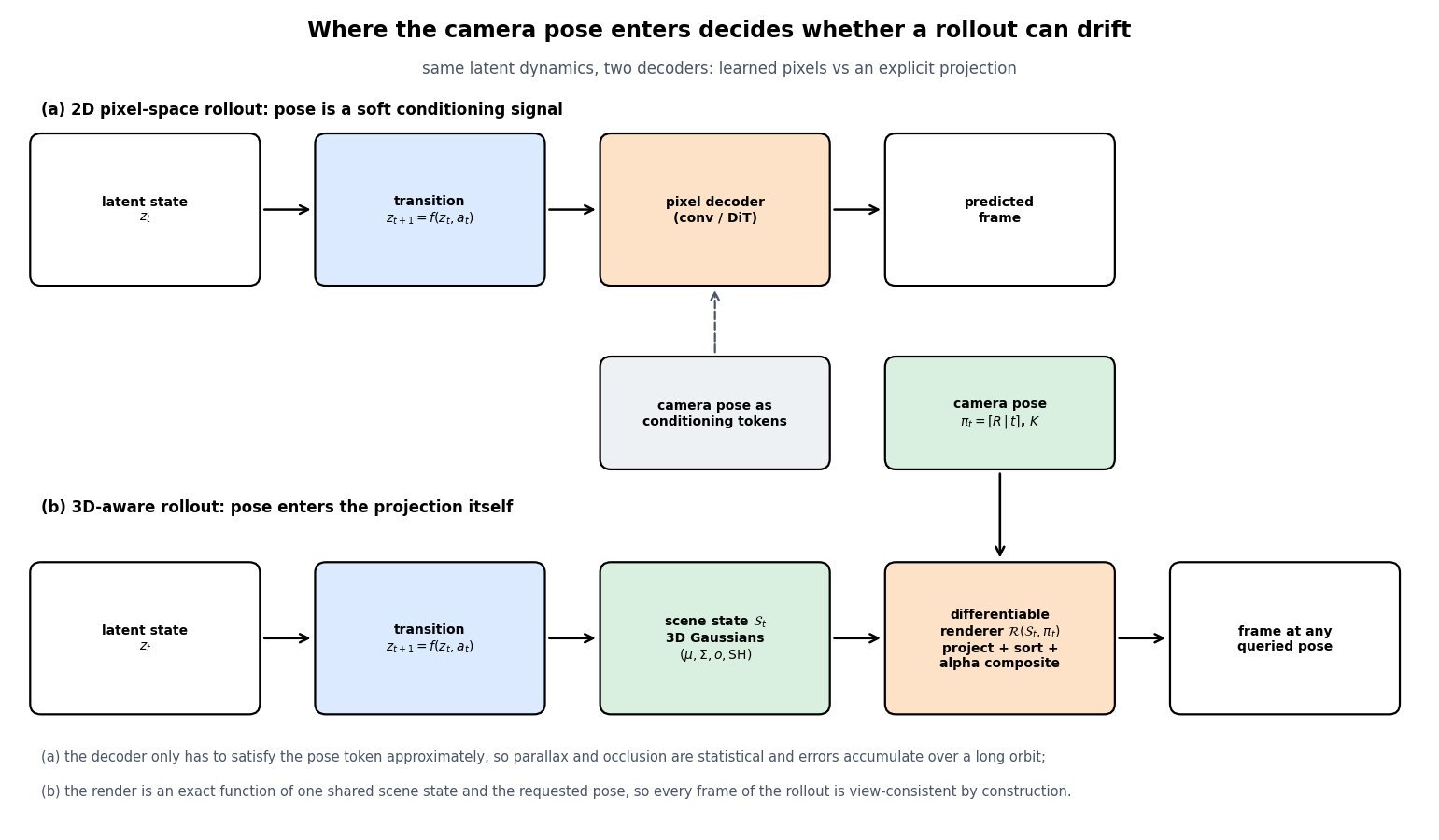


 the action, and
  decodes the latent into a scene state rather than into pixels.
 is the geometric state: for 3DGS a set of primitives
  , for a NeRF a field returning density and colour at a queried point and direction.
 is the camera pose and intrinsics, and
  the differentiable renderer;
  is the frame, so any pose can be queried at any rollout step.
 is the colour of pixel
  ,
,  indexes the
  is the view-dependent colour, and
  is the accumulated transmittance that produces occlusion for free.
 is the volume density at sample
  the spacing between adjacent samples along the ray;
  is a Gaussian’s opacity and
  its projected 2D density evaluated at the pixel.
 is the world-space covariance factored into rotation
  so it stays positive semi-definite under gradient descent, and
  is its screen-space projection through the viewing transform
  and the affine Jacobian
  .
. is the predicted per-primitive displacement from a canonical configuration, which is how dynamics enter without breaking the static consistency guarantee at each instant.
 rays times 192 samples for one 1080p frame, which is hundreds of millions of queries. Hash-grid encodings shrink the per-query cost by orders of magnitude but keep the same per-ray structure. Rasterization instead touches each Gaussian once, splats it into the tiles it covers, and blends sorted contributions, which turns rendering into a bandwidth-bound pass rather than a compute-bound integral. That is the reason 3D-aware world models became practical after 2023 rather than after 2020.
 demonstrations, while few-shot cells sweep
  target demonstrations and report a curve plus the retention on the original seen-task suite after adaptation. The trial budget sets the resolution of the entire experiment, because 20 trials per cell give a 95% interval of roughly
  points at
  , which cannot resolve the 10 to 15 point differences people actually argue about. Cheap simulation suites such as LIBERO and SIMPLER buy statistical power and reproducibility, and real-robot paired trials buy validity, so a credible report uses both and checks that they rank policies the same way.
![[0, 1]](https://s0.wp.com/latex.php?latex=%5B0%2C+1%5D&bg=ffffff&fg=000&s=2&c=20201002) , which exposes whether a novel object breaks perception or grasp geometry.
, which exposes whether a novel object breaks perception or grasp geometry. over several
  values and fit a demo-efficiency constant, because a single
  number hides whether the policy needed 2 demos or 50.


 is the estimated success rate of one evaluation cell and
  the outcome of trial
  is the generalization gap on axis
  , measured against the seen-task control run in the same session and the same scene.
 at 95% confidence,
  is the pooled rate of the two arms, and
  is the minimum detectable difference you are willing to claim.
 the zero-shot rate,
  the saturation rate, and
  the demo-efficiency constant in demonstrations, so smaller


 -dimensional space that holds the visual patch tokens. Inside the block, the language and vision residual stream supplies the queries while the concatenated visual and proprioceptive tokens form the key/value memory, so softmax attention decides layer by layer how much contact evidence to read instead of averaging modalities with fixed weights. Because the pretrained VLM has never seen a wrench token, the cross-attention output is normally added through a zero-initialized tanh gate, which makes the new modality an exact no-op at initialization and lets it grow in during robot fine-tuning without destroying the language prior. The two streams also carry different information: vision says where and what, force says when and how hard, and force is the only channel that survives occlusion once the tool is inside the hole. What this fusion cannot do is close the contact loop, since one VLA forward pass costs 50-200 ms while an impact transient decays in a few milliseconds, so the policy emits setpoints, target wrenches, and impedance gains for a 1 kHz low-level controller that does the actual reacting.
 with
with  preserves the pretrained VLM at step zero and is the standard fix for adding a modality that was absent from web-scale pretraining.
 holds only after subtracting harmonic-drive friction and stiction, which are velocity-dependent and hysteretic; current is therefore best used for coarse collision and jam detection across the whole arm rather than for fine wrench estimation at the tool. The second is bandwidth. Slip, chatter, and impact live in the 100-1000 Hz band, so pooling to 10 Hz destroys exactly the evidence you added the sensor for, which is why many implementations feed short-time spectral features or per-window statistics (peak, RMS, jerk) alongside the mean rather than a naive average.


![M = [\, U_{vis} ; U_{ft} ; U_{cur} \,]](https://s0.wp.com/latex.php?latex=M+%3D+%5B%5C%2C+U_%7Bvis%7D+%3B+U_%7Bft%7D+%3B+U_%7Bcur%7D+%5C%2C%5D&bg=ffffff&fg=000&s=3&c=20201002)


 is the wrench at time
  , with three forces
  is the measured current of joint
  ,
,  the motor torque constant, and
  the friction and stiction term that makes current a biased torque estimate.
 is the window encoder over the last
  its projection to the backbone width
  is the resulting small set of soft tokens.
 is the concatenated key/value memory holding visual, force-torque, and joint-current tokens, and
  is the language and vision hidden state that provides queries through
  .
. is the learned scalar gate, initialized at
  so that
  and the block reduces to the pretrained VLM on the first step.
 are the commanded stiffness and damping matrices,
  and
and  the desired pose and velocity, and
  the wrench the 1 kHz controller actually applies.


 and most of that
  comes from states the policy has never visited, which is exactly what the messy tail supplies. Two mechanical fixes matter as much as the curation: percentile-based action normalization so one jerky operator cannot rescale the action space, and an expressive action head over action chunks so contradictory strategies are not averaged into a mean action.

![\mathcal{L}_g(\theta) = \mathbb{E}_{(o,a) \sim D_g}[\ell(a, \pi_{\theta}(o))]](https://s0.wp.com/latex.php?latex=%5Cmathcal%7BL%7D_g%28%5Ctheta%29+%3D+%5Cmathbb%7BE%7D_%7B%28o%2Ca%29+%5Csim+D_g%7D%5B%5Cell%28a%2C+%5Cpi_%7B%5Ctheta%7D%28o%29%29%5D&bg=ffffff&fg=000&s=3&c=20201002)


 is the quality score of episode
  , with
  the proxy feature vector (jerk, path ratio, idle fraction, regrasps, VLM verdict) and
  fitted on a few hundred human-labelled episodes.
 is the loss on group
  its observation-action pairs with observation
  (images plus instruction plus proprioception) and action chunk
  indexes groups,
  is the simplex of mixture weights, and the inner maximization is group DRO, which upweights whichever group is currently worst-fit instead of trusting a hand-tuned mixture.
 is the policy,
  the per-sample cloning loss,
  the rollout horizon, and
  factor is why coverage of off-nominal states is worth more than average demo neatness.
 and
and  are the 1st and 99th percentiles of each action dimension over the training mixture, so
 ![\tilde{a} \in [-1,1]](https://s0.wp.com/latex.php?latex=%5Ctilde%7Ba%7D+%5Cin+%5B-1%2C1%5D&bg=ffffff&fg=000&s=2&c=20201002) is a quantile-normalized target that a single spiking operator cannot stretch.
is a quantile-normalized target that a single spiking operator cannot stretch.
![\mathbb{E}[a \mid o]](https://s0.wp.com/latex.php?latex=%5Cmathbb%7BE%7D%5Ba+%5Cmid+o%5D&bg=ffffff&fg=000&s=2&c=20201002) , the average of the two modes. That average is often an invalid action, so the policy fails on the exact scenes where it had the most data. The fixes are an expressive head (diffusion or flow matching over an action chunk, as in the pi-zero family) which samples a single coherent mode, action chunking so a commitment persists for several timesteps instead of flip-flopping per step, and conditioning on style or operator id when the modes are genuinely operator-specific. This is also why “smooth” should never be the only quality criterion: a smooth demonstration that solves the task differently from the rest of the corpus still injects a competing mode.
, the average of the two modes. That average is often an invalid action, so the policy fails on the exact scenes where it had the most data. The fixes are an expressive head (diffusion or flow matching over an action chunk, as in the pi-zero family) which samples a single coherent mode, action chunking so a commitment persists for several timesteps instead of flip-flopping per step, and conditioning on style or operator id when the modes are genuinely operator-specific. This is also why “smooth” should never be the only quality criterion: a smooth demonstration that solves the task differently from the rest of the corpus still injects a competing mode.

 , invalidate pixels where the simulated left and right views disagree or where the material is specular or transparent, quantize to the 1 mm uint16 grid, and finally apply the frame delay and rolling-shutter smear of the real driver. Two annotator traps show up in review: distance_to_camera returns Euclidean range while distance_to_image_plane returns the
 px and
  px, a 50 mm baseline is submillimeter at 0.5 m and roughly 13 mm at 2 m, while the simulator’s raw depth sits on the flat zero-error line at every range.


 the stereo baseline, and
  is subpixel matching noise, typically 0.05 to 0.2 px, and the
  is the depth quantization step (1 mm for uint16 output) and
  the residual additive noise; a separate invalid mask zeroes stereo-shadow, specular, and transparent pixels.
 is the constraint impulse the solver applied at a joint or contact and
  the physics step, so the reported force scales as
  and is rate and solver dependent rather than physical.
 , and
, and  is the penetration depth field on the tactile grid that drives both the gel image and the taxel normal force.
 and
and  are normal and tangential contact force with friction coefficient
  ; marker flow exists only inside the cone, and slip appears when the bound is reached.
 against the object SDF supplies both the rendered gel image and the taxel normal-force map, while tangential flow is only valid inside
  .
. each episode buys robustness without any real data, provided the true parameters lie inside the support.
 to logged real trajectories gives a sharper simulator and a higher-performance policy, but only for effects the simulator can represent.
 falls outside the randomization support, the policy has literally never trained on the real robot’s physics and no amount of averaging helps.
 converges to behavior that is safe for the average simulator and optimal for none, which is why Automatic Domain Randomization grows the ranges only as fast as the policy can absorb them. System identification runs in the opposite direction: excite the hardware, log
  , and minimize prediction residuals to recover
  . It buys back performance and shrinks the randomization ranges you still need, but it can only fit parameters the simulator exposes, so backlash or a compliant tendon that has no corresponding term stays invisible no matter how good the fit is. Visual domain adaptation is orthogonal to both: RCAN-style translation maps heavily randomized or real images to one canonical rendering before the policy sees them, GraspGAN-style translation pushes sim images toward realism, and feature-level alignment penalizes the discrepancy between sim and real encoder activations. The standard modern recipe is a pipeline: identify → randomize the residual uncertainty → train a privileged teacher with access to
![\pi_{\mathrm{DR}} = \arg\max_{\pi} E_{\xi \sim p(\xi)} [ J_{\xi}(\pi) ]](https://s0.wp.com/latex.php?latex=%5Cpi_%7B%5Cmathrm%7BDR%7D%7D+%3D+%5Carg%5Cmax_%7B%5Cpi%7D+E_%7B%5Cxi+%5Csim+p%28%5Cxi%29%7D+%5B+J_%7B%5Cxi%7D%28%5Cpi%29+%5D&bg=ffffff&fg=000&s=3&c=20201002)


 and
and  are the expected returns of policy
  on hardware and in simulation, and
  is the reality gap measured in task performance rather than in physics units.
 is the return in the simulator instantiated with
  .
. the simulator’s one-step transition model, and
  the one-step prediction residual against a logged real transition from state
  under action
  and
and  are observations from the two domains, and
 controller ticks in between and keeps commanded velocity and acceleration bounded.
 , so its early actions describe a state the robot has already left. Real-time chunking handles this by treating the overlap as an inpainting constraint, keeping the first
  , which smooths the splice but adds no latency compensation and biases the command toward older observations.


 is the wall-clock horizon a single chunk covers,
  is the rate at which those actions are consumed.
 is the end-to-end delay from shutter to first usable action, covering encoding, network transport, and the forward pass;
  is the policy replan rate, so
  is how many actions are consumed per replan and the third relation is the no-underrun condition.
 is the servo rate and
  and
and  the interpolated position and velocity setpoints,
  the measured state, and
  the gravity term.
 and
and  set the mechanical impedance; low gains make the arm compliant and forgiving of a slightly wrong setpoint, high gains make it track hard and punish every command discontinuity.


 (a 1.0 s horizon) buys margin for a GPU hiccup or a dropped packet. The controller then produces 20 interpolated setpoints per waypoint, so the neural policy is responsible for shape and the real-time layer for smoothness. Note that a longer horizon is not free: everything past the next replan is open-loop motion, so the chunk length trades buffer robustness against reaction time to disturbances, and only the first
  actions of a 50-action chunk are normally executed at all.
 into an executable chunk, of which only the first
  actions are executed before replanning. π0 keeps that output object and changes two things. The sampler becomes conditional flow matching along a straight noise-to-action path integrated with about 10 Euler steps, and the denoiser becomes a 300M-parameter action expert placed inside a PaliGemma 3B VLM as a second set of weights in one transformer. Images and language flow through the VLM weights, the robot state and the 50 noisy action tokens flow through the expert weights, and a single shared self-attention operation joins them, which is why the backbone is initialized from a VLM and fine-tuned rather than kept literally frozen.
 over an
  matrix, which suppresses per-step jitter and makes long idle or contact phases survivable.
 , re-observe, resample. This is the only feedback mechanism the chunk has.


![\tau \in [0,1]](https://s0.wp.com/latex.php?latex=%5Ctau+%5Cin+%5B0%2C1%5D&bg=ffffff&fg=000&s=2&c=20201002) from a beta distribution that deliberately over-weights the noisy end of the path, forms the linear interpolant, and regresses the network onto the constant velocity that carries noise to data. Because the path is straight by construction, inference integrates with a fixed step
from a beta distribution that deliberately over-weights the noisy end of the path, forms the linear interpolant, and regresses the network onto the constant velocity that carries noise to data. Because the path is straight by construction, inference integrates with a fixed step  from
from  to
to  , which is 10 network evaluations for a chunk of 50 actions at 50 Hz. Cross-embodiment training is handled crudely and effectively: every state and action vector is zero-padded to the largest action dimension in the mixture (18 in the released model), and robots with fewer joints simply ignore the padded slots.


 is the action chunk starting at time
  one action,
  and
and  are the conditioning observations: for Diffusion Policy a short stack of image features and proprioception, for π0 the image tokens, language tokens, and the state token.
 indexes discrete denoising steps and
  is the noise-prediction network;
  come from the noise schedule and
  is the injected sampling noise.
 the noise endpoint, and
  the linear interpolant between them.
 is the target velocity field of the straight path,
  the action expert’s prediction of it, and
  is the control period at 50 Hz, so one chunk covers one second;
  and
and  are the per-pass costs of the 3B prefix and the 300M expert.