
In the context of designing a K-Nearest Neighbors (KNN) model, can you explain your approach to selecting the value of K?
Answer
Selecting  in KNN is crucial because it directly controls model performance through the bias-variance tradeoff. The systematic approach is k-fold cross-validation combined with grid search over a range of values, picking the one that minimizes validation error, informed where possible by domain knowledge and data characteristics.
(1) Bias-Variance Tradeoff: A small (e.g., 1) gives low bias but high variance: it tracks noise and overfits; a large raises bias but lowers variance: it oversmooths and can underfit.
(2) Use Odd Values For Classification: In binary classification, an odd avoids tie votes.
(3) Cross-Validation + Grid Search: Evaluate every candidate with k-fold CV and select the minimizer of validation error.
(4) Domain Knowledge: Prior knowledge of the data distribution can narrow the search range.
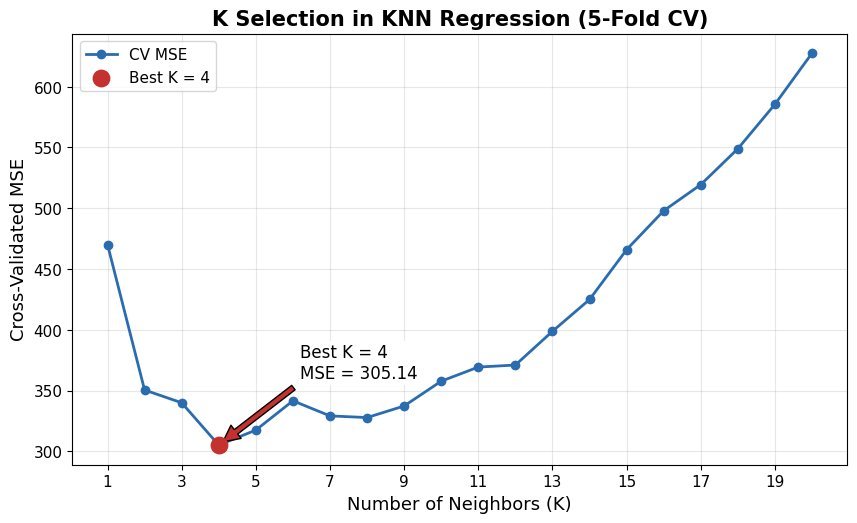
Figure 1: 5-fold CV error across K on a regression task: error dives as variance is tamed (tiny K overfits), bottoms at K = 4, then climbs steadily as over-averaging sets in (large K underfits). The minimizer is the selected K.
Mathematical Formulation:

Where:
 is the actual outcome for the -th validation instance.
- is the prediction made using neighbors (with the point’s own fold held out).
- is the number of validation samples and the loss (e.g., squared error for regression, 0-1 for classification).
 is the actual outcome for the
  -th validation instance.
 is the prediction made using
  is the number of validation samples and
  the loss (e.g., squared error for regression, 0-1 for classification).
Leave a Reply