
What is the difference between 2D and 3D convolutions, and when would you use each?
Answer
A 2D convolution slides a kernel across height and width, while aggregating all input channels at each spatial location. A 3D convolution slides across depth or time as well as height and width, so it learns joint spatiotemporal or volumetric features. Use 2D convolution for ordinary images, per-frame video processing, or slice-wise analysis when cross-slice context is unnecessary. Use 3D convolution for videos, CT/MRI volumes, or occupancy grids when local relationships along the third axis carry essential information and the additional memory and compute are affordable.
(1) Kernel Geometry: A 2D kernel has spatial extent  ; a 3D kernel adds
  and jointly traverses depth or time.
(2) Data Semantics: The third axis should represent an ordered neighborhood such as adjacent frames or slices, not an unordered feature channel.
(3) Trade-off: 3D convolution captures motion or volumetric continuity directly but costs roughly times more than a comparable 2D layer and stores larger activation volumes.
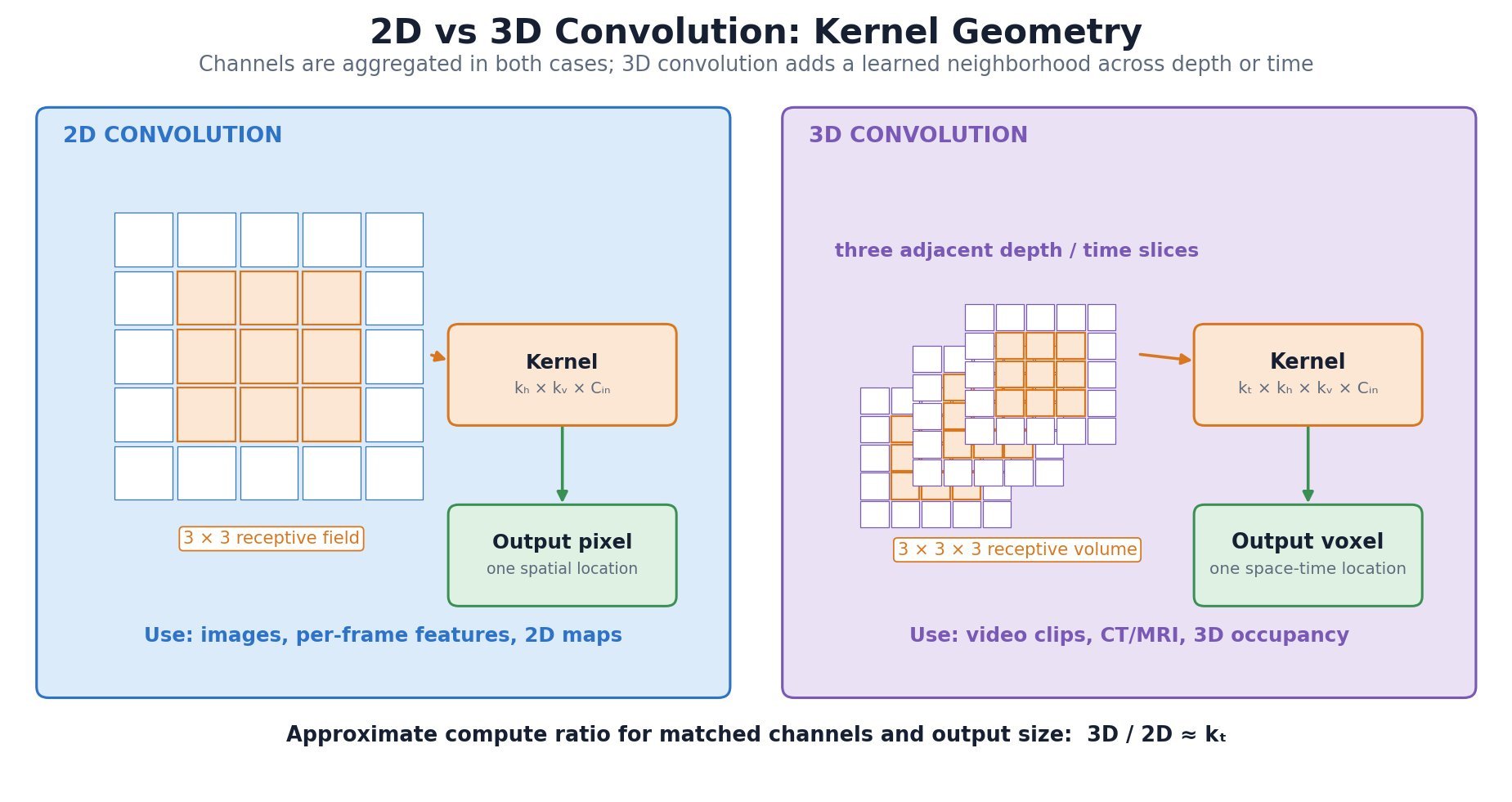
Figure 1: Kernel geometry and output formation for 2D spatial convolution and 3D spatiotemporal convolution.
Mathematical Formulation:

Where:
 and are the input and output tensors, while is the learned 3D convolution kernel.
- indexes output channels and indexes input channels.
- index output depth/time, height, and width; range over the kernel support along those axes.
- For a 2D convolution, and are removed, leaving only spatial indices ; stride, padding, and dilation modify each active index mapping.
 and
and  are the input and output tensors, while
  is the learned 3D convolution kernel.
 indexes output channels and
  indexes input channels.
 index output depth/time, height, and width;
  range over the kernel support along those axes.
 and
and  are removed, leaving only spatial indices
  ; stride, padding, and dilation modify each active index mapping.
Figure 2: Selection guide based on third-axis semantics, required context, resource budget, and deployment constraints.
Leave a Reply