
What is BERT and how is it used in NLP tasks?
Answer
BERT is a Transformer encoder pretrained to build bidirectional contextual representations of text. Its input combines token, segment, and positional embeddings, and every encoder layer lets each unmasked token attend to context on both sides. Original BERT is pretrained with masked language modeling and next sentence prediction, then adapted by adding a small task head and fine-tuning the whole model or using its representations. The [CLS] output supports sequence-level tasks, token outputs support tagging, and paired start/end scores support extractive question answering.
(1) Bidirectional Encoder: Unlike a causal decoder, BERT‘s self-attention normally uses both left and right context for every visible input token.
(2) Pre-Training: Original BERT predicts selected masked tokens and also trains an NSP classifier; later BERT-family models often modify or remove NSP.
(3) Task Adaptation: A lightweight output head maps contextual states to sequence labels, token labels, sentence-pair scores, or answer spans.

Figure 1: BERT combines token, segment, and position embeddings, processes them with bidirectional encoder layers, and exposes contextual outputs.
Mathematical Formulation:


Where:
 , , and are token, segment, and positional embedding matrices for the input sequence.
- is the bidirectional Transformer stack and contains one contextual vector per input position.
- is masked-language-modeling loss and is the selected set of prediction positions.
- indexes one selected target, is its original token, and denotes the visible corrupted context outside the selected targets.
- is the model probability assigned to the original target token given visible context.
 ,
,  , and
, and  are token, segment, and positional embedding matrices for the input sequence.
 is the bidirectional Transformer stack and
  contains one contextual vector per input position.
 is masked-language-modeling loss and
  is the selected set of prediction positions.
 indexes one selected target,
  is its original token, and
  denotes the visible corrupted context outside the selected targets.
 is the model probability assigned to the original target token given visible context.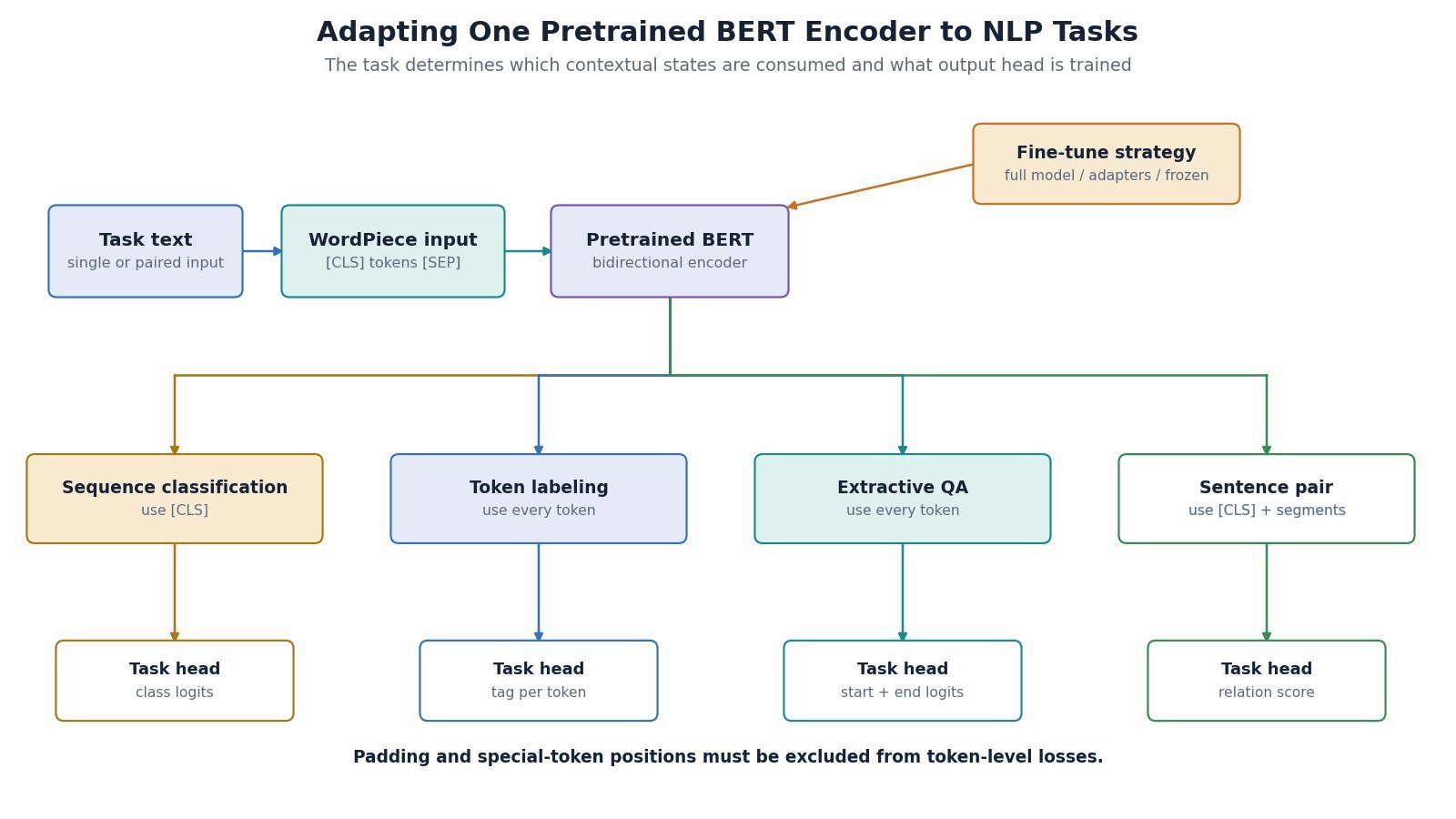
Figure 2: The same pretrained encoder can be adapted with small heads that consume either [CLS], every token state, or start/end span scores.
Leave a Reply