How do you leverage internet-scale human video datasets (e.g., Ego4D, Something-Something) for pre-training robotic VLA policies? How do you overcome the embodiment/kinematic gap?
Answer
Human video is enormous but action-free: Ego4D contributes roughly 3,670 hours of egocentric recording across 74 locations and Something-Something V2 adds about 220,000 clips over 174 manipulation-style classes, yet none of it carries joint commands, gripper states, or proprioception. The practical recipe is therefore to never try to learn a robot action space directly from video, but to choose an intermediate interface that video can supervise and that a small teleoperated dataset can later decode into commands. Three interfaces dominate: visual representation pretraining (R3M, VIP, VC-1 style encoders trained on Ego4D with time-contrastive or masked objectives), latent action pretraining (a VQ inverse-dynamics model turns each frame pair into a discrete code, the VLA is pretrained to predict those codes from image plus instruction, and only the final decoder head sees real actions), and embodiment-free intermediate predictions such as future 2D/3D point tracks, subgoal images, or hand-contact affordance maps. The embodiment gap is then attacked on four separate axes rather than as one problem: appearance (human arms and hands in frame), kinematics (a roughly 27-DoF hand versus a 1-DoF parallel gripper), viewpoint and calibration (head-mounted camera with unknown scale versus a fixed wrist or shoulder camera), and dynamics (contact forces and speeds a rigid gripper cannot reproduce). In every working system the last mile is still robot data, typically 50 to 200 hours of teleoperation, mixed into training with a weight that keeps human video as a prior rather than a target.
(1) Pick The Interface, Not The Dataset: transferability and actionability trade off directly, so the design decision is which quantity human video supervises, not whether to use it.
(2) Latent Actions As A Shared Vocabulary: a quantized inverse-dynamics model maps  to a discrete code that describes observed scene change, which both a hand and a gripper can produce.
(3) Inverse Dynamics Pseudo-Labeling: the VPT approach trains an IDM on a small labeled set and pseudo-labels the rest, which works when the action space is shared and fails badly across embodiments.
(4) Retargeting Where Geometry Allows: a MANO hand fit gives wrist pose plus a scalar aperture, enough to drive a parallel gripper but not a multi-finger in-hand manipulation.
(5) Visual Alignment Beats Visual Luck: masking or inpainting human hands, matching camera placement with head-mounted rigs, and cropping to the same field of view remove most of the appearance gap cheaply.
(6) Co-Training Ratio Is A Hyperparameter: human video enters with weight  alongside robot batches; too high and the policy predicts plausible video instead of executable actions.

Figure 1: The latent-action route: human video → discrete latent codes → VLA pretraining, with the embodiment gap crossed only in the final stage, where a few tens of hours of teleoperated demonstrations train the head that emits real commands.
Treating the gap as four separate problems makes each one tractable. For appearance, hand segmentation plus inpainting, or observation-space alignment using head-mounted capture on the human side and a matching camera on the robot, is usually enough that the frozen backbone stops keying on skin texture. For kinematics, the honest move is to restrict what human video is asked to teach: it supplies where to go, what to touch, and in what order, while grasp synthesis and force control come from robot data or from a classical controller. For viewpoint and scale, monocular depth or 3D point tracking lifts predictions into a metric frame, and predicting relative motion rather than absolute pose removes the calibration dependency. For dynamics, the temporal stride  matters more than people expect: a stride of a few frames captures human motion an order of magnitude faster than the robot will execute, so codes must be interpreted as subgoals and re-planned, not replayed. Cross-embodiment action tokenization, as used in the Open X-Embodiment and RT-X work over 22 embodiments, is the complementary trick on the robot side: a shared tokenizer plus per-embodiment heads lets one backbone absorb heterogeneous action spaces.
Mathematical Formulation:


Where:
 is the observation (usually a single RGB frame) and the language instruction; is the true robot action, such as an end-effector delta or joint target.
- is the discrete latent action for the transition, produced by encoder and quantizer against a codebook of size with tokens per transition, giving distinct codes.
- is the forward decoder that must reconstruct from and alone, which is what forces to carry the motion information.
- is the temporal stride in frames and weights the VQ commitment loss; small captures noise, large makes the code ambiguous.
- is the VLA backbone during latent pretraining, its features after pretraining, and the small action head trained only on robot data.
- is the co-training weight on the human-video term; a typical schedule anneals from near 1 toward 0 so that the deployed policy is dominated by real action supervision.
 is the observation (usually a single RGB frame) and
  the language instruction;
  is the true robot action, such as an end-effector delta or joint target.
 is the discrete latent action for the transition, produced by encoder
  and quantizer
  against a codebook of size
  with
with  tokens per transition, giving
  distinct codes.
 is the forward decoder that must reconstruct
  from
from  is the temporal stride in frames and
  weights the VQ commitment loss; small
  is the VLA backbone during latent pretraining,
  its features after pretraining, and
  the small action head trained only on robot data.
Figure 2: The interface ladder. Human video can only supervise quantities that are not tied to a specific body, so the useful designs sit in the middle band, where latent codes, point tracks, and subgoal images are both learnable from video and decodable into commands with modest robot data.
| Property | Frozen visual representations | Latent action pretraining | Tracks and subgoal images |
|---|---|---|---|
| What human video supervises | Encoder weights and a temporal value or progress signal | A discrete motion vocabulary shared by hands and grippers | Future 2D or 3D point trajectories, or the next subgoal frame |
| Robot data still required | A full policy trained on top of the frozen features | A small action head mapping codes to commands, tens of hours | A track-following or goal-reaching low-level policy |
| Handles hand versus gripper by | Ignoring actions entirely, so the mismatch never appears | Absorbing it in the quantizer: codes describe scene change, not joints | Staying in task space, where points and pixels carry no body |
| Main failure mode | Task-agnostic features help perception but little on long horizons | Codes drift toward camera motion and background dynamics | Tracker failure under occlusion, and no notion of contact force |
| Best fit | Small robot datasets and cluttered scenes needing better perception | Generalist VLAs that must follow unseen instructions | Quasi-static rearrangement and tool use with visible motion |
 ?
? to
to  environment steps of physically risky exploration. That is why essentially every published generalist VLA (RT-2, OpenVLA,
  under a fixed data distribution, while RL maximizes expected discounted return under the policy’s own visitation distribution.
 in the horizon, whereas interactive or on-policy training reduces this to
  .
.
![\theta_{BC} = \arg\max_{\theta} \mathbb{E}_{(o,a) \sim \mathcal{D}} \left[\log \pi_{\theta}(a \mid o)\right]](https://s0.wp.com/latex.php?latex=%5Ctheta_%7BBC%7D+%3D+%5Carg%5Cmax_%7B%5Ctheta%7D+%5Cmathbb%7BE%7D_%7B%28o%2Ca%29+%5Csim+%5Cmathcal%7BD%7D%7D+%5Cleft%5B%5Clog+%5Cpi_%7B%5Ctheta%7D%28a+%5Cmid+o%29%5Cright%5D&bg=ffffff&fg=000&s=3&c=20201002)
![J(\pi) = \mathbb{E}_{\pi}\left[\sum_{t=0}^{T} \gamma^{t} r(s_t, a_t)\right]](https://s0.wp.com/latex.php?latex=J%28%5Cpi%29+%3D+%5Cmathbb%7BE%7D_%7B%5Cpi%7D%5Cleft%5B%5Csum_%7Bt%3D0%7D%5E%7BT%7D+%5Cgamma%5E%7Bt%7D+r%28s_t%2C+a_t%29%5Cright%5D&bg=ffffff&fg=000&s=3&c=20201002)


![\max_{\theta} \mathbb{E}_{\mathcal{D}}\left[\log \pi_{\theta}(a \mid o) \exp\!\left(A(o,a)/\beta\right)\right]](https://s0.wp.com/latex.php?latex=%5Cmax_%7B%5Ctheta%7D+%5Cmathbb%7BE%7D_%7B%5Cmathcal%7BD%7D%7D%5Cleft%5B%5Clog+%5Cpi_%7B%5Ctheta%7D%28a+%5Cmid+o%29+%5Cexp%5C%21%5Cleft%28A%28o%2Ca%29%2F%5Cbeta%5Cright%29%5Cright%5D&bg=ffffff&fg=000&s=3&c=20201002)
 is the VLA policy mapping an observation
  (images, proprioception, language instruction) to an action or action chunk
  .
. is the fixed demonstration dataset, and
  is the human expert whose behavior it samples.
 and
and  are the environment state and control step,
  the reward, and
 ![\gamma \in (0,1]](https://s0.wp.com/latex.php?latex=%5Cgamma+%5Cin+%280%2C1%5D&bg=ffffff&fg=000&s=2&c=20201002) the discount.
the discount. is the per-step supervised action error under the expert’s distribution; the quadratic term comes from errors pushing the policy into states absent from
  is the estimated advantage and
  the temperature; as
  the advantage-weighted objective degenerates to plain behavior cloning, which is why the hybrid is a continuum rather than a binary choice.
 is initialized at
  and the task admits an automated reset plus a reward oracle, otherwise
  is not estimable on hardware.
 , the quadratic behavior-cloning bound separates from the linear on-policy bound by a factor of
  , which is why long-horizon manipulation degrades far faster than single-step prediction accuracy suggests.
 per timestep, usually predicted as an action chunk covering the next
  control steps.
 actions amortizes one forward pass across a full second of motion, at the price of running open loop within the chunk. Shorter chunks mean tighter feedback and better disturbance rejection but more compute and more jitter at chunk boundaries; longer chunks are smoother but blind to anything that happens mid-chunk. Naive autoregressive decoding of 350 discrete action tokens is also slow, which is exactly the bottleneck that continuous action experts and frequency-domain tokenizers were built to remove.


 are the text tokens a VLM emits for image
  and instruction
  is the action chunk,
  is the action dimension (7 for a 6-DoF pose delta plus gripper) and
  is the discrete bin for dimension
  , with
  and
and ![[a_{\min}, a_{\max}]](https://s0.wp.com/latex.php?latex=%5Ba_%7B%5Cmin%7D%2C+a_%7B%5Cmax%7D%5D&bg=ffffff&fg=000&s=2&c=20201002) set from per-dimension training quantiles so outliers do not collapse the resolution.
set from per-dimension training quantiles so outliers do not collapse the resolution. is the control frequency and
  the policy latency; the required deployment condition is that a new chunk arrives before the previous one is exhausted.
 and a 1% per-step error is fatal over a 400-step manipulation.
 patch tokens into one clip representation, and they differ only in where temporal information is allowed to mix. Frame-level pooling runs a purely spatial encoder per frame and then averages or attention-pools the
  , joint space-time attention lets all
  tokens attend to each other, and TimeSformer’s divided space-time attention factorizes that into a temporal MSA over the same spatial position across frames followed by a spatial MSA inside each frame. The cost separation is the first thing to state in an interview: joint attention is
  in the pair count while divided is
  , a ratio of
  that reaches roughly 64x at 96 frames. The accuracy separation depends almost entirely on whether the label actually depends on frame order: on scene-biased Kinetics-400 dropping temporal attention costs about a point, while on Something-Something V2 the same ablation costs roughly 23 points.
 frames per layer, so long-range order needs depth or a slow/fast dual pathway.
 , and every added frame inflates the attention matrix quadratically.


 is the clip embedding and
  the frozen or fine-tuned per-frame encoder applied to frame
  ; because the sum is symmetric,
  indexes frames,
  for ViT-B at
  with patch 16), and
  ,
,  , and
, and  are the attention costs of space-only, joint space-time, and divided space-time blocks; all three exclude the identical per-token MLP term.
 are the temporal and spatial kernel sizes of a 3D convolution, whose cost is linear in
  layers is only about
  frames.
 , and that count fixes both the KV cache size (linear in
  and prefill attention as
  , so a 4x frame-rate increase is a 4x memory bill and a 16x prefill bill.
 bytes, so GQA with 8 KV heads instead of 32 already cuts it 4x, and INT4 KV quantization cuts it another 4x before any sampling change.
 can cost the same tokens, but the first causes temporal aliasing of short events while the second destroys small text and fine spatial detail.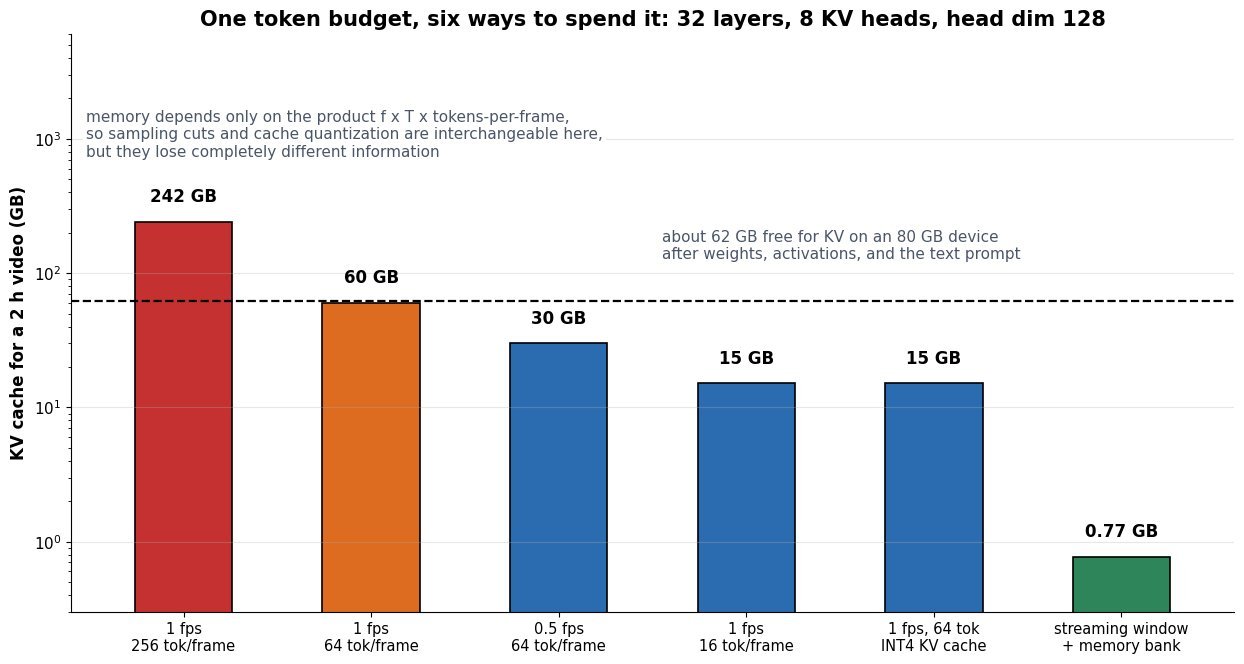
 and the per-token cost, so sampling changes and cache quantization are interchangeable for memory, but only a bounded streaming state stops growth with stream length.


 key-value heads, head dimension
  , and
, and  bytes per stored element; the factor 2 counts keys and values.
 is cache size and
  the free HBM after weights, activations, and the text prompt;
  is the highest frame rate a dense prefill can afford at a given
  is prefill attention cost with model width
  ,
,  , and
, and  bytes, giving 128 KB per token, and
  s at
s at  ,
,  , so
, so  GB.
GB. , the exact window plus a fixed memory bank, which is
  in
in 
 produces a fixed
  grid of 576 patch tokens, so a
  photograph is downsampled by
  x before a single transformer layer runs and a 60-pixel license plate lands inside less than one patch. Visual CoT closes that gap by making localization an explicit step in the reasoning chain: the model first emits a bounding box for the region the sub-question depends on, that crop is re-encoded at the encoder’s native resolution, the new visual tokens are appended to the context alongside the original global tokens, and only then does the model answer. The chain becomes localize → crop → re-encode → reason, and it can iterate, which is exactly what multi-step spatial questions need: “what does the sign to the left of the red truck say?” decomposes into finding the truck, resolving left of in the global view, then reading text at a magnification where the glyphs actually exist. The VisCoT work trains this behavior with 438k question-answer pairs carrying intermediate bounding-box annotations, and reports its largest gains on text-rich and small-object splits, precisely where fixed-resolution encoding destroys the evidence.
 crop at
  raises the sampling density on that region by
  without changing the encoder.
 K screenshots and document scans where uniform tiling would need dozens of tiles.


 the encoder’s square input side, and
  the patch size;
  gives the familiar 576 tokens.
 are the original image dimensions and
  is the areal sampling gain on the cropped region, so the linear magnification is
  for the numbers above.
 is the probability the emitted box actually contains the target and
  the probability of reading it correctly once magnified;
  is end-to-end accuracy for a two-hop chain.
 , and total visual tokens grow as
  because the global view is kept.
 tiling, but roughly 92 patches after a crop is re-encoded, at half the token cost of tiling.
 sequential operations before it must commit to the next token, so a task needing more sequential steps than the depth provides is simply not representable in one forward pass; every generated token reruns the whole stack, turning the context window into an external scratchpad that raises effective serial depth from
  . Theory backs this up: constant-depth transformers with a polynomially long chain can simulate any polynomial-time computation, while the same model restricted to direct answers cannot. The second mechanism is factorized conditioning: instead of sampling one high-entropy jump from question to answer, the model decomposes the problem into a product of low-entropy conditionals, each conditioned on the already-written steps, which keeps it on the distribution of solution traces seen in pretraining. CoT is not universally free money: it is emergent with scale, and later meta-analysis shows the gains concentrate on math, symbolic, and logical tasks rather than on knowledge or commonsense retrieval.
 read every earlier step as context.


![\hat{a} = \arg\max_{a} \sum_{i=1}^{k} \mathbf{1}[a_i = a]](https://s0.wp.com/latex.php?latex=%5Chat%7Ba%7D+%3D+%5Carg%5Cmax_%7Ba%7D+%5Csum_%7Bi%3D1%7D%5E%7Bk%7D+%5Cmathbf%7B1%7D%5Ba_i+%3D+a%5D&bg=ffffff&fg=000&s=3&c=20201002)
 the generated rationale, a latent variable the model writes into its own context.
 the answer extracted from sample
  , and
, and ![\mathbf{1}[\cdot]](https://s0.wp.com/latex.php?latex=%5Cmathbf%7B1%7D%5B%5Ccdot%5D&bg=ffffff&fg=000&s=2&c=20201002) the indicator used for majority voting.
the indicator used for majority voting. , and self-consistency approximates it with
  .
.


 is the token generated at step
  the tokens already committed, which is why an early mistake is irreversible.
 is the sequence of projected visual tokens (576 for a ViT-L/14 336 px grid, 32 for a Q-Former) and
  is the text prompt.
 is the same score with the image dropped, so
  is the visual grounding margin;
  means the token was chosen by the language prior alone.
 is the score under a distorted or noised image and
  the contrast strength, giving the contrastive decoding adjustment used by VCD-style mitigations.
 is the set of object mentions parsed from a caption and
  the subset absent from the annotation, so
  is an instance-level hallucination rate in
 ![[0, 1]](https://s0.wp.com/latex.php?latex=%5B0%2C+1%5D&bg=ffffff&fg=000&s=2&c=20201002) .
.

 whose four edges each shift by
  , so a 16 px object falls below 0.5 IoU once edges move about 3 px, while a 128 px object tolerates roughly 24 px. That is why generalist grounding scores jumped with higher effective input resolution rather than with finer coordinate grids: the earliest text-token generalists sat near 52 Acc@0.5 on RefCOCO val, Qwen-VL reached roughly 89, and Florence-2-L about 93, close to dedicated grounding detectors.


 is the target box in the encoder’s resized pixel frame of side
  is the prediction.
 is the
  the number of bins (1024 for Kosmos-2 location tokens, 1000 for Qwen-VL integers).
 the previously emitted coordinate tokens, so decoding is strictly autoregressive.
 is the worst-case quantization error per edge in pixels, which scales linearly with input side and inversely with bin count.
 weight the L1 and GIoU terms used by regression-head decoders; text-token models have no analogue of either.
 is a 3D box with center
  , extents
  , and yaw
  ; full 9 DoF variants add pitch and roll.
 is the camera intrinsic matrix and
  the projected image point; this constraint is the required initial condition for monocular 3D grounding, since without
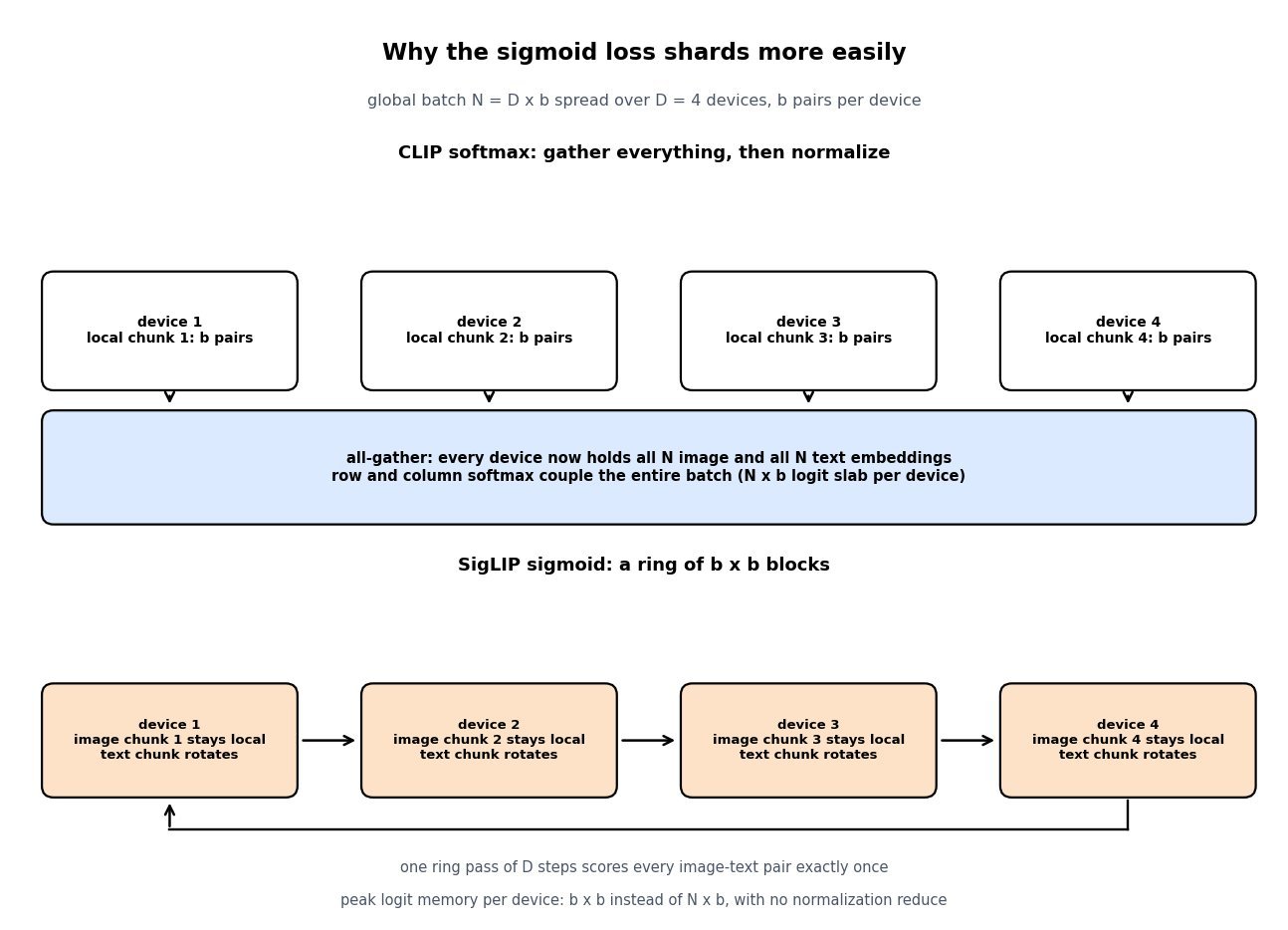
 cells of the similarity matrix as an independent binary decision (“is this a real pair?”), using a shared learnable temperature plus a learnable bias
  to absorb the fact that only
  blocks, which lets SigLIP be implemented as a memory-efficient ring over devices and trained at batch sizes a softmax implementation cannot fit. Empirically the sigmoid loss is clearly better at small and moderate batch sizes, the two objectives converge above roughly 32k examples per step, and the million-example batch study SigLIP made possible showed that accuracy saturates long before that. That efficiency, plus the shape-optimized SoViT-400m/14 backbone released with it, is why SigLIP checkpoints became the default vision tower in many recent vision-language models such as PaliGemma.
 grid.
grid. embeddings; sigmoid logits are independent, so blocks can be scored and reduced locally.
 negatives against


 and
and  are the unit-norm image and text embeddings, so
  is a cosine similarity in
 ![[-1, 1]](https://s0.wp.com/latex.php?latex=%5B-1%2C+1%5D&bg=ffffff&fg=000&s=2&c=20201002) .
. is the scaled logit and
  is the learnable temperature, parameterized in log space in both methods.
 index the global batch; the diagonal
  holds the
  for a matched pair and
  otherwise, which is the binary label the sigmoid loss regresses on.
 and
and  ; CLIP has no analogue because its softmax is shift-invariant.
 logit slab, and the row and column sums must be reduced across devices before any gradient exists. SigLIP instead keeps each device’s image chunk local and passes text chunks around a ring, accumulating loss from one