
What is a confidence interval, and what is the correct interpretation of a 95% confidence interval, as used in sequential A/B testing and experimentation platforms?
Answer
A confidence interval is a range computed from sample data that is designed to contain an unknown population parameter with a specified probability under repeated sampling. The correct frequentist interpretation of a 95% confidence interval is: if you repeated the experiment many times, computing a new interval from each sample, about 95% of those intervals would contain the true parameter. It is a statement about the procedure, not about any single interval. Once data is observed, the true parameter is either inside your specific interval or not (probability 0 or 1); you cannot say “there is a 95% probability the parameter is in this interval,” because that is a Bayesian credible interval interpretation requiring a prior. Sequential A/B testing platforms use “anytime-valid” confidence sequences that maintain this coverage guarantee across continuous monitoring, and asymmetric experiment designs treat confidence interval width as a design parameter controlled through sample allocation between test and control groups.
(1) Procedure vs Single Interval: the 95% refers to the long-run coverage rate of the interval-construction procedure across hypothetical repeated samples, not the probability that the true parameter is in any one observed interval.
(2) Frequentist vs Bayesian: saying “95% probability the parameter is in this interval” is a Bayesian credible interval statement; a 2024 paper showed this distinction has real business impact, as frequentist estimators overstate A/B test effect sizes (winner’s curse) while Bayesian estimators with correct priors do not.
(3) Production Use: anytime-valid confidence sequences enable canary testing so the 95% coverage holds throughout continuous monitoring, not just at a pre-specified endpoint; asymmetric experiment designs optimize CI width by nonlinearly increasing control group size when shrinking test group size (40% test reduction requires 3x control increase).

Figure 1: The frequentist interpretation: across 20 repeated experiments, about 19 of the 95% confidence intervals contain the true parameter (vertical line); the 95% is a property of the procedure, not of any single interval.
The width of a confidence interval depends on three things: the confidence level (higher confidence means wider intervals), the sample size (larger n means narrower intervals), and the variability of the data (higher variance means wider intervals). For a mean with known variance, the 95% CI is the sample mean plus or minus 1.96 standard errors. When the variance is unknown and estimated from the sample, the t-distribution replaces the normal, giving slightly wider intervals for small samples. A critical production issue is peeking: repeatedly checking whether a confidence interval excludes zero and stopping when it does inflates the false positive rate, because each check is a separate test. Anytime-valid confidence sequences solve this by using a test statistic whose coverage guarantee holds uniformly over time, so you can monitor continuously without breaking the 95% promise. Conformal prediction (2024-2025) extends the idea to distribution-free prediction intervals for ML models, providing finite-sample coverage without normality assumptions.
Mathematical Formulation:


Where:
 is the sample mean, is the population standard deviation (replaced by sample standard deviation with the t-distribution when unknown), and is the sample size.
- is the critical value of the standard normal at level ; for 95% confidence, and .
- The probability statement is over the random interval (which depends on ), not over the fixed parameter ; this is the frequentist distinction. The interval either covers or not for any single sample, but the procedure covers it of the time across repeated samples.
 is the sample mean,
  is the population standard deviation (replaced by sample standard deviation
  with the t-distribution when unknown), and
  is the sample size.
 is the critical value of the standard normal at level
  ; for 95% confidence,
  and
and  .
. ), not over the fixed parameter
  ; this is the frequentist distinction. The interval either covers
  of the time across repeated samples.
| Concept | Frequentist CI | Bayesian Credible Interval |
|---|---|---|
| Interpretation | 95% of repeated-sample intervals contain the true value | 95% probability the parameter is in this interval |
| Requires Prior? | No | Yes (prior over the parameter) |
| Parameter Is | Fixed, unknown constant | Random variable with a distribution |
| Production Note | Frequentist: winner’s curse overstates effect sizes | Bayesian: correct priors avoid winner’s curse |
 and
and  per class per feature; best for real-valued features like blood pressure, age, or sensor readings; assumes normality, so skewed or multi-modal features need transformation or kernel density estimation.
 ; the standard for text classification on word counts, and commonly run on TF-IDF weights as a practical approximation; Microsoft’s training module uses it for email spam filtering, and a production system classifies 85,000 reviews/day at AUC above 0.99.
 and explicitly models
  ; best for short documents or boolean feature sets where absence is informative; scikit-learn ships it alongside categorical and complement variants, and the R naivebayes package adds a Poisson variant for count features.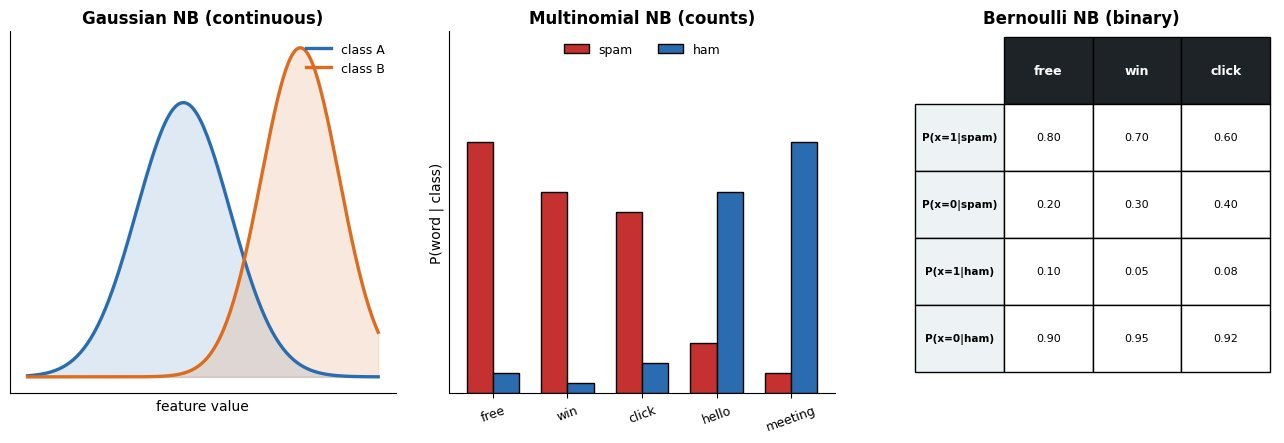


 in class
  , estimated from training data.
 is the count of feature
  is the total count,
  is Laplace smoothing, and
  is the vocabulary size.
 is the probability that feature
  explicitly models the absence of the feature.
 for each class and picks the argmax; the naive assumption factors the likelihood
  into a product of one-dimensional terms
  .
.

 is the predicted class;
  is the class prior, and the product of per-feature likelihoods replaces the intractable joint
  , which is a sum of precomputed log-likelihoods and runs in O(d) per prediction.

 is the input and
  the target; the joint can be factorized in two directions.
 while
while  is unchanged.
 while
while  is unchanged; concept drift:


 is the total (sample-weighted) impurity of the leaves of tree
  , and
, and  is its number of terminal nodes.
 is the effective alpha of node
  : the penalty value at which keeping its branch
  costs exactly as much as collapsing it, so the node with the smallest value is pruned first.
 , picks an action
  from its policy
  , the environment transitions to a new state and returns reward
  , and the agent updates its policy or value estimates from the experience; this repeats until the episode ends. Unlike supervised learning there are no labels: the only supervision is the reward signal, which may arrive many steps late, and the agent’s own actions decide what data it sees next, which is why exploration must be built in.
 ; the Markov property says the state summarizes everything relevant about the history.
 feeds the learning update.
![\pi^{*} = \arg\max_{\pi}\ \mathbb{E}_{\pi}\big[G_0\big]](https://s0.wp.com/latex.php?latex=%5Cpi%5E%7B%2A%7D+%3D+%5Carg%5Cmax_%7B%5Cpi%7D%5C+%5Cmathbb%7BE%7D_%7B%5Cpi%7D%5Cbig%5BG_0%5Cbig%5D&bg=ffffff&fg=000&s=3&c=20201002)
 is the discounted return from step
  is the reward received
  steps later.
 is the discount factor, trading immediate reward against future reward and keeping infinite-horizon returns finite.
 is the policy and the expectation runs over trajectories induced by
  is the optimal policy.


 is an orthonormal projection matrix and
  the
the  .
. is a learned map such as an autoencoder’s encoder; its parameters
  are fitted by gradient descent.
 , so new points need a parametric variant or a refit.
 is exactly the variance the data has along it.
 and keep enough components to cover, say, 95% of total variance.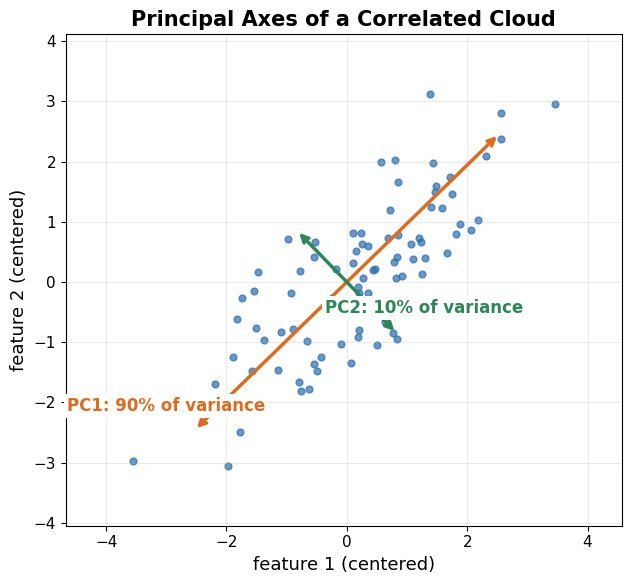


 samples and
  is its
  covariance matrix.
 are the eigenvector-eigenvalue pairs of
  stacks the top
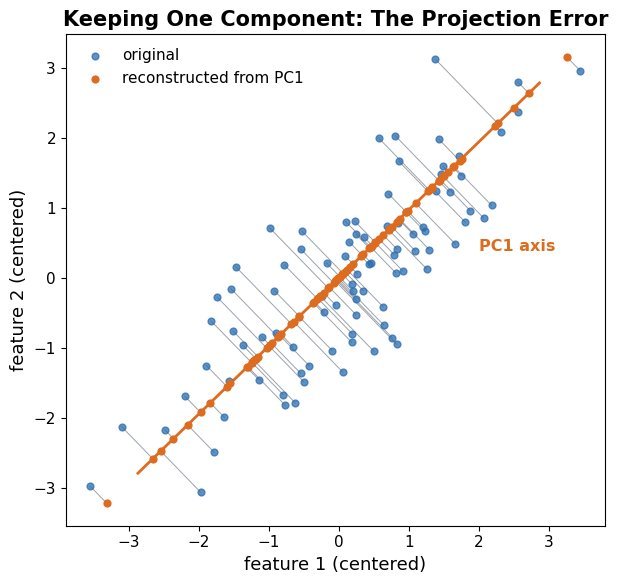
 (their sum is
  ).
). matrix
  squares the condition number
 ) is covariance divided by both standard deviations, which strips the units and bounds the result to
 ![[-1, 1]](https://s0.wp.com/latex.php?latex=%5B-1%2C+1%5D&bg=ffffff&fg=000&s=2&c=20201002) , so strengths become comparable across datasets. Neither proves causation, and both capture only linear association: a perfect parabola scores zero correlation despite being fully determined.
, so strengths become comparable across datasets. Neither proves causation, and both capture only linear association: a perfect parabola scores zero correlation despite being fully determined. vs
vs  means the same thing for any pair of variables.
 on symmetric data has
  while
while 
![\mathrm{Cov}(X, Y) = \mathbb{E}\big[(X - \mu_X)(Y - \mu_Y)\big]](https://s0.wp.com/latex.php?latex=%5Cmathrm%7BCov%7D%28X%2C+Y%29+%3D+%5Cmathbb%7BE%7D%5Cbig%5B%28X+-+%5Cmu_X%29%28Y+-+%5Cmu_Y%29%5Cbig%5D&bg=ffffff&fg=000&s=3&c=20201002)

 are random variables with means
  and standard deviations
  .
.![\mathbb{E}[\cdot]](https://s0.wp.com/latex.php?latex=%5Cmathbb%7BE%7D%5B%5Ccdot%5D&bg=ffffff&fg=000&s=2&c=20201002) is expectation over the joint distribution; in practice both quantities are estimated by sample averages.
is expectation over the joint distribution; in practice both quantities are estimated by sample averages. lies in
  meaning an exact linear relationship.
 degrees of freedom accounts for it. As


 the hypothesized mean, and
  as
as