Please explain how KNN classification works.
Answer
K-Nearest Neighbors (KNN) is a simple, non-parametric algorithm that predicts a label by majority vote among the  nearest neighbors of a test point, using a chosen distance metric. It is intuitive and effective for small datasets, though less efficient on large-scale data.
(1) Instance-based method: KNN doesn’t learn an explicit model; it stores the training data and makes predictions based on similarity.
(2) Distance-based classification: For a test point  , it computes the distance to every training point (e.g., Euclidean distance).
(3) Majority vote: It selects the  closest neighbors and assigns the label that appears most frequently among them.
(4) Sensitive to K and distance metric: The performance depends on the choice of and how distance is measured (Euclidean, Manhattan, etc.).
(5) No training phase: All computation happens during prediction (also called lazy learning).
Below is the equation for Euclidean Distance calculation:
Where: and
and  are the
  th features of the new and training points, respectively.
 is the number of features
Below is the equation for the Voting Rule in KNN classification:
Where: is the predicted class label for the query point.
 represents the set of all possible classes. is the number of nearest neighbors considered. is the class label of the i-th neighbor.
 is an indicator function, returning 1 if the neighbor’s class is
  , and 0 otherwise.
The example below shows KNN for classification.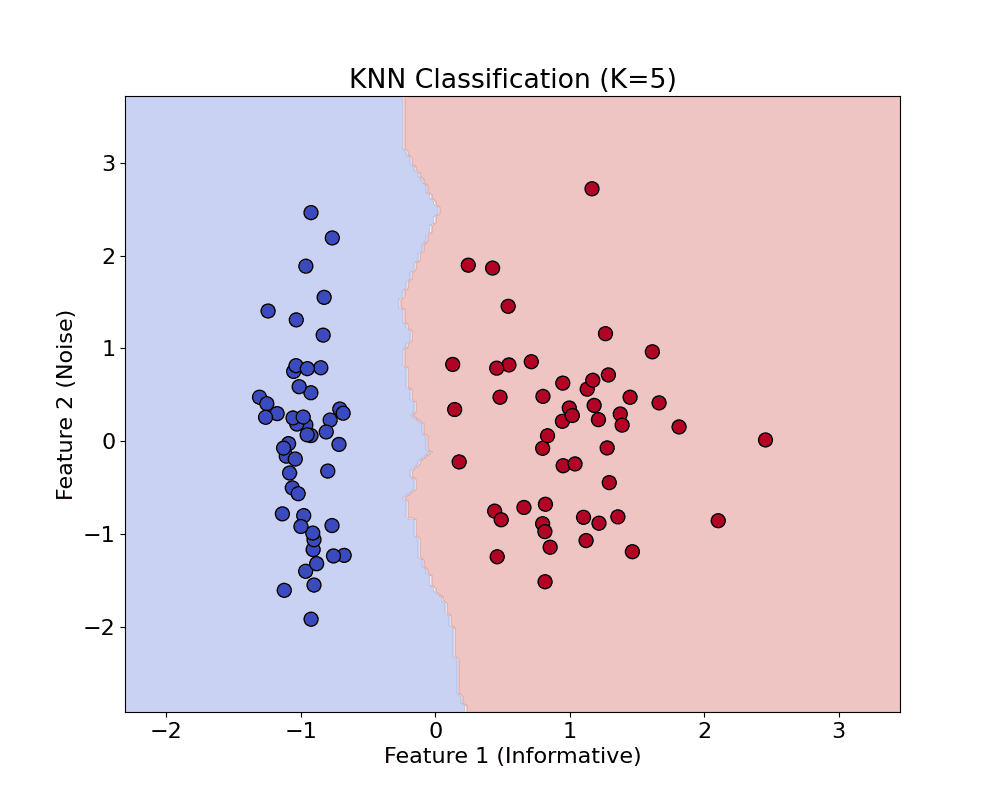
Leave a Reply