
What is a “cold start” problem in deep learning?
Answer
The cold start problem is the difficulty of making reliable predictions for new entities (users, items, or contexts) that have little or no historical data. Models that depend on past interactions, especially recommender systems built on collaborative filtering, have no signal to learn a meaningful representation of a brand-new user or item, so their predictions degrade to near-random or popularity-biased guesses until data accumulates.
(1) Missing Interaction History: Collaborative filtering infers taste from a user-item matrix; a new row (user) or column (item) is empty, so the model cannot locate the entity in its embedding space.
(2) Feedback Loop Risk: Poor early predictions reduce engagement, which further slows data collection for the new entity. The problem compounds itself.
(3) Three Flavors: New-user cold start, new-item cold start, and new-system cold start (no data at all) each demand different remedies.
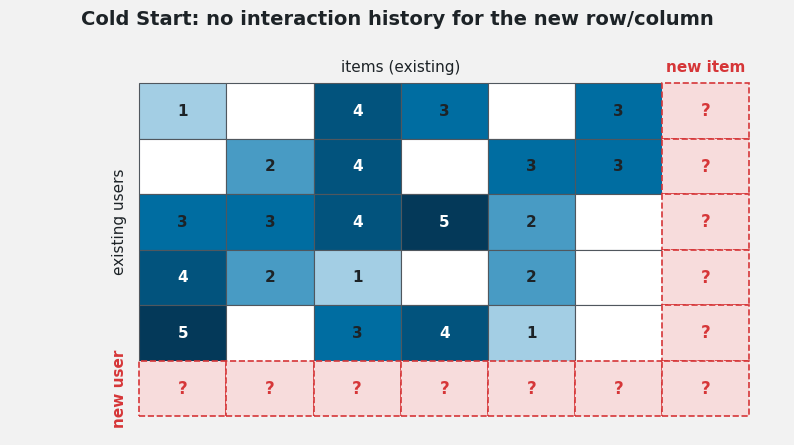
Figure 1: The new user row and new item column contain no interactions. Collaborative filtering has nothing to condition on for them.
Mitigation Strategies: The common theme is supplying side information until interaction data accumulates: transfer learning borrows representations from related domains; hybrid models mix collaborative signals with content features; and active onboarding explicitly gathers a few preferences from new users.
(1) Transfer Learning / Pre-trained Models: Initialize from embeddings or models trained on similar tasks so the new domain starts from useful structure rather than random weights.
(2) Hybrid Recommendation Models: Combine collaborative filtering with content-based features (user demographics, item metadata) so predictions remain reasonable with zero interactions.
(3) Active Learning / User Onboarding: Ask new users to rate a handful of popular or diverse items, turning cold start into a short warm-up phase.

Figure 2: All three strategies inject auxiliary signal into the recommender so cold entities get reasonable predictions before their interaction rows fill in.
Mathematical Formulation:

Where:
 is the predicted rating of user for item ; is the global mean rating.
- and are the learned latent factor vectors for user and item ; , are bias terms.
- Cold start means or was never trained: with an empty interaction row/column, the factors stay at random init, so is meaningless.
 is the predicted rating of user
  for item
  ;
;  is the global mean rating.
 and
and  are the learned latent factor vectors for user
  ,
,  are bias terms.
Leave a Reply