
Explain the Vision Transformer (ViT). How does it convert an image into a class prediction?
Answer
A Vision Transformer converts an image into a sequence of fixed-size patch tokens and processes them with a Transformer encoder. A learned class token is prepended, positional embeddings preserve patch order, and global self-attention lets every patch exchange information with every other patch. After the encoder stack, the class-token representation is passed to a prediction head. Compared with a CNN, a ViT has weaker built-in locality and translation bias, but it can model long-range interactions directly and scales effectively with data and compute.
(1) Tokenization: An image of shape  is divided into
  non-overlapping
  patches; each flattened patch is projected to width
  .
.
(2) Global Context: Multi-head self-attention mixes information across all patch positions, while residual connections and MLP sublayers refine each token.
(3) Classification: A learned [CLS] token aggregates evidence across the encoder stack; its final state is normalized and mapped to class logits.
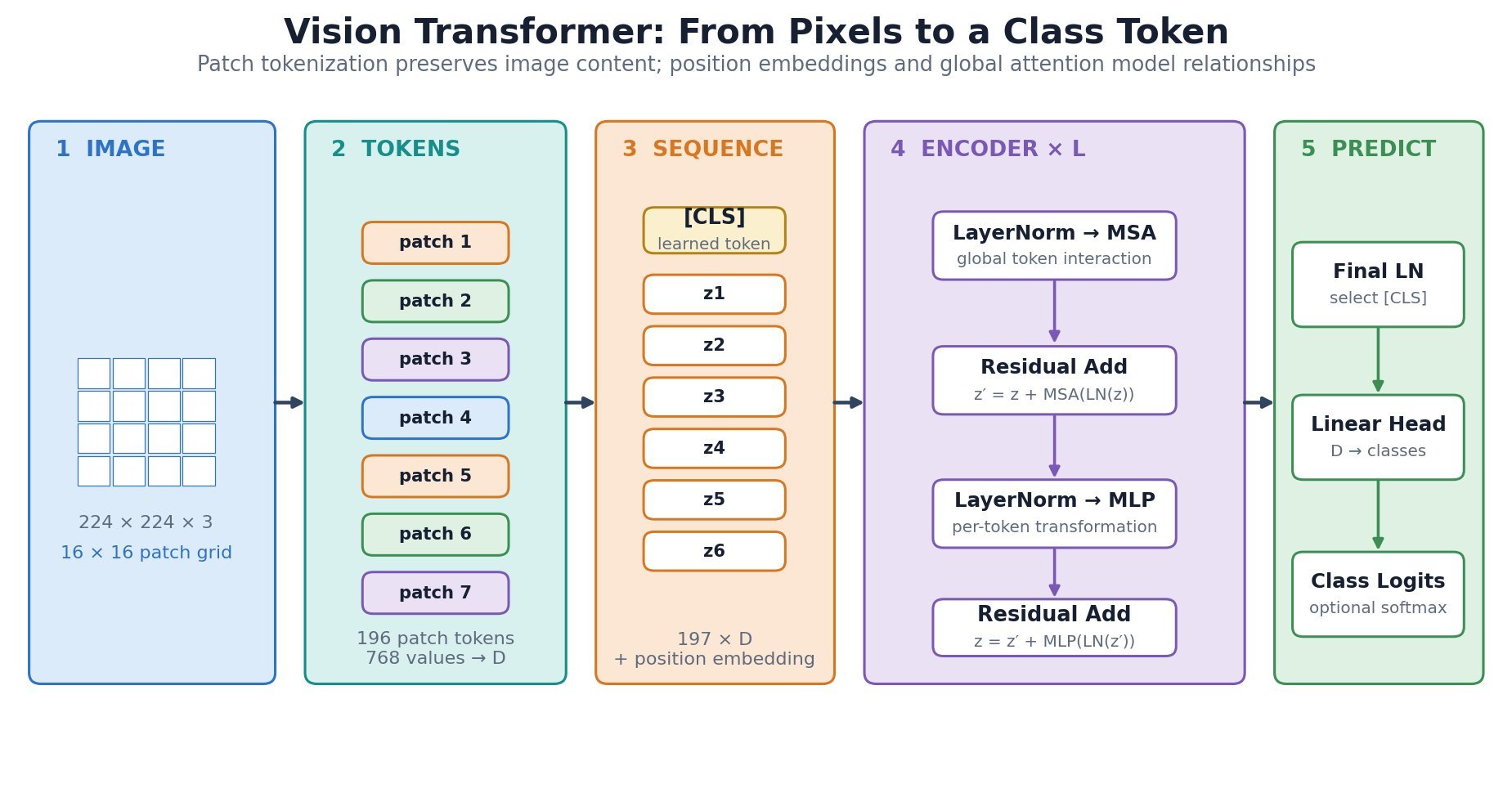
Figure 1: ViT architecture with tensor shapes, patch tokenization, the Transformer encoder stack, and the classification path.
Mathematical Formulation:
![z_0=[x_{\mathrm{cls}};x_p^1E;x_p^2E;\ldots;x_p^NE]+E_{\mathrm{pos}}](https://s0.wp.com/latex.php?latex=z_0%3D%5Bx_%7B%5Cmathrm%7Bcls%7D%7D%3Bx_p%5E1E%3Bx_p%5E2E%3B%5Cldots%3Bx_p%5ENE%5D%2BE_%7B%5Cmathrm%7Bpos%7D%7D&bg=ffffff&fg=000&s=3&c=20201002)

Where:
 is the initial token sequence supplied to the Transformer encoder.
- is the learned class token, and is flattened image patch .
- projects each patch to width , while supplies positional embeddings.
- is the patch count for an image of height , width , and channel count .
- , , and are query, key, and value matrices; is the per-head query/key width.
 is the initial token sequence supplied to the Transformer encoder.
 is the learned class token, and
  is flattened image patch
  .
. projects each
  patch to width
  supplies positional embeddings.
 , width
  , and channel count
  .
. ,
,  , and
, and  are query, key, and value matrices;
  is the per-head query/key width.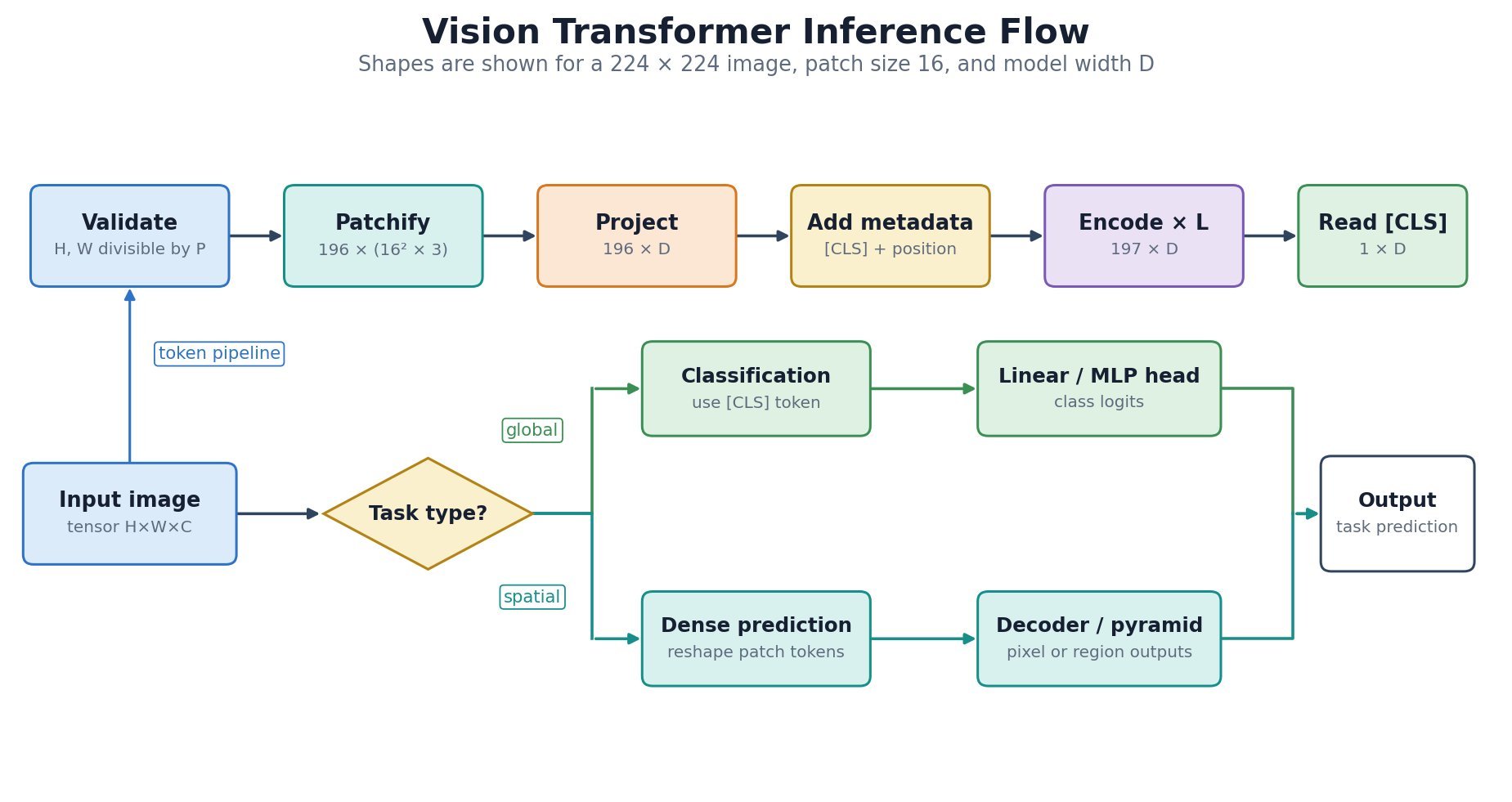
Figure 2: ViT inference flow from image validation and patch embedding to encoder processing and class prediction.
Leave a Reply