
In a Transformer architecture, which components are the primary contributors to computational cost, and why?
Answer
It depends on sequence length. For short sequences, the feed-forward network (FFN) usually dominates: its two wide GEMMs cost  while attention’s quadratic term is still small. For long sequences, multi-head attention takes over: forming the
  score matrix costs
  and grows much faster than anything else in the block.
(1) Multi-Head Attention: Q/K/V projections cost  , but the score matrix
  and its product with V cost , the quadratic term that explodes on long sequences.
(2) Feed-Forward Network: Two dense layers with expansion factor 4 cost , dominant when  is small but
  is large.
(3) Crossover Point: Attention overtakes the FFN roughly when  ; near
  for the classic
  design.
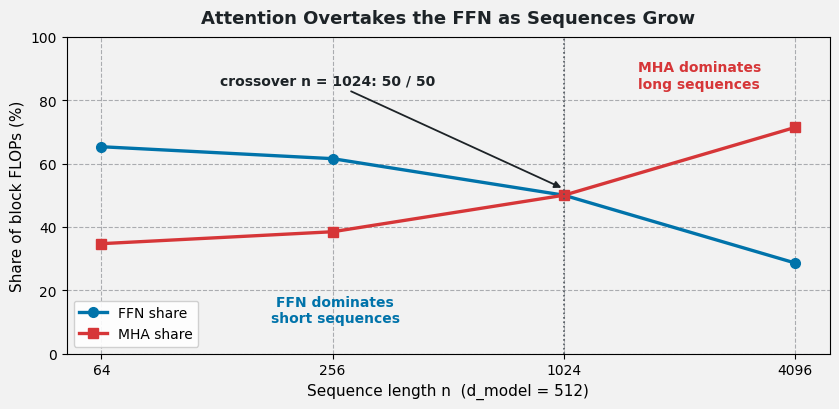
Figure 1: FLOP share vs sequence length ( ): FFN dominates below
  ; past the crossover, attention’s quadratic cost becomes the bottleneck.
Mathematical Formulation (per block):


Where:
 is the sequence length and ; constants count multiply–adds per GEMM.
- The term comes from multiplying to form scores, and again to mix values.
- Softmax itself is cheap elementwise work but also scales with entries.
 ; constants count multiply–adds per GEMM.
 term comes from multiplying
  to form scores, and again to mix values.
| Sequence Length n | MHA Share (%) | FFN Share (%) | Dominant Component |
|---|---|---|---|
| 64 | 34.69 | 65.31 | FFN |
| 256 | 38.46 | 61.54 | FFN |
| 1024 | 50.00 | 50.00 | Tie |
| 4096 | 71.43 | 28.57 | MHA |
Table 1: FLOP breakdown at : the tie at n = 1024 marks where quadratic attention catches up with the linear-in-n FFN.

Figure 2: Where the FLOPs live inside one block: only the and  pair grows quadratically with sequence length.
Practical Caveat: The FFN’s dominance at short assumes the standard 4x expansion; shrink the expansion to 1x and the Q/K/V projections become the largest term, while efficient attention variants (sliding-window, linear attention) specifically attack the  term for long contexts.
Leave a Reply