
What is layer normalization, and why is it used in Transformers?
Answer
Layer Normalization (LN) standardizes the features of each individual sample: for one token’s embedding vector, it computes the mean and variance across the feature dimension only, rescales to zero mean and unit variance, then applies a learnable scale and shift. Unlike BatchNorm, it never looks across the batch, which is exactly why Transformers, with variable-length sequences and small or on-the-fly batches, rely on it in every block.
(1) Normalization Within a Sample: Mean and variance come from the  features of a single token: one set of statistics per token, not per batch.
(2) Batch-Size Independence: Behavior is identical at train and test time and for any batch size: no running statistics, no mismatch.
(3) Stabilizes Training: Keeps activations in a consistent range, preventing exploding/vanishing gradients and enabling deep stacks to converge faster.
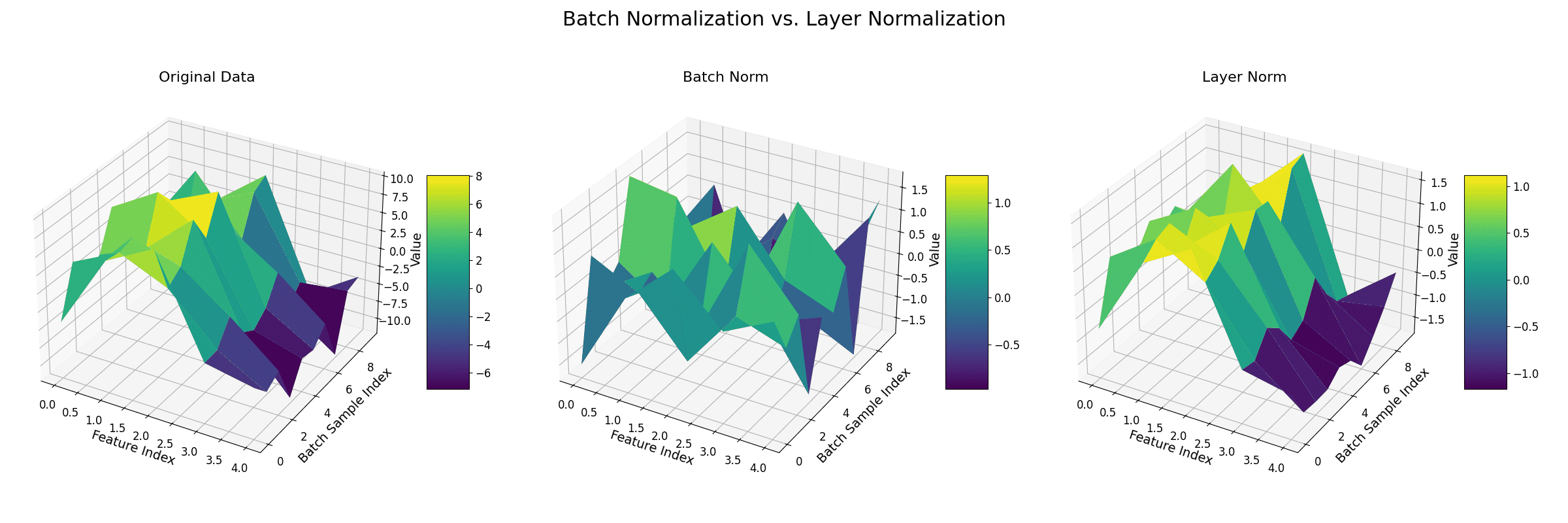
Figure 1: Layer Normalization standardizes each sample (row) across its own feature dimensions; statistics never cross sample boundaries, so batch size is irrelevant.
Mathematical Formulation:


Where:
 is one feature of a single token’s -dimensional vector; statistics are computed over for that token alone.
- is a small constant for numerical stability; are learnable per-feature scale and shift that restore representational freedom.
 is one feature of a single token’s
  -dimensional vector; statistics are computed over
  for that token alone.
 is a small constant for numerical stability;
  are learnable per-feature scale and shift that restore representational freedom.
Why Not BatchNorm: BatchNorm’s statistics mix information across samples, degrade with small or variable-size batches, behave differently at train vs inference, and pad tokens corrupt the per-feature means of variable-length sequences: all fatal for typical Transformer workloads.

Figure 2: Placement variants: original Post-LN (after the residual add) vs modern Pre-LN (inside the residual branch), which keeps a clean gradient highway.
Where It Sits: Every attention and FFN sub-layer is wrapped as  (Post-LN) in the original paper; most modern LLMs use Pre-LN, normalizing the sub-layer input instead, which trains stably even without learning-rate warmup.
Leave a Reply