
Explain the difference between convex and non-convex optimization landscapes in high-dimensional deep learning, and why non-convexity in deep networks is empirically more tractable than classical theory predicts.
Answer
A convex objective is shaped like a single bowl: every local minimum is a global minimum, the stationarity condition  is sufficient for optimality, and convergence rates hold from any initialization. Deep networks violate convexity by construction, because composing affine maps with nonlinearities produces a loss that is invariant under permuting hidden units within a layer, so the surface already carries
  equivalent copies of every solution and no convex reparameterization of the weights exists. Classical theory then warns that gradient descent could stall in a poor local minimum, but in high dimension the geometry is different: a local minimum requires all
  Hessian eigenvalues to be positive at once, which random-matrix and spin-glass arguments make exponentially improbable except very close to the loss floor, so the overwhelming majority of critical points are saddles that gradient noise escapes. Overparameterized networks add a second effect: along the training trajectory the loss satisfies a local Polyak-Lojasiewicz condition, which gives linear convergence to a near-zero-loss solution without any convexity assumption. The solutions SGD reaches are also not isolated, since distinct runs are joined by low-loss curved paths, so the practical obstructions are ill-conditioning, plateaus, and degenerate saddles rather than the isolated bad basins convexity theory teaches you to fear.
(1) What Convexity Buys: local equals global, a checkable optimality certificate, duality gaps, and initialization-independent rates such as  for gradient descent on smooth convex losses.
(2) Deep Nets Are Non-Convex By Construction: nested nonlinearities plus permutation and rescaling symmetries mean the loss is a highly multimodal function of the weights even when it is convex in the network output.
(3) Saddles Dominate Critical Points: the fraction of negative Hessian eigenvalues, the index, is almost never zero away from the loss floor, so most flat regions are passable rather than terminal.
(4) Band Structure Of Critical Values: the expected loss of a critical point grows roughly linearly with its index, so high-loss critical points come with escape directions and low-loss ones are what remains.
(5) Overparameterization Tames The Trajectory: in the wide-network regime the loss is nearly a convex function of the output and satisfies a PL inequality locally, giving linear convergence to global training loss near zero.
(6) The Low-Loss Set Is Connected: mode connectivity shows independent solutions are linked by low-loss curves, and permutation alignment removes most of the naive linear-interpolation barrier.
(7) The Real Enemies Are Conditioning And Degeneracy: plateaus with near-zero curvature in every direction, saturated units, and Hessian condition numbers in the thousands cost far more wall-clock time than bad minima.

Figure 1: The structural difference in two dimensions. On the convex bowl every trajectory reaches the same point, so the answer is a property of the objective. On the rugged surface the endpoint depends on initialization, yet the basins reached have comparable depth, which is the two-dimensional cartoon of what actually happens in  : many solutions, not many bad solutions.
The intuition that non-convexity means “gradient descent gets trapped” comes from low-dimensional pictures, where a basin is bounded by walls in both directions. In dimensions a critical point is a minimum only if the Hessian is positive definite in every one of directions, and a single negative eigenvalue is enough to make it a saddle with a downhill escape route. Under a Gaussian-random-field or spin-glass model of the loss, the probability that a randomly encountered critical point has index zero decays like  , and the critical values organize into a band: the higher the loss, the larger the expected index. Measured Hessian spectra at converged deep-network solutions match the qualitative picture, with a bulk of near-zero eigenvalues (the flat, degenerate directions created by symmetry and overparameterization), a handful of large positive outliers roughly matching the number of classes, and a thin slightly negative tail. Theory for deep linear networks makes the same point exactly: every local minimum is a global minimum, and the non-convexity manifests as saddles rather than as spurious basins.

Figure 2: Left, the band structure: critical points with a high fraction of negative curvature directions sit at high loss, and only points near the loss floor are close to index zero, so “escapable” and “bad” are the same set. Right, a representative Hessian spectrum: thousands of near-zero eigenvalues, a few large outliers that set the effective step-size limit, and a small negative tail that keeps the point technically a saddle.
Mathematical Formulation:


![\mathbb{E}[f \mid \alpha] \approx f_0 + c\,\alpha](https://s0.wp.com/latex.php?latex=%5Cmathbb%7BE%7D%5Bf+%5Cmid+%5Calpha%5D+%5Capprox+f_0+%2B+c%5C%2C%5Calpha&bg=ffffff&fg=000&s=3&c=20201002)

Where:
 is the training loss as a function of the parameter vector, are two parameter settings, and interpolates between them; the first line is the definition of convexity and the second its twice-differentiable equivalent.
- means the Hessian is positive semidefinite everywhere, which is exactly the condition a deep network’s loss fails to satisfy.
- counts negative Hessian eigenvalues at a critical point, is the parameter count, and is the index fraction; is a local minimum and any is a saddle.
- is the loss floor and a positive constant, so the fourth line states the band structure: expected critical value increases with index.
- The last line is the random-matrix scaling for an index-zero critical point of a Gaussian random field, which is why bad local minima are measure-zero in practice for large .
 is the training loss as a function of the parameter vector,
  are two parameter settings, and
 ![\lambda \in [0,1]](https://s0.wp.com/latex.php?latex=%5Clambda+%5Cin+%5B0%2C1%5D&bg=ffffff&fg=000&s=2&c=20201002) interpolates between them; the first line is the definition of convexity and the second its twice-differentiable equivalent.
interpolates between them; the first line is the definition of convexity and the second its twice-differentiable equivalent. means the Hessian is positive semidefinite everywhere, which is exactly the condition a deep network’s loss fails to satisfy.
 counts negative Hessian eigenvalues at a critical point,
  is the index fraction;
  is a local minimum and any
  is a saddle.
 is the loss floor and
  a positive constant, so the fourth line states the band structure: expected critical value increases with index.
Why Non-Convexity Is Still Solvable:


Where:
- The first line is the Polyak-Lojasiewicz (PL) inequality with constant and optimal value : wherever the loss is far from optimal, the gradient is large.
- PL plus -smoothness yields the second line, a linear convergence rate with no convexity assumption, and wide networks provably satisfy a local PL condition in a neighborhood of their initialization.
- The next two lines define an –second-order stationary point: small gradient and no strongly negative curvature, which rules out strict saddles rather than merely first-order stalls.
- is the iteration count in which perturbed gradient descent reaches such a point, with only polylogarithmic dependence on the dimension ; SGD’s minibatch noise plays the same role for free.
 and optimal value
  : wherever the loss is far from optimal, the gradient is large.
 -smoothness yields the second line, a linear convergence rate with no convexity assumption, and wide networks provably satisfy a local PL condition in a neighborhood of their initialization.
 –second-order stationary point: small gradient and no strongly negative curvature, which rules out strict saddles rather than merely first-order stalls.
 is the iteration count in which perturbed gradient descent reaches such a point, with only polylogarithmic dependence on the dimension
 The last piece of the empirical story is that the solutions are not isolated points in separate valleys. Naively interpolating linearly between two independently trained networks produces a large loss barrier, which looks like evidence for distinct basins, but that barrier is largely an artifact of the permutation symmetry: after matching the hidden units of one network to the other, the linear path becomes far flatter, and a low-loss quadratic Bezier path can be found between essentially any pair of solutions. Functionally the minima behave like a single connected low-loss manifold, modulo relabeling, which is why techniques that assume a connected solution set (weight averaging, ensembling along a path, cyclical learning rates) work at all. In production this reframes debugging: a run stuck at high loss is almost never in a bad minimum, it is in a plateau caused by dead units, a saturated nonlinearity, a bad initialization scale, or a step size fighting the largest Hessian eigenvalue.

Figure 3: The apparent wall between two solutions is mostly symmetry, not geometry. Naive linear interpolation crosses a large barrier; permutation alignment flattens most of it, and a learned curved path stays at the endpoint loss the whole way, evidence that the low-loss set is connected rather than a collection of isolated basins.
| Property | Convex objective (logistic regression, SVM, LASSO) | Non-convex deep network loss |
|---|---|---|
| Stationary points | One connected set of global minima; no saddles | Exponentially many critical points, mostly saddles; global minima replicated by permutation symmetry |
| Optimality certificate | Zero gradient (or a duality gap bound) proves global optimality | None available; you report training loss and validation metrics, not optimality |
| Effect of initialization | Affects speed only; the solution is unique up to degeneracy | Selects which solution you land in; scale of initialization can decide whether training starts at all |
| Role of dimension | Higher costs compute and risks overfitting | Higher helps: index-zero critical points become rare and a local PL condition appears |
| What stalls training | Condition number of the Hessian, non-smooth regularizers | Degenerate plateaus, dead or saturated units, exploding curvature at the step-size limit |
| Reproducibility | Bitwise-comparable solutions across seeds and solvers | Different weights every seed; only the function learned is comparable |
 , so the model can only ever emit one of the
  categories it was trained on plus background. Grounding DINO keeps the same output contract (boxes with scores) but deletes that fixed head and replaces it with a region-text similarity. A prompt such as “dog . traffic cone .” is encoded by BERT, its token features are fused with image features in three places (the neck feature enhancer, the language-guided query selection stage, and the cross-modality decoder), and each of the 900 decoder queries is scored by a dot product against every text token instead of by a softmax over classes. Because the class list moved out of the weight matrix and into the input, adding a category becomes a string edit rather than an annotation, retraining, and redeployment cycle. The bill arrives in training data (detection plus grounding plus caption-derived boxes instead of one boxed dataset) and in inference cost (a transformer detector with a text encoder instead of a ResNet with a two-layer head).
 over
over  rows; Grounding DINO scores each query against each text token and applies a sigmoid per pair, so categories do not compete for a shared probability mass.
 ; on the right it is a string that enters the network beside the pixels, so language influences which regions are proposed at all, not only how a finished proposal is labeled.
 and GIoU box terms. The payoff is that a Swin-T model reaches about 48.4 AP zero-shot on COCO without seeing a single COCO image, and roughly 27 AP on LVIS minival where the long tail is exactly what a fixed 80-way head cannot express.


 is the closed-set posterior for RoI
  over
over  is its pooled RoIAlign feature; the row count of
  is the
  ) and
) and  is the
  -th projected text token feature; both are projected into one shared embedding space, so the dot product is directly the logit.
 is the sigmoid, so every region-token pair is an independent binary decision; nothing forces the scores of a query to sum to one across the prompt.
 is the set of sub-word indices belonging to one phrase, and
  is the phrase-level score obtained by taking the maximum over that phrase’s tokens.
 and
and  with
with  BERT sub-word tokens, which is the hard cap on how large a prompt vocabulary can be in one forward pass.
 is not normalized across phrases, a single global confidence threshold that is right for “person” is usually wrong for “loose cable”, so production systems keep a per-phrase threshold table. The common industrial pattern is not to serve the open-vocabulary model at all: use it plus a segmenter as an auto-labeler to bootstrap a dataset, then train or distill a fast closed-set detector for the frames-per-second and cost envelope the product actually needs.
 patch tokens, and emits a single image embedding of shape
  that is computed once and cached. A tiny prompt encoder maps whatever the user supplies (clicks, a box, a coarse mask, text) into 256-dimensional tokens, and a two-block two-way cross-attention mask decoder reads the cached embedding together with those tokens to produce three mask logits plus three predicted IoU scores in roughly 50 ms. Generalization to unseen categories comes from the task definition rather than from any category machinery: the objective is “return a valid mask for this prompt”, there is no classification head and no fixed label set, so the model only ever learns a geometry-to-region mapping, supervised by 1.1B masks over 11M images (SA-1B) that a model-in-the-loop data engine collected without class labels. The one thing a category-free interface cannot resolve is ambiguity, and SAM handles it by predicting three nested candidates and back-propagating only the lowest-loss one.
 point grid with NMS and stability filtering. Ambiguity is the residual difficulty. A single click on a shirt pocket is consistent with the pocket, the shirt, and the person, so a single-output model trained with an averaged loss learns a blurred compromise. SAM emits three masks and only the one with the lowest loss receives gradient, which forces the three slots to specialize by scale.


 is the cached image embedding,
  the ViT-H encoder applied to the 1024×1024 image
  , and
, and  an optional coarse mask prompt whose convolutional embedding is added elementwise.
 is the token for sparse prompt
  , built from a random Fourier positional encoding
  of its coordinates plus a learned embedding
  for foreground point, background point, box corner, or text.
 prompt tokens plus three learned mask tokens
  and one IoU token
  .
. is the updated image feature map and
  the updated tokens after two blocks of two-way cross-attention;
  is a pair of transposed convolutions giving a
  map.
map. is mask
  with every spatial location of
  , then bilinearly resized to 1024×1024.
 and
and  are combined in a 20:1 ratio, and only the argmin slot receives gradient; the IoU head is trained separately with an MSE loss against the realized IoU.


 tokens, while the decoder is linear in the
  tokens it carries, which is why 32 clicks cost 1.75 s with caching but 6.4 s if the ViT is re-run each time. Automatic mask generation exploits the same asymmetry: a
 bits (10 to 18 in practice), while a continuous patch vector carries roughly
  bits of activation, three orders of magnitude more.
 is non-differentiable, so VQ needs a straight-through estimator plus codebook and commitment losses, whereas continuous encoders train by plain backpropagation.
 -normalized codes, dead-code re-initialization, and an entropy bonus on the assignment distribution. Continuous encoders have none of this machinery, but they also cannot be sampled from, since there is no distribution over
  that a softmax can express, which is precisely why continuous-latent generation requires a diffusion or flow model rather than a token classifier.


 is the input image,
  the encoder, and
  one continuous patch vector from the encoder grid; keeping
  and stopping here is the continuous path.
 for
for  are the learned codebook vectors,
  is the quantized vector fed to the decoder
  , and the residual
  is information the model can never recover.
 is the stop-gradient operator and
  (typically
  ) weights the commitment loss that pulls encoder outputs toward their assigned codes.
 ; only the reconstruction term survives in a plain VQ-VAE.


 compresses the image to 256 ids of 14 bits each, about 448 bytes, while a ViT-L/14 tower keeps 256 patch vectors of 1024 bf16 activations, about 512 KiB. That ratio is the whole argument: it is why a discrete sequence is short enough to model autoregressively alongside text, and equally why an OCR-heavy or chart-reading task should not be routed through it.
 entries because of codebook collapse, whereas lookup-free and FSQ-style quantizers keep scaling toward the continuous-latent floor.
 , so the difference is not the objective but the distribution the training pairs are drawn from. Offline DPO consumes a dataset collected once from some behavior policy, which makes it a purely supervised procedure: four log-probability forward passes per pair, no decoding, and reference log-probs that can be cached before training starts. Online DPO decodes two fresh completions from the current policy at every step, has them ranked by a preference oracle (reward model, LLM judge, or human), and applies the DPO gradient to that on-policy pair, so the data distribution moves as the model moves. The generalization gap follows directly from this. DPO’s derivation only pins the implicit reward down where the data has support, and a frozen dataset’s support stops moving while the policy keeps drifting, so on unfamiliar prompts the model is being shaped by an extrapolated reward that no label ever corrected. On-policy sampling forces the coverage mismatch back toward 1 by construction, so the KL-regularized objective is enforced exactly at the responses the model will actually emit.
 from a fixed
  while online draws them from
  and labels them on the fly.


![\mathcal{L}(\theta) = -\mathbb{E}\left[\log \sigma(\Delta)\right]](https://s0.wp.com/latex.php?latex=%5Cmathcal%7BL%7D%28%5Ctheta%29+%3D+-%5Cmathbb%7BE%7D%5Cleft%5B%5Clog+%5Csigma%28%5CDelta%29%5Cright%5D&bg=ffffff&fg=000&s=3&c=20201002)


 is the implicit reward that DPO optimizes in place of an explicit reward model, and
  .
. the preferred completion,
  the rejected one, and
  their implicit-reward margin.
 is the per-pair gradient weight: pairs the model already ranks correctly contribute almost nothing.
 is the contrastive direction.

 , the worst-case density ratio between the target policy and the data-collecting policy. On out-of-distribution prompts,
 from option token logits, which carries more information per comparison than a human click and lets you distil graded preference strength.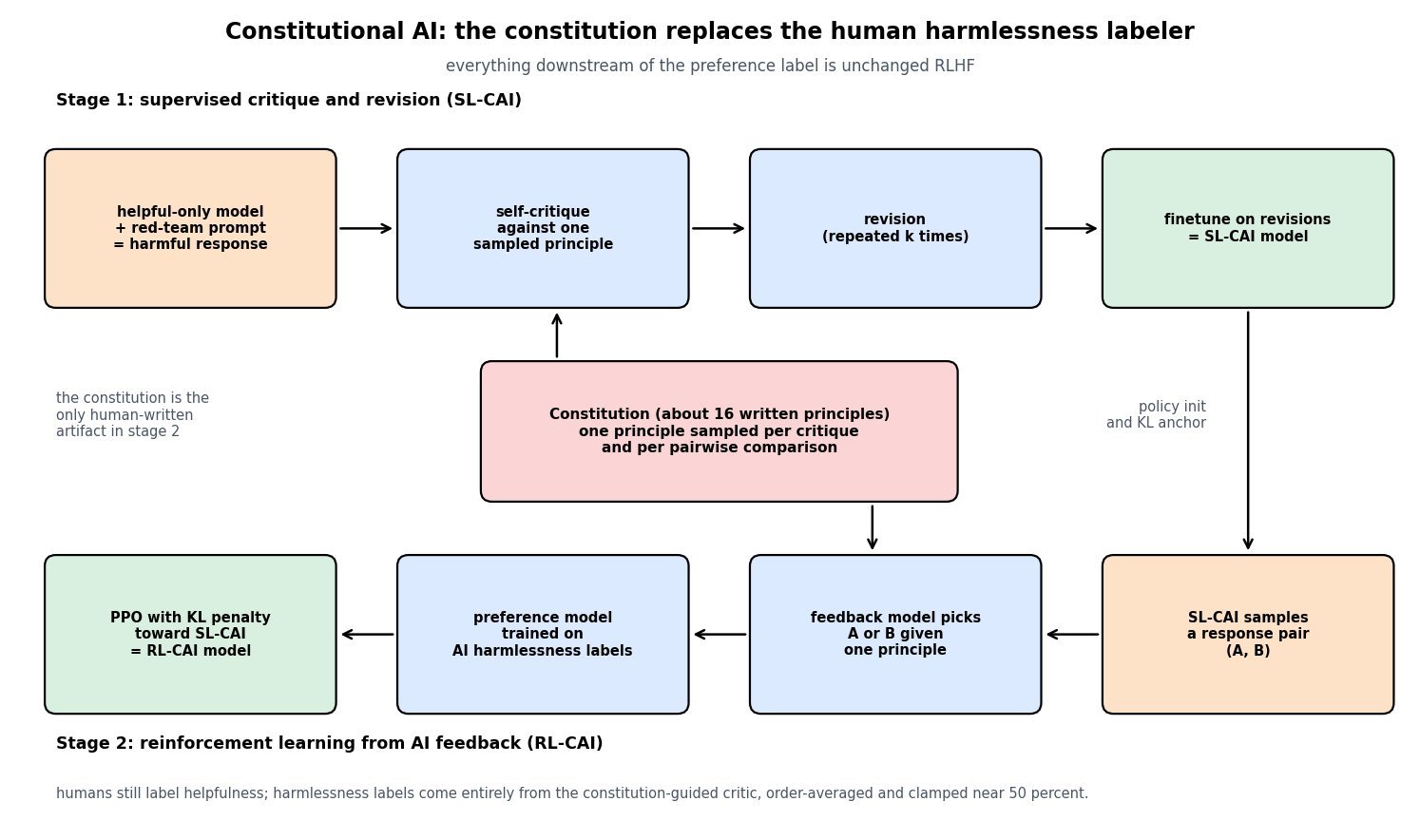


![J(\theta) = \mathbb{E}\left[r_\phi(x,y)\right] - \beta\,\mathrm{KL}\!\left(\pi_\theta \,\|\, \pi_{\mathrm{ref}}\right)](https://s0.wp.com/latex.php?latex=J%28%5Ctheta%29+%3D+%5Cmathbb%7BE%7D%5Cleft%5Br_%5Cphi%28x%2Cy%29%5Cright%5D+-+%5Cbeta%5C%2C%5Cmathrm%7BKL%7D%5C%21%5Cleft%28%5Cpi_%5Ctheta+%5C%2C%5C%7C%5C%2C+%5Cpi_%7B%5Cmathrm%7Bref%7D%7D%5Cright%29&bg=ffffff&fg=000&s=3&c=20201002)
 is the response after
  is the helpful-only model doing both the critique and the rewrite.
 is one principle sampled uniformly from the constitution
  , typically around 16 short written rules.
 and
and  are the critic’s logits for the option tokens of the multiple-choice question, and
  and
and  are the probabilities assigned to the same candidate under the two presentation orders, and
  is the order-debiased label actually stored.
 is the preference model,
  the standard Bradley-Terry loss, unchanged from RLHF.
 sets how far the policy may drift before the KL penalty dominates the reward.


 parameters in the attention projections and about
  in the MLP, so a fixed budget pins the product
  and the only remaining freedom is the aspect ratio
  . Cutting depth by 4x buys only 2x width, which is why the two axes are so asymmetric in practice. Depth buys serial computation: each layer is one more composition step, and multi-hop reasoning and compositional generalization improve with layers in a way that width cannot replicate. Width buys parallel capacity and hardware efficiency: larger GEMMs, higher arithmetic intensity, clean tensor-parallel sharding, and a smaller KV cache per token because the cache grows linearly in
  , so width is an expensive axis and depth is a cheap one. Doubling
  output-projection init, Pre-LN or DeepNet-style residual scaling, and they show more loss spikes and attention rank collapse.
 adds directly to time per token even though total FLOPs are unchanged.
 , which at a 128k vocabulary swamps a sub-billion model, so on-device work favors deep and thin shapes.
 , which is the whole trade-off in one picture: width is quadratically expensive, so moving from 64 layers to 16 layers pays for only a 2x wider residual stream. Real production shapes cluster in the middle band, roughly
  between 60 and 160.


 is the non-embedding parameter count, from
  matches the same count).
 .
. is KV-cache bytes per token, with
  key-value heads, head dimension
  , and
, and  bytes per element. Under GQA with a fixed head count it is proportional to
  is per-token decode latency,
  the achievable HBM bandwidth, and
  the fixed serial cost per layer from kernel launches and collective synchronization.
 term is identical across shapes and only the


 in fp16, each layer stores 4 KiB per token, so the 64-layer shape carries 4x the KV cache of the 16-layer shape and supports a proportionally smaller batch at the same context length. On the latency side, a plausible tensor-parallel-8 deployment has roughly
  microseconds per layer once you count two all-reduces plus launch overhead, which turns depth into 2.56 ms of pure serial cost at 64 layers against 0.64 ms at 16 layers, on top of an identical weight-read term.

 FLOPs of arithmetic, so a batch of one runs at a tiny fraction of peak FLOPs and the GPU is idle waiting on memory. Adding sequences to the same forward pass reuses that single weight read for more tokens, so throughput climbs steeply until the KV-cache reads and finally the matmuls take over. Static batching’s effective batch size decays as its short members retire, so it spends most of its time in the low-intensity regime; continuous batching holds the batch near
  and stays in the high-intensity regime. Reported end-to-end gains follow from this: Orca measured up to 36.9x throughput over a static FasterTransformer baseline at matched latency, and vLLM measured a further 2x to 4x from paged memory alone.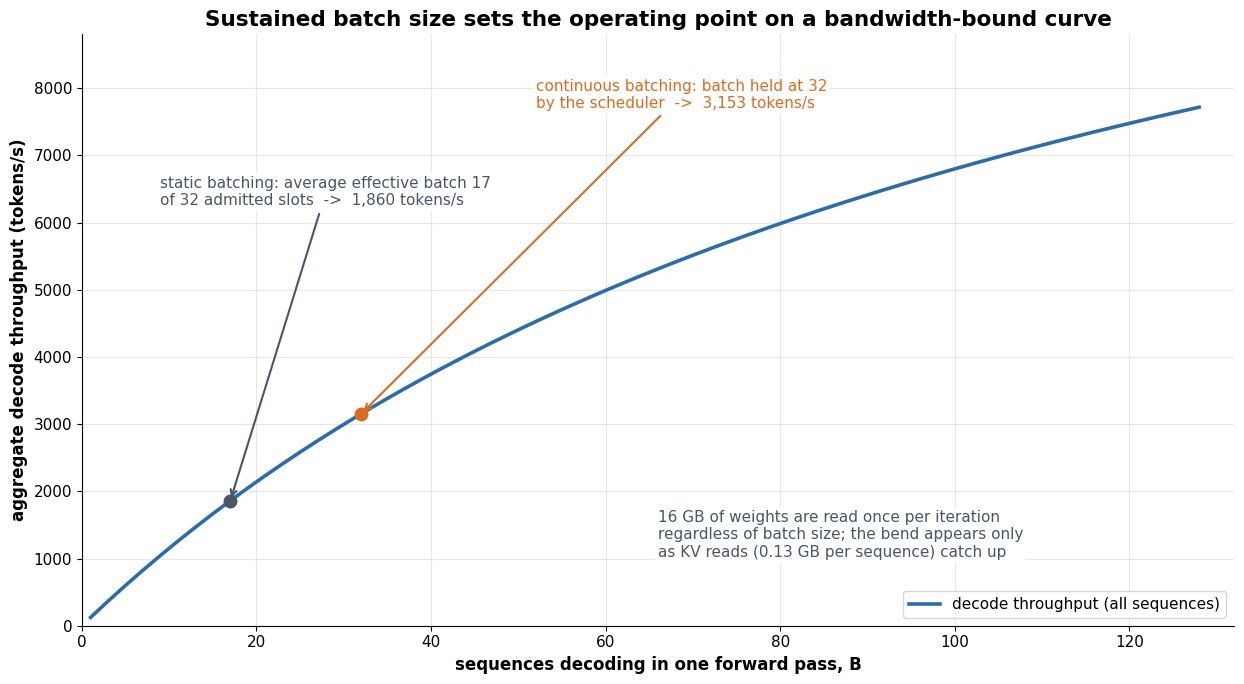


 is the fraction of batch slot-iterations that produce a token under static batching, with
  the output length of request
  ; it is exactly 1 only when all lengths are equal.
 is KV bytes per token, where
  is layers,
  key/value heads (small under GQA),
  head dimension,
  bytes per element, and the leading 2 counts K and V.
 is achievable HBM bandwidth.
 is the mean context length in the running batch and
  is aggregate decode throughput in tokens per second; it is concave in
  is HBM left after weights and activations, so


 GB of KV, divided by 2000 GB/s. Nearly doubling the sustained batch costs only 11% more time per step and yields 1.7x the tokens per second, which is the whole economic case for iteration-level scheduling: the extra sequences ride along in memory traffic that was already being paid.
 converges to the same vector, so the representation is effectively rank-1 and no head can distinguish positions any more. Uniform attention scores are one route to that state but not a requirement, because every softmax attention map is row-stochastic, and a product of row-stochastic matrices contracts any mean-zero component of the token set by the second-largest eigenvalue at each step, even when each individual map looks sharp and interpretable. Dong et al. proved the sharper version of this: pure self-attention without residual connections or MLPs loses rank doubly exponentially in depth, so the residual stream, the FFN nonlinearity, and the normalization placement are the load-bearing defenses that let 100-layer stacks exist at all. A third, opposite pathology is attention entropy collapse, where rows become nearly one-hot as the spectral norm of the query-key map grows; that destroys training stability rather than smoothing representations, and it is the failure that spectral reparameterization targets. Register tokens, cross-layer attention coupling, and gated layer skipping each attack a different factor of the product that drives the representation toward rank-1.
 , the all-ones vector is always a fixed point, and repeated application contracts everything else toward the Perron eigenvector.
 rather than
  . In path-decomposition terms, the identity path carries the full-rank input straight through, and only paths that traverse many attention modules are strongly contracted. The FFN nonlinearity adds a second defense by increasing the Lipschitz constant of the layer map away from a pure average, which is why the empirical decay of the distance to rank-1 in a working model looks geometric with a factor close to 1 instead of doubly exponential. The remaining problem at extreme depth is that these defenses only slow the contraction: with a per-layer factor of 0.95, a 120-layer stack still retains only about 0.2% of the initial token spread, which shows up as flat similarity matrices, near-duplicate hidden states in the last third of the network, and layers whose removal barely changes the loss.
 by layer 5, and merely slow once residuals and FFNs are present. Right: entropy can fail in either direction, drifting up toward the uniform limit
  (over-smoothing) or down toward zero (entropy collapse and loss spikes), and a healthy deep model must stay in the band between them.


 is the token matrix at layer
  , with
  is the distance to the nearest rank-1 matrix whose rows are all equal;
  is the all-ones vector and
  , where
  and
and  is the head dimension.
 , which is why attention-only depth is hopeless while residual depth is merely expensive.
 is the row-stochastic attention map, so
  is any mean-zero deviation across tokens,
  .
. is the second-largest eigenvalue modulus of
  , strictly less than 1 whenever all entries are positive; the surviving spread after
  .
. is the entropy of attention row


 activation memory per block


 is the SSM state at step
  ,
,  the layer input and
  the layer output;
  are the discretized transition, input, and output matrices. In a selective SSM they depend on the current token, which is what lets the layer decide what to keep and what to forget.
 is the input-dependent step size; a large
  overwrites the state with the new token, a small one carries the old state forward.
 the number of attention layers only,
  , namely
  ):
):


