
What can cause a BERT-based model to struggle with GPU underutilization, how do you detect CPU-side preprocessing bottlenecks, and what optimizations (pinned memory, ONNX export, TensorRT, INT8 quantization) would you recommend?
Answer
A BERT forward pass at batch 32 and sequence length 128 is a few milliseconds of dense GEMM work, so the GPU is almost never the slow part of a badly performing BERT service. Underutilization comes from three separable causes: the host-side pipeline (Python tokenization, collation, and synchronous host-to-device copies that block the training or serving loop), wasted GPU work (padding every request to max_length, batch size 1 traffic, or fragmented small kernels whose launch overhead exceeds their compute), and framework overhead (eager-mode PyTorch dispatching hundreds of tiny kernels per layer instead of fused ones). Detection is a matter of separating those causes rather than staring at the single nvidia-smi utilization number, which reports only whether any kernel was resident during a sampling window and happily shows 90% while the SMs are mostly idle. The fix ladder is ordered by cost: first hide the host work with fast tokenizers, multiple dataloader workers, pinned memory plus non_blocking copies and prefetch; then remove padding waste with length bucketing and dynamic batching; then export to ONNX for graph fusion and constant folding; then build a TensorRT engine in FP16; and only last apply INT8 post-training quantization, which is the only step in the list that can change your accuracy.
(1) Host-Bound Pipeline: a Python BertTokenizer plus per-batch collation can cost 15-25 ms while the forward pass costs 6 ms, so a serial loop pins utilization near 25% no matter how fast the GPU is.
(2) Synchronous Copies: a transfer from pageable host memory cannot be overlapped with compute, because the driver must stage it through an internal pinned buffer; pinned memory plus non_blocking=True is what makes DMA overlap legal.
(3) Padding Waste: attention cost scales as  , so padding a batch whose mean length is 27 tokens out to 128 burns roughly 79% of the tokens on
 [PAD], which looks like high utilization and low throughput.
(4) Kernel Launch Overhead: eager BERT-base issues on the order of a thousand kernels per forward pass; at batch 1 the launch and layout overhead, not the math, sets latency.
(5) Detection By Elimination: loop over one cached pre-tokenized tensor. If throughput jumps, the bottleneck was host-side; if it does not, profile kernels with Nsight Systems and look at gaps between them.
(6) Optimize In Cost Order: dataloader and padding fixes are free and safe, ONNX and TensorRT FP16 are numerically near-lossless, and INT8 is the only step that requires a calibration set and an accuracy regression gate.

Figure 1: The same model and the same GPU, two pipelines. In the serial loop the GPU waits for tokenization and the utilization ceiling is  . With three prefetching workers writing into pinned buffers, host work is fully hidden behind compute after an 18 ms warm-up and the GPU runs back to back. No kernel was made faster here; only the schedule changed.
How To Detect A Host-Side Bottleneck: start by distrusting the utilization percentage. nvidia-smi samples whether at least one kernel was resident, not how many SMs were busy, so query DCGM fields such as SM activity and SM occupancy, or run nvidia-smi dmon and watch the memory-controller column: a host-bound job shows low SM activity and near-zero copy activity in the gaps. Then run the decisive experiment, which takes ten minutes: tokenize one batch once, keep it on the device, and loop the forward pass. That measures your true kernel-only throughput, and the gap between it and end-to-end throughput is exactly your host overhead. Confirm the cause with torch.profiler (look for aten::copy_, cudaStreamSynchronize, and dataloader wait time) or an Nsight Systems timeline, where a host-bound run appears as short kernel clusters separated by long empty stretches on the CUDA stream. Common culprits found this way: the slow Python tokenizer instead of the Rust BertTokenizerFast, num_workers=0, tokenizing inside the request handler on the same thread that owns the GPU, a stray .item() or .cpu() inside the loop forcing a sync every step, and logging metrics per step.
Mathematical Formulation:


Where:
 is the fraction of wall-clock time the GPU spends executing kernels, capped at 1, with for a blocking loop and for an overlapped prefetch pipeline.
- is per-batch host time (tokenize, collate, copy) and is per-batch device time for the forward, or forward plus backward when training.
- is the number of dataloader workers or preprocessing processes; overlap only holds if their output lands in pinned memory and the copy is issued as
non_blocking. - is the dominant FLOP count per batch with the batch size, the padded sequence length, and the hidden width; the term is attention and the term is the projections and feed-forward.
- is the fraction of computed tokens that are padding, with the mean true length and the padded length; understates the true waste whenever the term dominates.
 is the fraction of wall-clock time the GPU spends executing kernels, capped at 1, with
  for a blocking loop and
  for an overlapped prefetch pipeline.
 is per-batch host time (tokenize, collate, copy) and
  is the number of dataloader workers or preprocessing processes; overlap only holds if their output lands in pinned memory and the copy is issued as
  is the dominant FLOP count per batch with
  the batch size,
  the padded sequence length, and
  the hidden width; the
  term is attention and the
  term is the projections and feed-forward.
 is the fraction of computed tokens that are padding, with
  the mean true length and
  the padded length;
  term dominates.
Worked Numbers For One Batch:


Three workers are enough to hide 18 ms of host work behind a 6 ms forward pass, and the same arithmetic tells you when adding workers stops helping: once  drops below
  , extra workers only add memory pressure and page-cache churn. The padding figure is the other half of the story. Sorting a serving queue by length into buckets, or using dynamic padding to the longest member of each batch, typically recovers most of that 79% at zero accuracy cost, and it is strictly better than buying a larger GPU to compute attention over
 [PAD] tokens faster.

Figure 2: An illustrative optimization ladder for BERT-base at batch 32, sequence 128, on one mid-range GPU. Each rung removes a different bottleneck: host stalls first, then kernel launch and layout overhead through graph fusion, then arithmetic precision. Only the last rung can move your evaluation metric, which is why it ships behind an accuracy gate.
| Property | PyTorch eager | ONNX Runtime | TensorRT (FP16 / INT8) |
|---|---|---|---|
| Graph optimization | None by default; op-by-op dispatch | Constant folding, LayerNorm and GELU fusion, attention fusion | Full autotuned kernel selection plus fused multi-head attention |
| Variable sequence length | Free; any shape runs | Dynamic axes supported, some re-optimization per new shape | Needs declared optimization profiles; shapes outside them fail or fall back |
| Build and deploy cost | Zero; ship the checkpoint | One export step, portable artifact | Minutes of engine build, plus a calibration pass for INT8 |
| Portability | Runs anywhere PyTorch runs | CPU, GPU, and other execution providers | Engine is tied to GPU architecture and TensorRT version |
| Accuracy risk | Baseline | Numerically equivalent in FP32 | FP16 usually within noise; INT8 needs a regression gate |
| Dominant failure mode | Launch overhead and host stalls dominate at small batch | Unsupported op forces a subgraph back to a slow path | Engine rebuild on driver or hardware change; activation outliers break INT8 |
Code Implementation:
# 1) hide host work: fast tokenizer, workers, pinned memory, prefetch
from transformers import AutoTokenizer
tok = AutoTokenizer.from_pretrained("bert-base-uncased", use_fast=True)

def collate(batch):
    # dynamic padding to the longest item, not to max_length
    return tok([b["text"] for b in batch], padding=True,
               truncation=True, max_length=128, return_tensors="pt")

loader = torch.utils.data.DataLoader(
    ds, batch_size=32, collate_fn=collate,
    num_workers=4, pin_memory=True, persistent_workers=True,
    prefetch_factor=4)

for batch in loader:
    batch = {k: v.to("cuda", non_blocking=True) for k, v in batch.items()}
    with torch.autocast("cuda", dtype=torch.float16):
        out = model(**batch)      # no .item() / .cpu() inside the loop

# 2) measure kernel-only throughput to prove where the time goes
cached = {k: v.cuda() for k, v in collate(ds[:32]).items()}
torch.cuda.synchronize(); t0 = time.perf_counter()
for _ in range(200):
    with torch.no_grad(), torch.autocast("cuda", dtype=torch.float16):
        model(**cached)
torch.cuda.synchronize()
print("device-only seq/s:", 200 * 32 / (time.perf_counter() - t0))

# 3) export and build: ONNX -> TensorRT with dynamic shape profiles
# torch.onnx.export(model, tuple(cached.values()), "bert.onnx",
#                   dynamic_axes={"input_ids": {0: "B", 1: "L"}}, opset_version=17)
# trtexec --onnx=bert.onnx --fp16 --int8 --calib=calib.cache \
#         --minShapes=input_ids:1x16 --optShapes=input_ids:32x128 \
#         --maxShapes=input_ids:64x256 --saveEngine=bert.plan
 probes, the 95% upper bound on the per-probe rate is about
  , which is why a 200-prompt smoke test can never clear a production gate.

![\hat{e} = \frac{1}{N} \sum_{i=1}^{N} \mathbf{1}[ g(p_i) = s_i ]](https://s0.wp.com/latex.php?latex=%5Chat%7Be%7D+%3D+%5Cfrac%7B1%7D%7BN%7D+%5Csum_%7Bi%3D1%7D%5E%7BN%7D+%5Cmathbf%7B1%7D%5B+g%28p_i%29+%3D+s_i+%5D&bg=ffffff&fg=000&s=3&c=20201002)

![\Pr[M(D) \in S] \leq e^{\epsilon} \Pr[M(D') \in S] + \delta](https://s0.wp.com/latex.php?latex=%5CPr%5BM%28D%29+%5Cin+S%5D+%5Cleq+e%5E%7B%5Cepsilon%7D+%5CPr%5BM%28D%27%29+%5Cin+S%5D+%2B+%5Cdelta&bg=ffffff&fg=000&s=3&c=20201002)
 is the sensitive string under test and
  the set of same-format candidates it is ranked against, so
  (30 bits for a 9-digit-scale secret) is the maximum exposure.
 is the model’s perplexity of a candidate;
  means the true secret is the model’s single most likely completion.
 is the empirical extraction rate,
  the
the  -th adversarial prompt,
  the decoding procedure, and
  is the 95% upper confidence bound on the per-probe leak probability, which is the number a risk gate should be written against.
 is the training mechanism,
  and
and  two datasets differing in one record, and
  the differential privacy budget that bounds any single record’s influence on the released weights.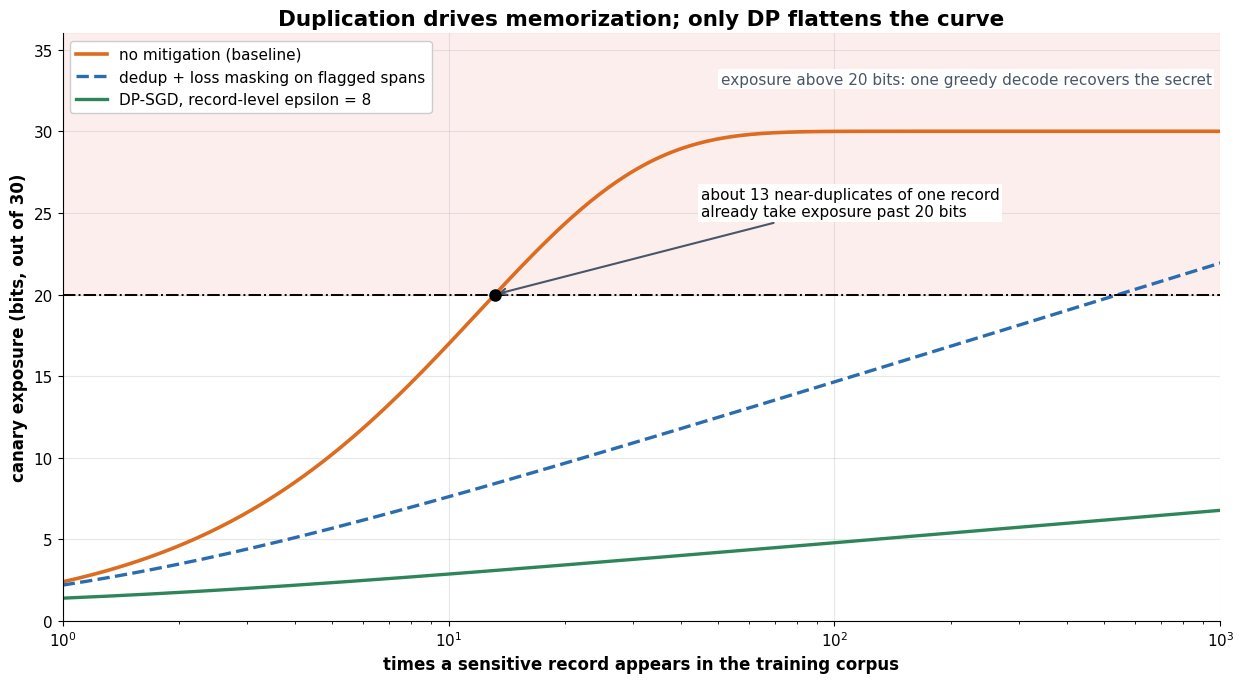
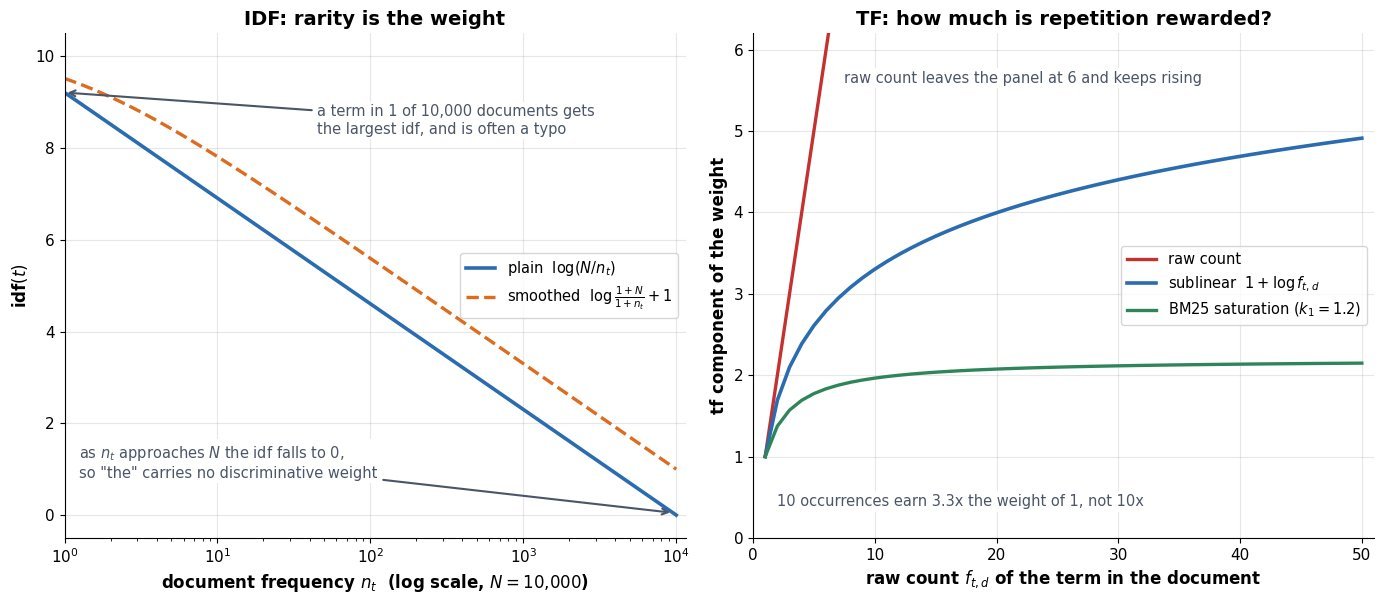
 holds a weight that rises with how often term
  so that ten occurrences do not count ten times as much as one. The inverse document frequency factor is a global corpus statistic,
  , which pushes function words such as “the” toward zero and lifts rare, discriminative terms. Multiplying the two produces the classic “frequent here, rare elsewhere” signal, and L2 normalization turns a plain dot product into cosine similarity. The result is extremely sparse (typically over 99.9% zeros), exactly interpretable per term, and requires no training beyond counting. Its weaknesses are structural rather than fixable by tuning, because every term is its own orthogonal dimension, so “car” and “automobile” share zero similarity, word order and negation are discarded, and any term outside the fitted vocabulary is silently dropped.
 or BM25 saturation caps the reward for saying the same word again.
 statistics are frozen at fit time, so corpus drift, duplicated documents, and tiny corpora all distort the weights.


 is the unnormalized weight of term
  is the final L2-normalized document vector.
 is the raw count of
  ; terms with zero count keep weight zero, which is what makes the vector sparse.
 .
. is the smoothed variant used by scikit-learn, which adds one to both counts to tolerate unseen terms and adds a constant so a term present everywhere still keeps a small nonzero weight.
 is the query treated as a short pseudo-document, so retrieval scoring is just a cosine between two sparse vectors over shared nonzero coordinates.


 .
. with
with 


 are the parameters after the
  the step size, and
  the arriving example; the pure online case uses each
  exactly once.
 is the batch actually used at step
  and a buffer sample
  , with replay ratio
  typically in the 0.05 to 0.20 range.
 is the loss on the incoming chunk and
  a stability penalty anchored at the previous checkpoint
  , with
  trading plasticity for retention.
 is the diagonal Fisher information for parameter
  reduces the penalty to plain L2-to-previous.
 is accuracy on task
  measured after training through task
  , with
  chunks seen so far.
 is average accuracy over everything seen and
  the forgetting on task
 or below, early stopping on held-out pairwise accuracy, plus label smoothing or a margin term and an auxiliary language-modeling loss to keep the backbone from collapsing.
 to
to  members whose pretraining seeds differ disagree most off-distribution, which is exactly where reward hacking begins.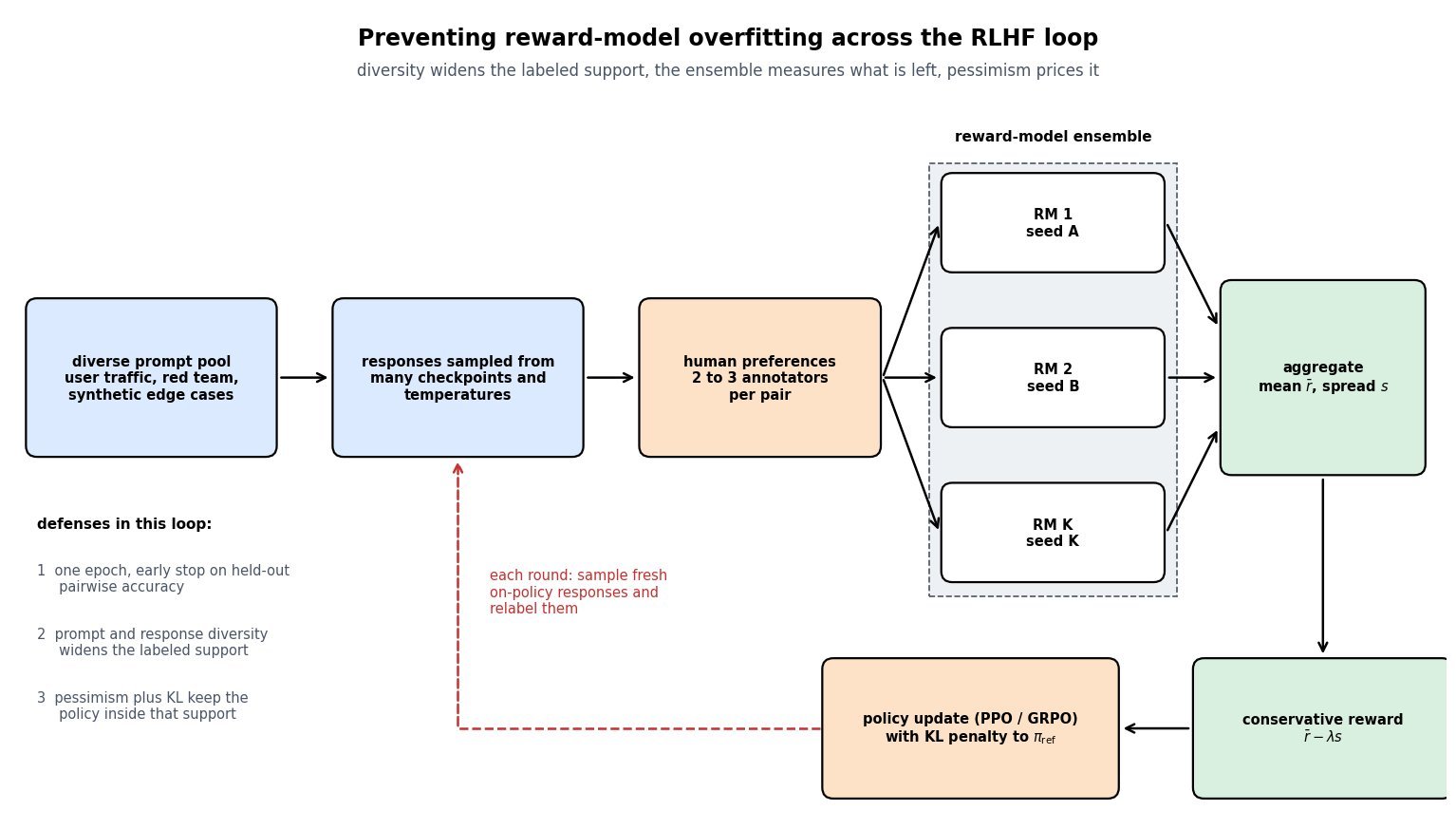


![J(\pi) = \mathbb{E}_{\pi}[r_{\mathrm{LCB}}] - \beta D_{\mathrm{KL}}](https://s0.wp.com/latex.php?latex=J%28%5Cpi%29+%3D+%5Cmathbb%7BE%7D_%7B%5Cpi%7D%5Br_%7B%5Cmathrm%7BLCB%7D%7D%5D+-+%5Cbeta+D_%7B%5Cmathrm%7BKL%7D%7D&bg=ffffff&fg=000&s=3&c=20201002)
 is the score margin between the preferred response
  and the rejected response
  for prompt
  , and
, and  is the logistic function, so
  is the Bradley-Terry negative log-likelihood.
 are the RM parameters: a pretrained or SFT backbone with a scalar head, usually trained for one epoch so
  is the score of ensemble member
  , and
, and  their mean, which is also a mild variance reduction on the reward itself.
 is the ensemble spread, used as an epistemic uncertainty proxy: it stays small on the labeled support and grows on responses no annotator ever judged.
 is the pessimism coefficient, commonly in the range
  to
to  ;
;  recovers plain mean aggregation.
 is the KL coefficient (typically
  to
to  ) and
) and  the divergence from the frozen reference policy, which bounds how far the policy may travel from the RM’s support.
 rather than of training steps.

 and
and  are fitted constants that improve with RM size and with the amount of preference data, so a larger RM trained on more diverse comparisons does not merely score better, it peaks later. Ensembling contributes on two fronts. Averaging
  is deleted. The loop then repeats on whatever is left: sort → pick the max → suppress → repeat. The algorithm rests on two assumptions, that confidence ranks localization quality and that a high IoU means two boxes describe the same object. Both fail in crowds, where the best box on a partially occluded neighbour can sit above
  sort plus up to
  pairwise IoU tests, which is why production stacks cap candidates and run a batched CUDA kernel.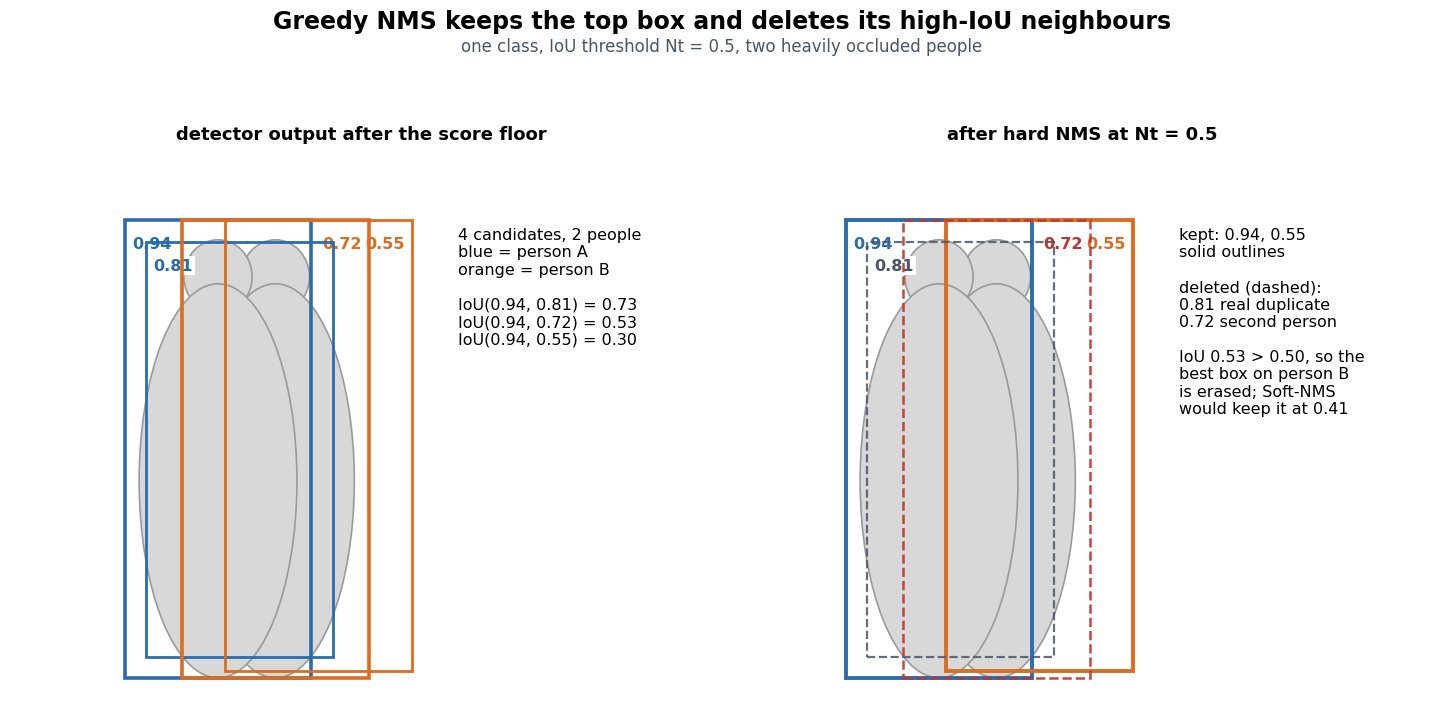


![s_i \leftarrow s_i \cdot \mathbf{1}[\mathrm{IoU}(M, b_i) \leq N_t]](https://s0.wp.com/latex.php?latex=s_i+%5Cleftarrow+s_i+%5Ccdot+%5Cmathbf%7B1%7D%5B%5Cmathrm%7BIoU%7D%28M%2C+b_i%29+%5Cleq+N_t%5D&bg=ffffff&fg=000&s=3&c=20201002)


 is the current candidate set for one class,
  a box in it with score
  , and
, and  .
. ; line 5 is Gaussian Soft-NMS, applied to every remaining box with no threshold at all.
 ; a smaller
  is the Euclidean distance between the two box centers and
  the diagonal of the smallest box enclosing both, so
  lies in
  and is scale-invariant.


 is a one-line change at inference and needs no retraining, whereas swapping backbone weights per weather condition doubles the validation surface.


 is the fused feature tensor consumed by the task heads, and
  is the raw feature map of sensor
  , with
  its degradation-conditioned version.
![q_m \in [0,1]](https://s0.wp.com/latex.php?latex=q_m+%5Cin+%5B0%2C1%5D&bg=ffffff&fg=000&s=2&c=20201002) is the absolute quality score produced by a small monitor head
is the absolute quality score produced by a small monitor head  with logistic output
  and
and  are the FiLM scale and shift vectors, and
  is channel-wise multiplication.
 is a content-dependent attention logit from the ordinary fusion module, so the gate combines what is informative with what is trustworthy.
 values rather than by the weights.


 is the Mahalanobis drift at frame
  of a mid-level feature map and the clean-data reference
  with covariance
  .
. is the CUSUM statistic with slack
  and
and  is the reprojection residual in pixels for correspondence
  , where
  is the observed image point,
  the 3D point from LiDAR or a second camera,
  the extrinsic transform, and
  the projection using current intrinsics.
 patch grid emerging from the last block is already a linearly separable semantic map rather than an intermediate code that only a trained decoder can read. The property that keeps this true at 7B parameters and 1.689B curated images is Gram anchoring: late in training DINOv3 adds a loss that matches the student’s patch-token Gram matrix to that of an earlier EMA teacher, pinning the patch-to-patch similarity structure while global features keep improving. Register tokens remove the high-norm artifact patches that otherwise pollute attention maps, and axial RoPE with frequency jittering makes the same weights usable at resolutions far above the training crop. The result is that read-out becomes non-parametric: k-NN on the CLS token classifies, and cosine similarity between patch embeddings segments, with no gradient ever entering the backbone. A single linear layer on the frozen features reaches roughly 88% ImageNet-1k top-1 and around 56 mIoU on ADE20k, which is why “frozen backbone plus tiny head” is a competitive deployment strategy rather than a baseline.
 similarity matrix, not the absolute features, lets representations keep drifting globally while patch-similarity geometry stays sharp.


 is the image-level cross-view self-distillation loss on the CLS token and
  the patch-level masked-latent loss, with
  holds the student’s
  -normalized patch features and
  the same for the Gram teacher, an earlier EMA checkpoint evaluated at higher resolution and downsampled.
 are the patch-patch cosine similarity matrices, so the loss constrains relations between patches and not the patch vectors themselves.
 is the number of patch tokens for an
  input at patch size 16, and
  per view.
 is the normalized embedding of test patch
  and
and  a normalized reference embedding, taken from an annotated patch, a class prototype, or a cluster centroid.
 is the predicted label for patch
 looks like in image space. Zero-shot dense segmentation is nothing more than thresholding or arg-maxing maps like these, so map sharpness is the capability: the right-hand panel, typical of dense degradation, produces masks that bleed into the background even though the model’s classification accuracy is higher.
 the cross-view layer is numerically identical to the single-view layer, so the model is a strict superset of its monocular predecessor rather than a compromise.
 blocks, exactly what a monocular model computes, repeated in parallel. A cross-view layer fills in the off-diagonal blocks, and those off-diagonal entries are the whole mechanism, because a token on a wall corner in view 3 can now match the same corner in view 1 and inherit its depth ordering. Because the projection matrices are unchanged, the same weights serve both scopes and the model never has to learn a separate matching operator. The cost of filling those blocks is the reason view count dominates the budget, and it is also the reason non-overlapping views buy nothing: the off-diagonal blocks exist, but there is no correspondence for them to find, so the relative scale between two disjoint clusters of views stays unconstrained.
 to
to  , a factor of exactly
 ![Z = [\,X_1; X_2; \ldots; X_N\,]](https://s0.wp.com/latex.php?latex=Z+%3D+%5B%5C%2CX_1%3B+X_2%3B+%5Cldots%3B+X_N%5C%2C%5D&bg=ffffff&fg=000&s=3&c=20201002)


 holds the tokens of view
  and
and  is the single concatenated sequence the transformer actually sees.
 are the projections restricted to one view, while
  are the same projections applied to all of
  ; the weights are shared, only the scope differs.
 indexes pixels,
  indexes views,
  is tokens per view for patch size
  is the predicted depth and
  the predicted ray map (origin and unit direction) expressed in a shared frame, so
  is a 3D point in that frame and the camera pose follows from fitting
  .
. and
and  count attention token pairs per layer, so their ratio is


 , applied to the full neighborhood in one sparse matrix product over the entire graph. GraphSAGE replaces the full neighborhood with a fixed-size random sample and a permutation-invariant aggregator (mean, max-pool, or LSTM), and keeps the node’s own vector in a separate concatenated slot instead of averaging it away. GAT makes the coefficient content-dependent: a small shared scoring vector reads both endpoint features, a softmax over each node’s neighborhood turns those scores into weights
  , and several attention heads are run in parallel. Transductive versus inductive is then mostly a property of the training procedure and of what the coefficients depend on, not of the layer equation itself.
 depends only on the two degrees, so a high-degree hub is deliberately down-weighted and no coefficient is ever learned. This is a strong, cheap prior when features are weak and the graph is homophilous.
 , and the sample size is the knob that bounds compute rather than the node’s true degree.
 stored coefficients and gradients flowing through the attention scores.
 per target node, while sampling caps it at
  at the cost of estimator variance.
 despite having a middling degree.


![h_i' = \sigma(W \, [\, h_i \,\|\, a_i \,])](https://s0.wp.com/latex.php?latex=h_i%27+%3D+%5Csigma%28W+%5C%2C+%5B%5C%2C+h_i+%5C%2C%5C%7C%5C%2C+a_i+%5C%2C%5D%29&bg=ffffff&fg=000&s=3&c=20201002)
![e_{ij} = \mathrm{LeakyReLU}(a^{\top}[W h_i \,\|\, W h_j])](https://s0.wp.com/latex.php?latex=e_%7Bij%7D+%3D+%5Cmathrm%7BLeakyReLU%7D%28a%5E%7B%5Ctop%7D%5BW+h_i+%5C%2C%5C%7C%5C%2C+W+h_j%5D%29&bg=ffffff&fg=000&s=3&c=20201002)


 is the incoming representation of node
  the layer output;
  is the neighborhood including the self-loop, and
  is the corresponding degree, so
  is the sampled fan-out of fixed size
  at layer
  , and
, and  is a permutation-invariant reducer (mean, elementwise max over an MLP, or LSTM over a shuffled order).
 is concatenation, so the GraphSAGE weight matrix has shape
  and the node’s own features get an independent parameter block.
 is the shared attention vector and
  the raw score; the softmax is taken over
  so that
  per node.
 and needs the whole feature matrix plus every layer’s activations resident, which is why it stops fitting long before the graph itself does. GAT adds
  scores and their gradients on top of the same sparse pattern, so its memory is edge-bound rather than node-bound. GraphSAGE instead bounds a minibatch: with batch size
  , the computation graph holds a number of node instances that is completely independent of
  . That is the property that makes web-scale graph learning practical, and it is the mechanism behind Pinterest’s PinSage, which trains on a graph of billions of nodes by expanding only short sampled neighborhoods per target.


