What is the “dilemma of fixed-size input” for CNNs? How is it typically resolved?
Answer
The “dilemma of fixed-size input” for Convolutional Neural Networks (CNNs) refers to the requirement that traditional CNN architectures demand input images of a predetermined, fixed size. This presents a challenge because real-world images often vary widely in dimensions.
Fixed Input Requirement: Traditional CNN architectures (like VGG or ResNet) require inputs of a fixed size due to the structure of fully connected layers at the end.
Data Preprocessing Constraint: Real-world images vary in size, so they must be resized or cropped, which may distort or lose important features.
Inefficiency & Information Loss: Resizing may stretch or compress content unnaturally, affecting model performance.
Below shows an example of information loss during resizing or cropping.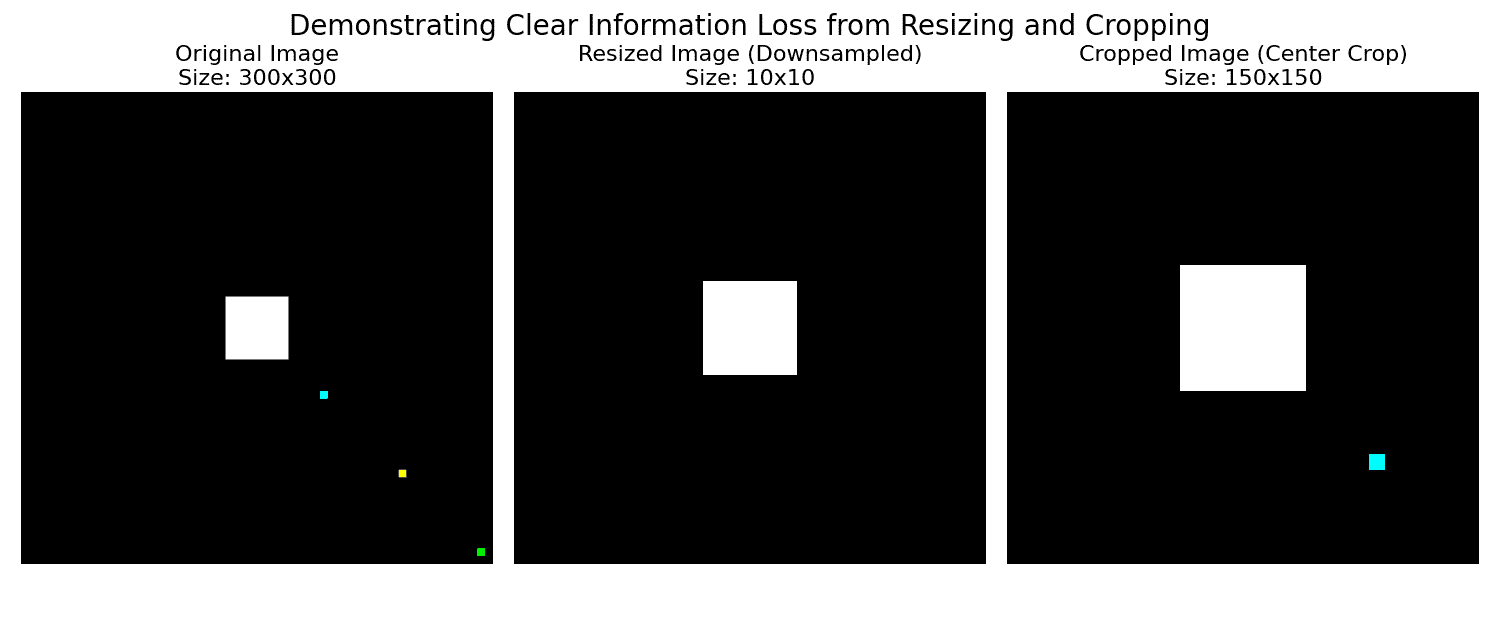
Common Solutions for the dilemma of fixed-size input:
(1) Global Average Pooling (GAP): Replaces fully connected layers, allowing input of variable size and reducing overfitting.
(2) Fully Convolutional Networks (FCNs): Use only convolutional and pooling layers, which can handle variable-sized inputs.
(3) Adaptive Pooling (e.g., in PyTorch): Pools features to a fixed size regardless of input dimensions.
Leave a Reply