
Compare V-JEPA (Joint-Embedding Predictive Architecture) with video generation world models such as OpenAI’s Sora or NVIDIA Cosmos. What does each objective actually learn, and when would you deploy one over the other?
Answer
Both families are trained by predicting the unseen part of a video, and both are called world models, but they differ in where the prediction target lives. V-JEPA masks a large 3D region of a clip and trains a predictor to regress the embeddings of that region produced by an EMA target encoder, using an L1 loss in representation space; there is no decoder anywhere in the system, so the model is never asked to reproduce a pixel. Sora and Cosmos Predict instead train a generative model (a diffusion transformer over spacetime latent patches, or an autoregressive token model) to reconstruct the actual frames, which forces the network to spend capacity on every detail, including detail that is fundamentally unpredictable, such as the exact texture of foliage or the phase of a reflection. That single design choice cascades: V-JEPA gets a compact motion-aware representation and a rollout that costs one forward pass per step, which is what makes energy-based planning tractable, while generative world models get a renderable future that can serve as a simulator, a synthetic-data generator, or an input to an existing camera-based perception stack. Neither dominates; the question to ask in an interview is whether your downstream consumer is a policy or a pixel pipeline.
(1) Target Space: V-JEPA minimizes distance between predicted and EMA-encoded latents; Sora and Cosmos minimize a reconstruction or denoising loss defined on tokenizer latents that decode back to RGB.
(2) Discarded Information Is A Feature: because the target is learned, JEPA can drop aleatoric high-frequency detail instead of averaging over it, which is exactly what produced blurry futures in older pixel-space predictors.
(3) Collapse Risk: a learned target can be gamed by a constant function, so JEPA needs stop-gradient plus an EMA teacher and aggressive 3D block masking; a generative model has a fixed data target and cannot collapse.
(4) No Rendering: V-JEPA cannot show you its prediction, so debugging and human review happen through probes and downstream task metrics, not by watching a video.
(5) Rollout Cost: one predictor call per latent step versus tens of denoiser calls plus a decoder pass, a difference of one to two orders of magnitude inside a model-predictive control loop.
(6) Evaluation Protocol: JEPA is scored with frozen attentive probes on motion-heavy benchmarks and with planning success rate; generative world models are scored with FVD, human preference, physics-consistency suites, and sim2real transfer of policies trained on their output.
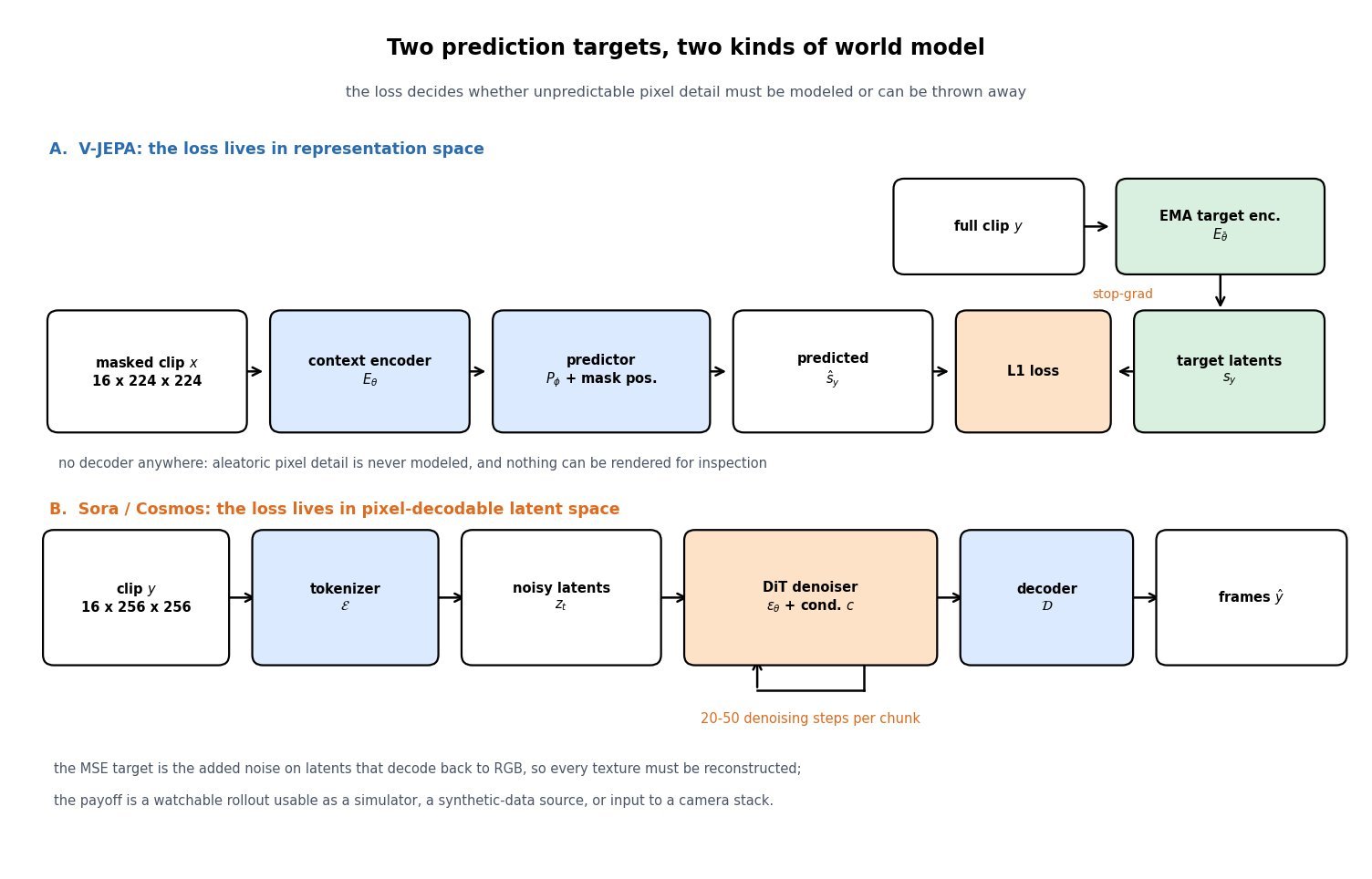
Figure 1: The two families share a video encoder but differ in the prediction target: V-JEPA regresses EMA target embeddings and never instantiates a pixel, while a generative world model passes through a tokenizer, an iterative denoiser, and a decoder that must reconstruct every frame.
The masking strategy is what makes the latent objective non-trivial. V-JEPA masks large 3D blocks that span the full temporal extent of the clip, removing on the order of 90 percent of the tubelet tokens, so the predictor cannot solve the task by interpolating from neighboring patches and is pushed toward object identity, motion, and rough physics. V-JEPA 2 scaled this recipe to a ViT-g encoder over more than a million hours of internet video and then post-trained an action-conditioned predictor on roughly 62 hours of unlabeled robot video, after which planning is just a search over action sequences whose predicted latent lands closest to a goal image embedding. Cosmos takes the opposite bet at similar scale, curating on the order of tens of millions of hours of video into diffusion and autoregressive world foundation models plus tokenizers, precisely because a physical-AI developer wants renderable, controllable rollouts they can feed into an existing autonomy stack. The two are complementary in practice: Cosmos ships a separate reasoning model alongside its generators, and several robotics stacks now use a generative model for data augmentation and a latent predictor for the control loop.
Mathematical Formulation:


![\mathcal{L}_{\mathrm{gen}} = \mathbb{E}\left[\lVert \epsilon - \epsilon_{\theta}(z_t, t, c) \rVert_2^2\right]](https://s0.wp.com/latex.php?latex=%5Cmathcal%7BL%7D_%7B%5Cmathrm%7Bgen%7D%7D+%3D+%5Cmathbb%7BE%7D%5Cleft%5B%5ClVert+%5Cepsilon+-+%5Cepsilon_%7B%5Ctheta%7D%28z_t%2C+t%2C+c%29+%5CrVert_2%5E2%5Cright%5D&bg=ffffff&fg=000&s=3&c=20201002)

Where:
 is the visible (context) part of a clip and the masked target region; carries the positional mask tokens telling the predictor where to predict.
- is the online encoder, the EMA target encoder, and the narrow predictor discarded after pretraining.
- is the stop-gradient that blocks the trivial solution, and is the EMA momentum, typically ramped from about 0.998 toward 1.
- is the noised tokenizer latent at diffusion step , the sampled Gaussian noise, the denoiser, and the conditioning (text, past frames, or actions).
- is the current latent state, a candidate action sequence, and the goal embedding; the planner requires an initial condition from the current observation.
 is the visible (context) part of a clip and
  the masked target region;
  carries the positional mask tokens telling the predictor where to predict.
 is the online encoder,
  the EMA target encoder, and
  the narrow predictor discarded after pretraining.
 is the stop-gradient that blocks the trivial solution, and
  is the EMA momentum, typically ramped from about 0.998 toward 1.
 is the noised tokenizer latent at diffusion step
  ,
,  the sampled Gaussian noise,
  the denoiser, and
  the conditioning (text, past frames, or actions).
 is the current latent state,
  a candidate action sequence, and
  the goal embedding; the planner requires an initial condition
  from the current observation.
Figure 2: For the same 200-candidate, 16-step CEM search, a single-pass latent predictor needs 3,200 network calls while a 30-step generative rollout needs 96,000, before the decoder is even invoked; this 30x gap is why planning loops favor latent prediction.
| Property | V-JEPA (latent predictive) | Sora / Cosmos (generative world model) |
|---|---|---|
| Training target | Embeddings from an EMA copy of the encoder, L1 loss | Noise or next token on VAE latents that decode to RGB |
| Handles stochastic detail by | Dropping it from the representation | Sampling it, which costs capacity and steps |
| Can render a future | No decoder; futures exist only as vectors | Yes, watchable and consumable by any vision stack |
| Cost per rollout step | One predictor forward pass | Tens of denoiser passes plus a decode |
| Main pathology | Representation collapse and shortcut solutions under weak masking | Physically implausible but photoreal rollouts, plus error accumulation over long horizons |
| Natural deployment | Frozen backbone for recognition and anticipation; goal-conditioned planning | Synthetic data, neural simulators, scenario replay, content generation |
Leave a Reply